Exploring Humanity and Relationships in Mary Shelley's "Frankenstein"
80 likes | 207 Vues
Mary Shelley's "Frankenstein" delves into profound questions about humanity, female/male relationships, family, and the ethics of science and technology. This work of British Romanticism captures the essence of human emotion while exploring the belief in innate goodness and the power of individuality. Through a mix of Gothic elements and intense emotions, Shelley evokes fear and contemplation about the characters' experiences of isolation and companionship. The narrative intertwines themes of light/dark, knowledge/ignorance, and the contrasts of existence to question the very nature of being human.


Exploring Humanity and Relationships in Mary Shelley's "Frankenstein"
E N D
Presentation Transcript
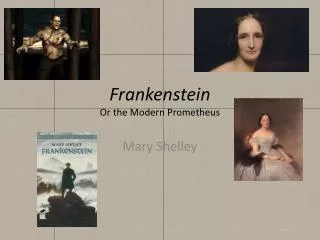
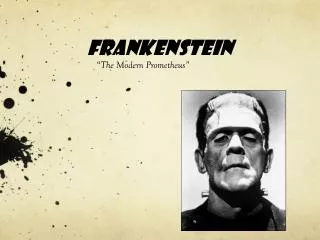
Frankenstein: The Modern Prometheous By Mary Shelley
Essential Questions: • What does it mean to be human? • What is the nature of male/female relationships? • What does it mean to be part of a family? • What are the limits and uses of science and technology?
British Romance • Passion for human emotion • Belief that all humans are innately good • Proponent of free thought • Nature brings healing and comfort • Oppose political authority and social conventions • Sense of human individuality • Belief in supernatural • Use of morbid and grotesque
Gothic Romance • Use of intense emotion • Evocation of fear • Weather to depict character and mood • Use of vocabulary such as diabolical, lamentable, melancholy, misery, wretched, etc. • Nature has power to destroy
Binaries/Contrasts • Isolation/companionship • Light/dark • Day/night • Handsome/ugly • Male/female • Science/philosophy • Knowledge/ignorance
Characters • Robert Walton • Victor Frankenstein • Elizabeth • Henry Clerval • Creature • William (Victor Frankenstein’s brother) • Justine Moritz • Peasant family: (blind man (DeLacy), Felix, Agatha (children of De Lacy), and Safie (foreign woman)