Understanding Covalent Molecular Naming: Prefixes and Unique Rules
This guide explains how to name covalent molecules using prefixes, similar to ionic compounds. Follow the rule of adding prefixes before the ion name, except when the first element is mono-, which is left off. Examples include CF4 as carbon tetrafluoride and CO2 as carbon dioxide. It also addresses special cases of double vowels in names, where the first vowel may be dropped, as seen in monoxide and dioxide. Learn the correct usage to avoid common errors in naming such as decoxide and pentoxide.


Understanding Covalent Molecular Naming: Prefixes and Unique Rules
E N D
Presentation Transcript
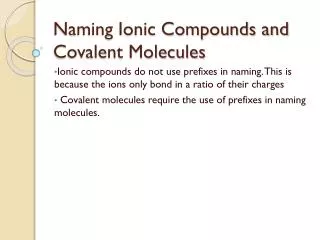
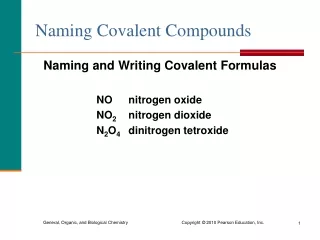
JUST like ionic, but use prefixes Put a prefix in front of the ion name (except if it is mono- for the first element, then just leave it off) CF4 = carbon tetrafluoride CO2 = carbon dioxide N2H4 = dinitrogen tetrahydride N2O3 = dinitrogen trioxide
Weird naming with double vowels • When (ao) or (oo) bump up against each other drop the first one • NOT decAOxide ---- decoxide • NOT monOOxide ---- monoxide • NOT pentAOxide ---- pentoxide • Hexaiodide is correct!!! • Diiodide is correct!!! • Dioxide is correct!!! • Trioxide is correct!!!