Understanding Observation and Inference in Science
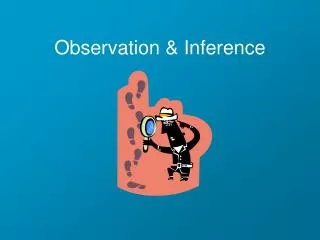
This guide explains the concepts of observation and inference, which are crucial in scientific inquiry. Observations can be quantitative (measurable or countable) or qualitative (descriptive). They can be objective (based on facts) or subjective (based on opinions). In contrast, inferences are conclusions drawn from observations. This resource includes examples to illustrate how to make accurate observations and inferences, such as differentiating between measurable facts and personal feelings. Practice exercises are also included to enhance understanding.

Understanding Observation and Inference in Science
E N D
Presentation Transcript
Observations • Any information collected with our five senses. • Quantitative – measureable or countable • 3 meters long • 4 marbles • 50 kilograms • 35 degrees Celsius • Qualitative – describable, not measureable • red flowers • smells like fresh baked cookies • Tastes bitter • A skill for describing scientific events
Observations • Subjective • an observation based on opinion • opinion – a statement that expresses a belief, value, or feeling Objective • an observation based on fact fact – a piece of information that can be strictly defined and proved true.
Observations • Science looks like fun today. • Kanye West’s songs sound good. • The Smartboard is white and grey. • Poutine taste good. • The summer was too short. • There are sixty seconds in a minute.
Inference • Conclusions based on observations. • The process of drawing a conclusion from evidence or observation Practice: • Observations: • I hear people screaming. • I smell cotton candy, popcorn, and vomit. • I see a lot of people. • Inference = ?
Look at these two sets of animal tracks. List 3 OBSERVATIONS Make an INFERENCE
Now what do you think? Make 3 OBSERVATIONS Make an INFERENCE
Now what do you think? Make 3 OBSERVATIONS Make an INFERENCE