Trends in the Periodic Table
170 likes | 286 Vues
This comprehensive guide explores the atomic radius, its trends, and how atoms behave when forming ions. It explains how atomic size increases down a group and across periods, highlighting the differences between anions and cations. Learn about the concept of ionization energy, the energy required to remove an electron, and electron affinity, the energy released when an atom gains an electron. The document also covers predicting ionic charges based on valence and the relationships between ionization properties and elemental behavior in the periodic table.


Trends in the Periodic Table
E N D
Presentation Transcript
F. Schifano, Department of Science Bayonne High School Bayonne, NJ Trends in the Periodic Table
Atomic Radius • The “size” of the atom • Measured as half the distance from the nucleus of one atom to the nucleus of the next • Border of the electron cloud is fuzzy • Different atoms have different radii.
Anions • An atom can gain one or more electrons, forming a negatively charged anion. • Anions are larger than their neutral atoms.
Cations • Atoms can give up one or more electrons to form postively charged cations. • Cations are much smaller than their neutral atoms.
Ionic Radius • Cations (+) • Anions (-)
Valence Runs the Show • What charge an atom will acquire when it becomes an ion is easily predicted using the atom’s valence.
What ion is formed by each of the following? • Ba • Ca • Cl • O • Al
Which is larger? • Ba or Ba2+ • Ca or Ca2+ • Cl or Cl- • O or O2- • Al or Al3+
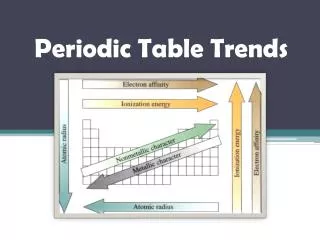
Ionization Energy— Breaking the “Binding Chain” • Ionization energy is the amount of energy in joules it takes to strip an electron off a neutral atom.
Electron Affinity– The “Joy” of Receiving a Gift • Electron affinity is how much energy in joules is released when an atom gains an electron. • The number is given as a negative to show that energy is released from the atom.
Both Ionization Properties Increase Up, Right • Elements with low valence numbers naturally lose electrons when they bond. Their electron affinities and ionization energies are both close to zero. • They don’t fight losing electrons and they don’t take much joy in gaining electrons.
Both Ionization Properties Increase Up, Right • Elements with high valence numbers naturally gain electrons when they bond. Their ionization energies are both far from zero. • They viciously defend their electrons, and celebrate mightily when they get more.