
SlideServe
Menu
Préférences
© SlideServe · v2026

George Kelly Construct Theory

fairly avatar
13 diapositives · 1K Views · Aug 23, 2012

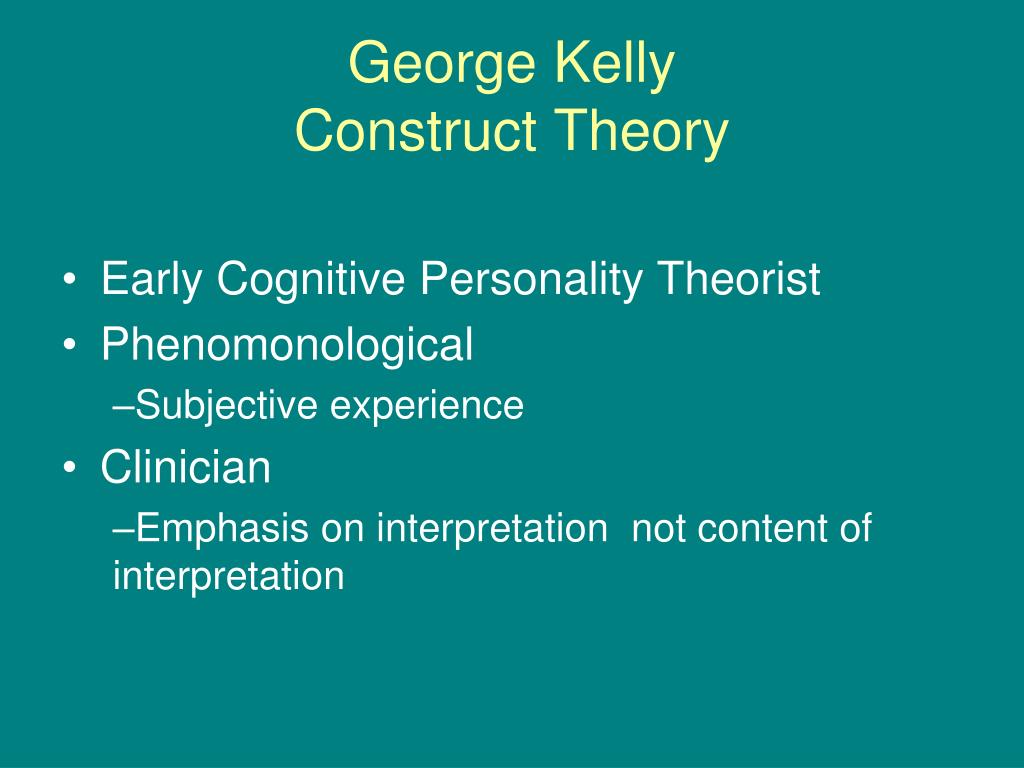
George Kelly Construct Theory. Early Cognitive Personality Theorist Phenomonological Subjective experience Clinician Emphasis on interpretation not content of interpretation. George Kelly’s Construct Theory. Fundamental Motivation: to understand, explain, and predict our world
George Kelly Construct Theory - slide 1
01 / 13George Kelly Construct Theory
1 / 17

Télécharger la présentation

George Kelly Construct Theory
Une image / un lien ci-dessous est fourni (tel quel) pour télécharger la présentation

Politique de téléchargement : le contenu du site vous est fourni TEL QUEL pour votre information et votre usage personnel ; il ne peut être vendu, concédé sous licence ni partagé sur d’autres sites sans l’accord de son auteur.Le contenu vous est fourni TEL QUEL, pour votre information et votre usage personnel uniquement. Téléchargez la présentation en cliquant sur ce lien. Lors du téléchargement, si vous ne parvenez pas à télécharger une présentation, l’éditeur a peut-être supprimé le fichier de son serveur.Pendant le téléchargement, si vous ne parvenez pas à obtenir une présentation, le fichier a peut-être été supprimé par l’éditeur.

F I N

Plus de contenu associé

Transcription de la présentation
  1. George KellyConstruct Theory • Early Cognitive Personality Theorist • Phenomonological • Subjective experience • Clinician • Emphasis on interpretation not content of interpretation

  2. George Kelly’s Construct Theory • Fundamental Motivation: to understand, explain, and predict our world • People are scientists • Constructive Alternativism: All explanations are equally valid • Phenomonological view; reality is in the head

  3. George Kelly’s Construct Theory • Act on the basis of interpretations • Action follows cognition • Interpretation requires categorization • Categorize with constructs • Constructs bipolar categories • Good-bad work-play friendly-unfriendly • Constructs automatically applied

  4. George Kelly’s Construct Theory • Constructs develop over time as people notice similarities and differences • Individual Differences • Construct content • E.g., intelligent-unintelligent vs. friendly-unfriendly • Construct endpoints • Friendly-unfriendly vs. friendly-hostile • Number of constructs

  5. Construct Assessment • Rep Role Grid • Used by researchers and clinicians • Respondents generate a list of role names and words regarding their differences and similarities

  6. Rep Role Grid • Part A Instructions: Please write the name of the persons indicated in the blanks provided below. Do not repeat names. If any role title appears to call for a duplicate name, substitute the name of another person whom the second role title suggests to you.

  7. Rep Role Grid Part A • Your mother or person who has played the part of mother in your life. _________________ • Your father or person who has played the part of father in your life. _________________ • Your brother nearest your age (or person who is most like a brother). ______________ • Your sister nearest your age (or person who is most like a sister). ______________ • A teacher you like. _________________ • A teacher you dislike. _______________

  8. Rep Role continued • 7. Your last closest girl(boy) friend (ex-flame). _______ • 8. Your spouse or present boy(girl) friend. __________ • 9. An employer during a period of stress. ___________ • 10. A person who dislikes you (for no apparent reason) _ • 11. A person you would like to know better. ________ • 12. A person you would like to help. _______ • 13. The most intelligent person you know. _________ • 14. The most successful person you know. ________ • 15. The most interesting person you know. ________

  9. Rep Role Grid Part B • Part B Instructions: The set of three numbers in the following sorts refer to numbers 1-15 in part A. For each sort, consider the three people for whom you have listed for these numbers. In what important way are two of these people alike and different from the third? Write that word down in the construct column. Then, write down what you believe to be the opposite of that in the contrast column.

  10. Rep Role Grid Part B • Sort Persons Construct Contrast • 1 9, 11, 14 _______ _______ • 2 10,12,13 _______ _______ • 3 2, 5, 12 _______ _______ • 4 1, 4, 8 _______ _______ • 5 7, 8, 12 _______ _______ • 6 3, 13, 6 _______ _______

  11. Construct Theory and Psychopathology • Anxiety • Depression • Schizophrenia

  12. Construct Theory • Criticisms