Understanding Science Lab Reports, Properties of Matter, and Chemical Reactions
This comprehensive guide outlines the essential components that make up a good science lab report, including the introduction, materials, procedures, data table, and conclusion. It also covers significant topics in chemistry, such as extensive and intensive properties, states of matter, and the difference between physical and chemical changes. Key concepts like mixtures, elements, compounds, and the classification of materials are explored. Practical exercises are included for reinforcing understanding of scientific notation and unit conversions, making this resource ideal for students engaging in scientific studies.

Understanding Science Lab Reports, Properties of Matter, and Chemical Reactions
E N D
Presentation Transcript
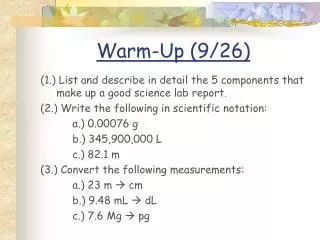
Warm-Up (9/26) (1.) List and describe in detail the 5 components that make up a good science lab report. (2.) Write the following in scientific notation: a.) 0.00076 g b.) 345,900,000 L c.) 82.1 m (3.) Convert the following measurements: a.) 23 m cm b.) 9.48 mL dL c.) 7.6 Mg pg
Answers to Warm-Up (9/26) (1.) Introduction, Materials, Procedures, Data Table, Conclusion (2.) a.) 7.6 x 10⁻⁴ g b.) 3.459 x 10⁸ L c.) 8.21 x 101 m (3.) a.) 2.3 x 103 cm b.) 9.48 x 10⁻²dL c.) 7.6 x 10¹⁸ pg
Chapter 2Matter and Change Ms. Riggins Lawndale High School
Chapter 2.1 – Properties of Matter • Properties used to describe matter can be classified as extensive or intensive
Extensive and Intensive • Extensive – depends on the amount of matter in a sample (mass or volume) • Intensive – depends on the type of matter in a sample (hardness/softness)
Practice • Classify the following properties as extensive or intensive • 5 pounds of apples • Glass Jar • 2 miles long • Plastic Box • Odor
Identifying Substances Every sample of the same substance has identical intensive properties because every sample has the same composition • Physical Property – a quality of a substance that can be observed or measured (color, hardness, shape, state of matter, boiling temperature)
States of Matter • Solid – form of matter that has a definite shape and volume
States of Matter • Liquid – form of matter that has an indefinite shape with a definite volume (usually flows)
States of Matter • Gas – form of matter that has an indefinite shape and volume (takes the shape and volume of its container
Physical Changes • Physical Change – when properties of a material change, but the composition does not change • Examples – break, split, cut, crush, boil freeze, melt, condense • Physical changes can be reversible (melting) or irreversible (cutting hair, filing nails, cracking an egg)
Chemical Change • Chemical Change – a change that produces matter with a different composition than the original matter • Example – heating can be used to break down some compounds into new compounds, or electricity can break down water into hydrogen and oxygen
Chapter 2.2 - Mixtures • A physical blend of two or more components
2 Types of Mixtures (1.) Homogeneous – a mixture in which the composition looks the same throughout (also known as solution) For example: oil or vinegar separately (2.) Heterogeneous – a mixture in which the composition does NOT look the same throughout (chicken soup, salad, oil & vinegar mixed together)
Separating Mixtures You can use a variety of methods to separate mixtures depending on the substances and their physical properties. • Filtration – process that separates a solid from a liquid in a heterogeneous mixture (cooked pasta in a colander, coffee grounds to make coffee) • Distillation – a process involving liquid being boiled to produce a vapor, which is then condensed back to a liquid
Chapter 2.3 - Elements and Compounds • Element – simplest form of matter (oxygen, carbon, nitrogen) Compound – substance that contains two or more elements chemically combined together
Elements vs. Compounds • Compounds can be broken down into simpler substances, but elements cannot • Compound = H2O • Elements = 2 hydrogen’s 1 oxygen
Substances vs. Mixtures • Substance – composition of a material is fixed (Elements and Compounds) • Mixture – composition of a material varies (Homogeneous and Heterogeneous Mixtures)
Practice • Classify the following materials as element, compound, or mixture • Table Salt (NaCl) • Salt Water • Sodium (Na)
Chemical Symbols • Chemists use chemical symbols to represent elements, and chemical formulas to represent compounds Each element is represented by a 1- or 2-letter chemical symbol The 1st letter is always CAPITALIZED, while the 2nd letter (if used) is lowercase. (Example: H, O, C, Cl, He, Na)
Chemical Formulas • Anytime subscripts are used in a formula, they indicate the number of elements in the compound • How many atoms does each formula contain? • NaOH • BaCr2O7 • C12H22O11 • HC2H3O2 • Mg(OH)2
Chapter 2.4 – Chemical Reaction • During a physical change, physical properties change. During a chemical change, chemical properties change. • The result of a chemical reaction can produce a physical or chemical change, or both
Physical Changes • During a physical change, properties of a material change, but the composition of the material does not. • Physical Changes include… FREEZING CUTTING BOILING BREAKING MELTING CRUSHING CONDENSING
Chemical Change • A change that produces matter with a different composition than the original matter
Chemical Reaction One or more substances changes into one or more new substances
Reactant versus Product • Reactants - Substance present at the beginning of the reaction (left side) • Products - Substance present at the end of the reaction (right side) Reactant Product
How to Recognize a Chemical Change (1.) Transfer of energy (heat) (2.) Change in color (3.) Produces a gas (bubbles) (4.) Forms a precipitate (solid that forms and settles out of a liquid mixture)
Conservation of Mass • During any physical or chemical reaction, the mass of the reactants and products is conserved (stays the same) Example: 10 grams of ice melts into 10 grams of water Law of Conservation of Mass – mass of the products is always equal to the mass of the reactants (mass is neither created nor destroyed)
Classwork • Sec 2-1 #’s 5, 8 • Sec 2-2 #’s 11, 14, 16, 17 • Sec 2-3 #’s 20, 21, 24, 25, 26, 27 • Sec 2-4 #”s 29, 30, 31, 32, 33, 34