Download
1 / 1
10 likes | 130 Vues
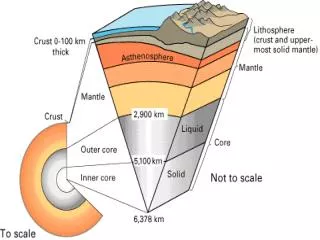
In the early 1960s, seismologists made groundbreaking discoveries about Earth's internal structure, observing how seismic waves travel through its layers. They identified the lithosphere, a rigid layer composed of the crust and upper mantle, and the asthenosphere, a deeper layer with fluid-like properties. This plastic-like layer beneath the lithosphere is crucial for understanding continental movement and tectonic activity. These findings shed light on the fundamental processes driving plate tectonics and the dynamics of our planet's geology.

E N D
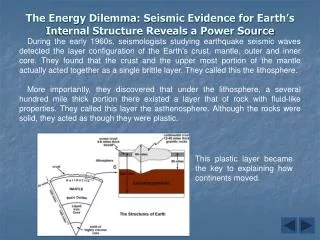
The Energy Dilemma: Seismic Evidence for Earth’s Internal Structure Reveals a Power Source During the early 1960s, seismologists studying earthquake seismic waves detected the layer configuration of the Earth’s crust, mantle, outer and inner core. They found that the crust and the upper most portion of the mantle actually acted together as a single brittle layer. They called this the lithosphere. More importantly, they discovered that under the lithosphere, a several hundred mile thick portion there existed a layer that of rock with fluid-like properties. They called this layer the asthenosphere. Although the rocks were solid, they acted as though they were plastic. This plastic layer became the key to explaining how continents moved.