Introduction to Ionic Compounds: Naming and Formula Writing
This guide covers the fundamentals of ionic compounds, including monatomic ions and their formation through the loss or gain of electrons. It outlines how cations and anions combine to create neutral binary compounds, with a focus on naming conventions and formula writing, particularly for transition metals that may have multiple charges. It also addresses the characteristics of ionic compounds and provides examples of both binary and tertiary ionic compounds, emphasizing the use of polyatomic ions. Enhance your understanding of ionic bonding and nomenclature with practical examples.

Introduction to Ionic Compounds: Naming and Formula Writing
E N D
Presentation Transcript
Ionic Compounds Naming & Formula Writing
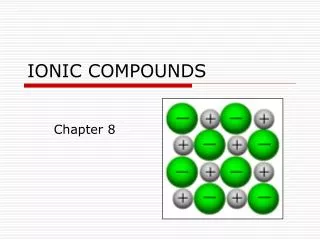
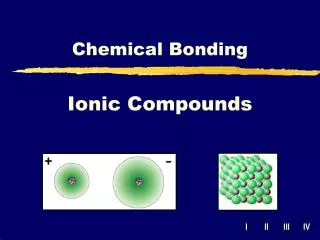
Monatomic Ions • Charged particles composed of one type of atom • Cations (+) or anions (-) atoms lose or gain electrons to become stable • Oppositely charged ions are attracted to each other and form an ionic bond Ex. • Na+ Cl- form NaCl
Binary Compounds • Composed of a cation and an anion • Metal and a nonmetal • Neutral (total + and – charges cancel) • Use subscripts to make charges = 0 • Ions are in smallest whole # ratio • Naming – cation first (name of metal), anion second (name of nonmetal with an “ide” ending
Binary Examples • Lithium and oxygen • Li+ O2- forms Li2O • Lithium oxide • Magnesium and sulfur • Mg2+ S2- forms MgS • Magnesium sulfide
Try the criss cross method! • If the charges equal zero, no subscripts are required. • If they don’t equal zero, use subscripts to make the total charge zero. • Strontium and phosphorus • Sr2+ P3- • Sr3P2 • Strontium phosphide
You try it! • Potassium and bromine • KBr potassium bromide • Calcium and phosphorus • Ca3P2 calcium phosphide • Aluminum and chlorine • AlCl3 aluminum chloride • Sodium and nitrogen • Na3N sodium nitride
Characteristics of Ionic Compounds • Electrically neutral • High melting point • Brittle solids • Water soluble • Solutions are good electrical conductors
Binary Compounds with Transition Metals • Transition metals may have more than one charge • When naming, must indicate charge with a Roman Numeral – look at what it is bonded with to determine • Ex. CuCl2 copper (II) chloride CuCl copper (I) chloride
Formula Writing with Transitions • The Roman numeral in the name tells the charge of the transition metal. • Ex. Chromium (III) oxide • Cr2O3 • Exceptions: Zn & Cd are always 2+ and silver is always 1+ so no Roman numeral is used
Other Exceptions • Lead and Tin are not transition metals but they act like them – can have more than one charge. • Therefore, a Roman numeral is used when naming ionic compounds containing them. • SnO2 tin (IV) oxide
Now you try it! • Iron (III) oxide • Fe2O3 • Nickel (II) nitride • Ni3N2 • Cu2S • Copper (I) sulfide • Co3P2 • Cobalt (II) phosphide
STOP!!! • DON’T GO ANY FURTHER!!
Tertiary Ionic Compounds • Composed of either a cation or anion and a polyatomic ion • Polyatomic ions are covalently bonded atoms that behave as a charged particle. (most are anions) • When naming, use same naming rules except give the polyatomic its same name
Tertiary Example • Calcium and phosphate • Ca2+ PO43- form Ca3(PO4)2 • Calcium phosphate • Note that when more than one of a polyatomic ion is required in the formula, the PAI is in () with the subscript outside the ()
Try these! • Aluminum and acetate • Al(C2H3O2)3 • Magnesium and sulfate • MgSO4 • Copper (II) phosphate • Cu3(PO4)2 • Iron (II) carbonate • FeCO3 • Ammonium and nitrite • NH4NO2 • Nickel (II) hydroxide • Ni(OH)2