Une image / un lien ci-dessous est fourni (tel quel) pour télécharger la présentation
Politique de téléchargement : le contenu du site vous est fourni TEL QUEL pour votre information et votre usage personnel ; il ne peut être vendu, concédé sous licence ni partagé sur d’autres sites sans l’accord de son auteur.Le contenu vous est fourni TEL QUEL, pour votre information et votre usage personnel uniquement.Téléchargez la présentation en cliquant sur ce lien.Lors du téléchargement, si vous ne parvenez pas à télécharger une présentation, l’éditeur a peut-être supprimé le fichier de son serveur.Pendant le téléchargement, si vous ne parvenez pas à obtenir une présentation, le fichier a peut-être été supprimé par l’éditeur.
F I N
Plus de contenu associé
Transcription de la présentation
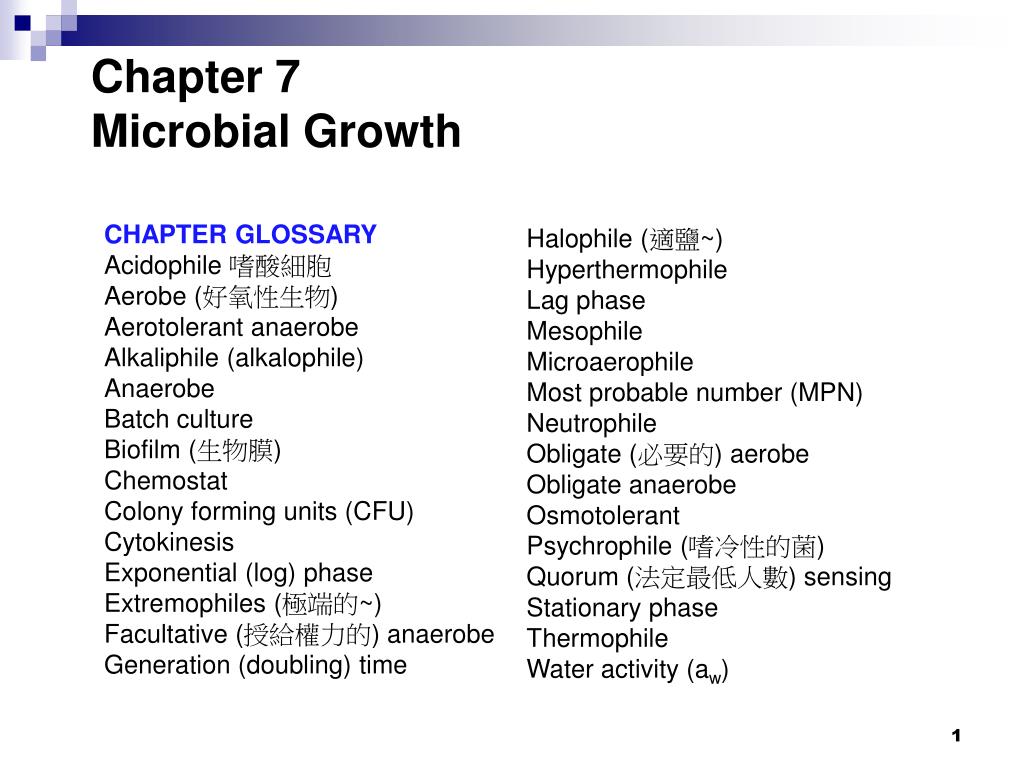
Chapter 7 Microbial Growth CHAPTER GLOSSARY Acidophile 嗜酸細胞 Aerobe (好氧性生物) Aerotolerant anaerobe Alkaliphile (alkalophile) Anaerobe Batch culture Biofilm (生物膜) Chemostat Colony forming units (CFU) Cytokinesis Exponential (log) phase Extremophiles (極端的~) Facultative (授給權力的) anaerobe Generation (doubling) time Halophile (適鹽~) Hyperthermophile Lag phase Mesophile Microaerophile Most probable number (MPN) Neutrophile Obligate (必要的) aerobe Obligate anaerobe Osmotolerant Psychrophile (嗜冷性的菌) Quorum (法定最低人數) sensing Stationary phase Thermophile Water activity (aw)
Reproductive Strategies • the reproductive strategies of eukaryotic microbes • asexual and sexual, haploid or diploid • Bacteria and Archaea • haploid only, asexual - binary fission, budding, filamentous • all must replicate and segregate the genome prior to division
Bacterial Cell Cycle • cell cycle is sequence of events from formation of new cell through the next cell division • most bacteria divide by binary fission • two pathways function during cycle • DNA replication and partition (分開) • cytokinesis (細胞質分裂)
Chromosome Replication • most procaryotic chromosomes are circular • Single origin of replication – site at which replication begins • terminus– site at which replication is terminated • replisome – group of proteins needed for DNA synthesis • DNA replication proceeds in both directions from the origin • origins move to opposite ends of the cell
Chromosome Partitioning • replisome pushes, or condensation of, daughter chromosomes to opposite ends • MreB (murein cluster B) – an actin homolog, plays role in determination of cell shape as spiral inside cell periphery, and chromosome segregation • new origins associate with MreB tracks • if MreB is mutated, chromosomes do not segregate Cytokinesis - Septation • septation – formation of cross walls between daughter cells • several steps • selection of site for septum formation • assembly of Z ring • linkage of Z ring to plasma membrane (cell wall) • assembly of cell wall synthesizing machinery • constriction of cell and septum formation
Z Ring Formation - Role in Septation • protein FtsZ • tubulin homologue, found in most bacteria and archaea • polymerization forms Z ring, filaments of meshwork • MinCDE system in E. coli limits the Z ring to the center of the cell • MinC, MinD, MinE oscillate from one side of cell to other • link Z ring to cell membrane • Z ring constricts and cell wall synthesis of septal wall MinCD: inhibitor of Z-ring
Plasmid Segregation • plasmids replicate independently and carry proteins necessary for segregation • E. coli R1 plasmid produces three proteins essential for its inheritance • ParM – similar to MreB, actin homolog forms long filaments • ParR (repressor) and ParC (centromere-like) both bind to origins and link to ParM • ParM filaments elongate and separate plasmids to opposite ends of cell
Cell Wall Growth and Cell Shape Determination • coccidivisome- new peptidoglycan forms only at the central septum • FtsZ determines site of cell wall growth • FtsZ may recruit PBPs for synthesis of septum • rods are similar but elongate prior to septation • MreB determines cell diameter and elongation as Z ring forms in center
vibrio (comma-shaped bacteria) • FtsZ – forms Z ring • MreB – helical polymerization throughout cell • crescentin – intermediate filament homologue cytoskeletal protein • localizes to short, curved side of cell • asymmetric cell wall synthesis forms curve
Growth • increase in cellular constituents that may result in: • increase in cell number • increase in cell size • growth refers to population growth rather than growth of individual cells The Growth Curve • observed when microorganisms are cultivated in batch culture • culture incubated in a closed vessel with a single batch of medium • usually plotted as logarithm of cell number versus time • has four distinct phases • lag, exponential, stationary, senescence, and death
Lag Phase • cell synthesizing new components • e.g., to replenish spent materials • e.g., to adapt to new medium or other conditions • varies in length • in some cases can be very short or even absent Exponential Phase • also called log phase • rate of growth and division is constant and maximal • population is most uniform in terms of chemical and physical properties during this phase Balanced growth • during log phase, cells exhibit balanced growth • cellular constituents manufactured at constant rates relative to each other
Unbalanced growth • rates of synthesis of cell components vary relative to each other • occurs under a variety of conditions • change in nutrient levels • shift-up (poor medium to rich medium) • shift-down (rich medium to poor medium) • change in environmental conditions Effect of nutrient concentration on growth
Stationary Phase • closed system population growth eventually ceases, total number of viable cells remains constant • active cells stop reproducing or reproductive rate is balanced by death rate Possible reasons for entry into stationary phase • nutrient limitation • limited oxygen availability • toxic waste accumulation • critical population density reached
Stationary Phase and Starvation Response • entry into stationary phase due to starvation and other stressful conditions activates survival strategy • morphological changes • e.g., endospore formation • decrease in size, protoplast shrinkage, and nucleoid condensation • RpoS protein assists RNA polymerase in transcribing genes for starvation proteins
Starvation responses • production of starvation proteins • increase cross-linking in cell wall • Dps protein protects DNA • chaperone proteins prevent protein damage • cells are called persister cells • long-term survival • increased virulence Senescence and Death Phase • two alternative hypotheses • cells are Viable But Not Culturable (VBNC) • cells alive, but dormant, capable of new growth when conditions are right • programmed cell death • fraction of the population genetically programmed to die (commit suicide)
The Mathematics of Growth • generation (doubling) time • time required for the population to double in size • Varies depending on species of microorganism and environmental conditions • range is from 10 minutes for some bacteria to several days for some eucaryotic microorganisms
Prolonged Decline in Growth • bacterial population continually evolves • process marked by successive waves of genetically distinct variants • natural selection occurs
Measurement of Microbial Growth Measurement of Cell Numbers • can measure changes in number of cells in a population • can measure changes in mass of population • direct cell counts • counting chambers • electronic counters • on membrane filters Counting chambers • easy, inexpensive, and quick • useful for counting both eucaryotes and procaryotes • cannot distinguish living from dead cells
Direct counts on membrane filters • cells filtered through special membrane that provides dark background for observing cells • cells are stained with fluorescent dyes • useful for counting bacteria • with certain dyes, can distinguish living from dead cells Flow Cytometry • microbial suspension forced through small orifice with a laser light beam • movement of microbe through orifice impacts electric current that flows through orifice • instances of disruption of current are counted • specific antibodies can be used to determine size and internal complexity
Viable Counting Methods • spread and pour plate techniques • diluted sample of bacteria is spread over solid agar surface or mixed with agar and poured into Petri plate • after incubation the numbers of organisms are determined by counting the number of colonies multiplied by the dilution factor • results expressed as colony forming units (CFU) • membrane filter technique • bacteria from aquatic samples are trapped on membranes of known pore size • membrane soaked in culture media • colonies grow on membrane • colony count determines number of bacteria in original sample
Viable Counting Methods • if microbe cannot be cultured on plate media • dilutions are made and added to suitable media • turbidity determined to yield the most probable (可能) number (MPN) Measurement of Cell Mass • dry weight • time consuming and not very sensitive • quantity of a particular cell constituent • e.g., protein, DNA, ATP, or chlorophyll • useful if amount of substance in each cell is constant • turbidometric measures (light scattering) • quick, easy, and sensitive
The Continuous Culture of Microorganisms Importance of Continuous Culture Methods • growth in an open system • continual provision of nutrients • continual removal of wastes • maintains cells in log phase at a constant biomass concentration for extended periods • achieved using a continuous culture system • constant supply of cells in exponential phase growing at a known rate • study of microbial growth at very low nutrient concentrations, close to those present in natural environment • study of interactions of microbes under conditions resembling those in aquatic environments • food and industrial microbiology
The Chemostat (化學恆定) Dilution Rate and Microbial Growth • rate of incoming medium = rate of removal of medium from vessel • an essential nutrient is in limiting quantities • chemostat operates best at low dilution rate cell density maintained at wide range of dilution rates dilution rate – rate at which medium flows through vessel relative to vessel size
The Turbidostat (渾濁恆定) • regulates the flow rate of media through vessel to maintain a predetermined turbidity or cell density • dilution rate varies • no limiting nutrient • turbidostat operates best at high dilution rates
The Influence of Environmental Factors on Growth • most organisms grow in fairly moderate environmental conditions • extremophiles • grow under harsh conditions that would kill most other organisms
Solutes and Water Activity • water activity (aw) • amount of water available to organisms • reduced by interaction with solute molecules (osmotic effect) higher [solute] lower aw • reduced by adsorption to surfaces (matric effect) • water activity of a solution is 1/100 the relative humidity of solution • also equal to ratio of solution’s vapor pressure (Psoln) to that of pure water (Pwater) • Aw = Psoln/ Pwater
Solutes and Water Activity • changes in osmotic concentrations in the environment may affect microbial cells • hypotonic solution (lower osmotic concentration) • water enters the cell • cell swells may burst • hypertonic (higher osmotic concentration) • water leaves the cell • membrane shrinks from the cell wall (plasmolysis) may occur Microbes Adapt to Changes in Osmotic Concentrations • reduce osmotic concentration of cytoplasm in hypotonic solutions • mechanosensitive (MS) channels in plasma membrane allow solutes to leave • increase internal solute concentration with compatible solutes to increase their internal osmotic concentration in hypertonic solutions • solutes compatible with metabolism and growth
Extremely Adapted Microbes • halophiles • grow optimally in the presence of NaCl or other salts at a concentration above about 0.2M • extreme halophiles • require salt concentrations between 2M and 6.2M • extremely high concentrations of potassium • cell wall, proteins, and plasma membrane require high salt to maintain stability and activity
pH • measure of the relative acidity of a solution • negative logarithm of the hydrogen ion concentration
pH • acidophiles • growth optimum between pH 0 and pH 5.5 • neutrophiles • growth optimum between pH 5.5 and pH 7 • alkalophiles • growth optimum between pH 8.5 and pH 11.5 • most microbes maintain an internal pH near neutrality • the plasma membrane is impermeable to proton • exchange potassium for protons • acidic tolerance response • pump protons out of the cell • some synthesize acid and heat shock proteins that protect proteins • many microorganisms change the pH of their habitat (棲息地) by producing acidic or basic waste products
Temperature • microbes cannot regulate their internal temperature • enzymes have optimal temperature at which they function optimally • high temperatures may inhibit enzyme functioning and be lethal • organisms exhibit distinct cardinal (主要的)growth temperatures • minimal • maximal • optimal
Temperature • psychrophiles – 0o C to 20o C • psychrotrophs – 0o C to 35o C • mesophiles – 20o C to 45o C • thermophiles – 55o C to 85o C • hyperthermophiles – 85o C to 113o C
Adaptations of thermophiles • protein structure stabilized by a variety of means • e.g., more H bonds • e.g., more proline • e.g., chaperones • histone-like proteins stabilize DNA • membrane stabilized by variety of means • e.g., more saturated, more branched and higher molecular weight lipids • e.g., ether linkages (archaeal membranes)
Oxygen Concentration • growth in oxygen correlates with microbes energy conserving metabolic processes and the electron transport chain (ETC) and nature of terminal electron acceptor • aerobe • grows in presence of atmospheric oxygen (O2) which is 20% O2 • obligate aerobe – requires O2 • anaerobe • grows in the absence of O2 • obligate anaerobe • usually killed in presence of O2
Oxygen Concentration • microaerophiles • requires 2–10% O2 • facultative anaerobes • do not require O2 but grow better in its presence • aerotolerant anaerobes • grow with or without O2 need oxygen prefer oxygen ignore oxygen oxygen is toxic < 2 – 10% oxygen
Basis of different oxygen sensitivities • oxygen easily reduced to toxic products • superoxide radical • hydrogen peroxide • hydroxyl radical • aerobes produce protective enzymes • superoxide dismutase (SOD) • catalase The GasPak anaerobic system
Strict Anaerobic Microbes • all strict anaerobic microorganisms lack or have very low quantities of • superoxide dismutase • catalase • these microbes cannot tolerate O2 • anaerobes must be grown without O2 • work station with incubator • gaspak anaerobic system
Pressure • microbes that live on land and water surface live at 1 atmosphere (atm) • some Bacteria and Archaea live in deep sea with very high hydrostatic pressures • barotolerant • adversely affected by increased pressure, but not as severely as nontolerant organisms • barophilic organisms • require or grow more rapidly in the presence of increased pressure
Radiation Radiation Damage • ionizing radiation • x rays and gamma rays • mutations death • disrupts chemical structure of many molecules, including DNA • damage may be repaired by DNA repair mechanisms • Deinococcus radiodurans • extremely resistant to DNA damage
Radiation Damage… • ultraviolet (UV) radiation • wavelength most effectively absorbed by DNA is 260 nm • mutations death • causes formation of thymine dimersin DNA • requires direct exposure on microbial surface • DNA damage can be repaired by several repair mechanisms • visible light • at high intensities generates singlet oxygen (1O2) • powerful oxidizing agent • carotenoid pigments • protect many light-exposed microorganisms from photooxidation
Connexion au compte
Connectez-vous pour publier votre contenu sur SlideServe.