Understanding Traits, Alleles, and Punnett Squares in Genetics
180 likes | 319 Vues
This resource explores how traits are inherited through genetic alleles, providing insights into dominant and recessive alleles, including definitions of homozygous and heterozygous traits. It explains the structure of Punnett Squares and guides users through examples to predict offspring genotypes and phenotypes from parental trait combinations. By using Punnett Squares, you can visually determine the likelihood of various genetic traits appearing in future generations, helping to decipher the complex world of heredity and genetics.


Understanding Traits, Alleles, and Punnett Squares in Genetics
E N D
Presentation Transcript
Traits and Punnett Squares http://www.brainpop.com/science/cellularlifeandgenetics/heredity/zoom.weml
Traits and Alleles • Traits are characteristics passed from your parents, ex) eye color • Each cell in your body has a complete set of DNA-46 chromosomes (23 from mom, 23 from dad) • Sex cells (sperm and egg) have 23 chromosomes each • Each trait is determined by a pair of genes, called alleles • For each trait, you have 1 allele from mom, 1 allele from dad. • Alleles are shown by using letters, ex) T for height • Alleles are considered dominant or recessive
Dominant Alleles • An allele that masks a recessive alleles • Dominant alleles are shown in capital letters. • Presence of the dominant allele will mean the dominant trait is shown ex) Tt or TT • Dominant alleles are always listed first-so it would be Tt not tT.
Recessive Alleles • An allele that is masked by a dominant allele • Recessive alleles are shown in lower case letters. • The only way that a recessive trait is shown is if there are 2 of them-1 from each parent Ex) tt
Homozygous Traits or Alleles • Means that there are 2 of the same alleles ex) TT or tt • Pure is another word for homozygous
Heterozygous Traits or Alleles • Means that there are 2 different alleles ex) Tt • Hybrid is another term for heterozygous
Genotype • What 2 alleles are present Ex) TT or Tt or tt
Phenotype • What trait is shown-the characteristic that is shown Ex) tall or short
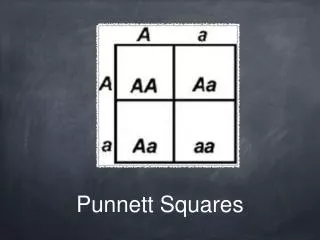
Punnett Square • Used to determine the genotype and phenotype of offspring Steps: • Draw square • Fill in parent genotypes • Complete offspring genotypes • Determine % of genotypes of offspring • Determine % of phenotypes of offspring
Punnett Square Example Steps: • Draw square Example 1) A brown (BB) rabbit is crossed with a white rabbit (bb). For their offspring, give the % of each genotype and each phenotype.
Punnett Square Example 1)A brown (BB) rabbit is crossed with a white rabbit (bb). For their offspring, give the % of each genotype and each phenotype. 2) Fill in parent genotypes B B b b
Punnett Square Example 1)A brown (BB) rabbit is crossed with a white rabbit (bb). For their offspring, give the % of each genotype and each phenotype. 3) Complete offspring genotypes B B Bb b Bb b Bb Bb
Punnett Square Example 1)A brown (BB) rabbit is crossed with a white rabbit (bb). For their offspring, give the % of each genotype and each phenotype. B B • Determine % of genotypes of offspring: • BB-0/4=0% • Bb-4/4=100% • bb-0/4=0% Bb b Bb b Bb Bb
Punnett Square Example 1)A brown (BB) rabbit is crossed with a white rabbit (bb). For their offspring, give the % of each genotype and each phenotype. B B 5) Determine % of phenotypes of offspring: Brown-4/4=100% White-0/4=0 % Bb b Bb b Bb Bb
Punnett Square Example 2) A cross is done between green (Gg) and yellow parent plants (gg). For their offspring, give the % of each genotype and each phenotype. Fill in parent genotypes g G g g
Punnett Square Example 2) A cross is done between green (Gg) and yellow parent plants (gg). For their offspring, give the % of each genotype and each phenotype. Complete square g G gg Gg g g Gg gg
Punnett Square Example 2) A cross is done between green (Gg) and yellow parent plants (gg). For their offspring, give the % of each genotype and each phenotype. Genotypes: GG-0/4=0% Gg-2/4=50% gg-2/4=50% g G gg Gg g g Gg gg
Punnett Square Example 2) A cross is done between green (Gg) and yellow parent plants (gg). For their offspring, give the % of each genotype and each phenotype. Phenotypes: Green-2/4=50% Yellow-2/4=50% g G gg Gg g More practice: http://glencoe.mcgraw-hill.com/sites/0078778066/student_view0/chapter5/math_practice.html g Gg gg