Understanding Machines: Mechanical Advantage and Efficiency Simplified
A machine is a device that facilitates work by altering one or more factors such as the force, distance, or direction applied. Input force is the effort you exert, while output force is what the machine delivers. Mechanical advantage (MA) quantifies how much a machine increases force, with values greater than 1 indicating an increase. Efficiency, the ratio of output work to input work, reflects performance quality. Ideal machines achieve 100% efficiency, but real machines experience losses due to friction. Explore how machines enhance our ability to perform tasks effectively! **Relevant

Understanding Machines: Mechanical Advantage and Efficiency Simplified
E N D
Presentation Transcript
How Machines Do Work What is a machine, Mechanical advantage & efficiency.
What is a machine? • Device that allows you to do work in a way that is easier • change at least one of the three factors
machine • Change the amount of force you exert • Change the distance over which you exert the force • Change the direction in which you exert the force • Machines make work easier by changing either the force, distance or direction.
Input & output forces • Input force = force you exert on the machine • Output force = the force the machine exerts on an object
Input and output work • Input work = input force x input distance • Output work = output force x output distance • No machine produces more work than is input.
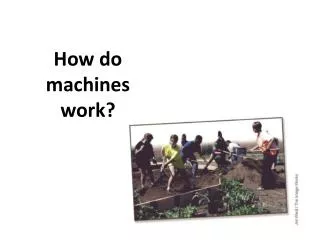
The amount of input work done by the gardener equals the amount of output work done by the shovel.
Mechanical Advantage • The number of times the machine increases the force exerted on it. • MA = output force/input force
Increasing force: MA > 1 • You exert an input force of 10 N • Can opener exerts an output force of 30 N • Mechanical advantage = • 30N/10N • = 3
Increasing Distance: MA < 1 • You exert an Input force of 20 N on the chopsticks • Chopsticks exert an Output force of 10 N • Mechanical advantage? • 10 N/ 20 N • = 0.5 • Input distance • Output distance
Changing direction • If you only change the direction, • what will be the mechanical advantage? • Mechanical advantage = 1 • Input force • Output force
Efficiency • Efficiency = output work/input work x 100% • Friction reduces the efficiency of objects (like glue on scissors)
Real and ideal machines • Efficiency of 100 % ideal machine • 100 % efficiency perpetual motion machine • Unfortunately no such machine exists • All machines lose some work due to friction
1. Machine increases force, you must exert input force over a greater distanceExample: faucet
2. Machine increases distance, you must apply greater input forceExample: chopsticks
3. Machine changed direction, the amount of force and distance remain the same.Example: tricep presses