Benefit-Cost Analysis Principles for Decision Making in Asset Management
This exercise engages five groups in identifying and justifying the benefits and costs associated with various assets such as printers, computers, software, bridges, and roads. Participants will analyze a do-nothing scenario versus alternatives like upgrading assets to improve their conditions. By using Benefit-Cost Analysis (BCA), each group will determine which alternative offers the highest value for investment. The exercise emphasizes the role of BCA in simplifying decision-making and encourages discussion on the application of deterioration models for different asset types.

Benefit-Cost Analysis Principles for Decision Making in Asset Management
E N D
Presentation Transcript
Benefit Cost Analysis (BCA)
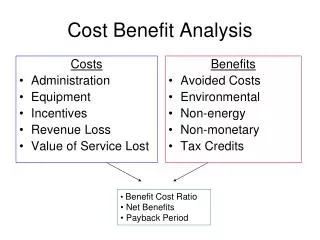
Class exercise • 5 groups • List the benefits and costs that you believe will help in determining the BC of the asset. Justify your answers.
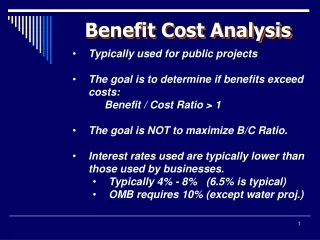
Decision making based on BCA • Base case: DO-nothing scenario • Example: • Road – Poor condition • Printer – Poor condition • Software – Full of bugs • Server – Very slow • Alternative 1: Upgrade to a better condition • Example: • Upgrade road so that overall condition becomes “Fair” • Upgrade server so that it becomes faster
Decision making based on BCA • Alternatives – numerous • How to decide which alternative is better or the best in comparison to the base case “Do-nothing scenario” • Use BCA • Alternative with a higher BCA value is the most economically judicious one to invest/fund. • BCA makes decision making for AM much easier.
Discussion Topic • For what type of assets would you consider building deterioration models?