Understanding Solution Preparation and Dilution Techniques in Chemistry
This guide explores the concept of solution preparation, focusing on standard solutions whose precise concentrations are known. It discusses the process of dilution, which involves decreasing a solution's concentration by adding more solvent, and emphasizes the importance of stock solutions in research and industrial processes. Essential equipment for preparing solutions is outlined, including graduated pipettes and volumetric flasks. The document also provides key formulas and an example calculation for creating diluted solutions. Prepare for practical applications in chemical analysis and laboratory work.

Understanding Solution Preparation and Dilution Techniques in Chemistry
E N D
Presentation Transcript
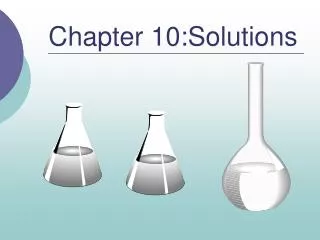
Solutions & Solubility 6.5 Solution Preparation
Review • Standard Solution = a solution for which the precise concentration is known • Used in research laboratories and industrial processes • Used in chemical analysis and precise control of chemical reactions
Preparing a Solution by Dilution • Dilution = the process of decreasing the concentration of a solution, usually by adding more solvent • Stock Solution = a solution that is in stock or on the shelf (i.e., available); usually a concentrated solution
Solution Preparation • Equipment needed to prepare a standard solution: • Graduated Pipettes and bulbs • Volumetric flask
Graduated & Volumetric Pipettes and Bulb transfer small quantities of liquid
The Formula • the number of moles (n) does not change when more solvent is added to a solution; only the concentration changes • therefore, ni (initial) = nf (final) • If a solution is diluted from Vi to Vf, the molar concentration of that solution changes according to the following equation: • Vix Ci = Vfx Cf • ** remember: n = C X V **
The Variables Vix Ci = Vfx Cf • Vi = initial volume • Ci = initial concentration • Vf = final volume • Cf = final concentration
Example • How do you prepare 250 mL of a 0.01 mol/L solution from a stock solution of 0.1 mol/L? • The Calculations:
Preparing a Standard Solution by dilution • Video • Classroom Demonstration
Homework • Section 6.5 Questions (pg. 306 – 307): #2 – 5, 8 a & b, 9, 10 • Chapter 6 Review (pg. 309 – 311): #2, 7 – 9, 11– 13, 17a, 18a