Chest/Pulmonary Exam
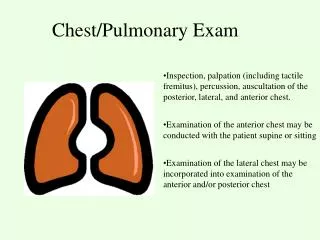
Chest/Pulmonary Exam. Inspection, palpation (including tactile fremitus), percussion, auscultation of the posterior, lateral, and anterior chest. Examination of the anterior chest may be conducted with the patient supine or sitting

Chest/Pulmonary Exam
E N D
Presentation Transcript
Chest/Pulmonary Exam • Inspection, palpation (including tactile fremitus), percussion, auscultation of the posterior, lateral, and anterior chest. • Examination of the anterior chest may be conducted with the patient supine or sitting • Examination of the lateral chest may be incorporated into examination of the anterior and/or posterior chest
AnteriorChest Anterior Chest (lying or sitting or at 30 0) 73. Inspection: For symmetry, fully exposed (in female patient may cover with gown as in photo)
Anterior Chest 74,75. Palpation: For tactile fremitus Palpation: Alternates from side to side or may use both hands simultaneously
Anterior Chest: Percussion: 76-78 Percussion: Must be done: Bilaterally Symmetrically Good tone Must alternate from side to side
Patient instructed slow, deep breath, mouth open Auscultation: Alternates from side to side Auscultation: At least 3-4 areas auscultated on each side Anterior Chest: Auscultation • (Starting above clavicles, 3-4 places, listens throughout inspiration and expiration)
Posterior Chest 84. Inspection: For symmetry
Posterior Chest: Palpation A. B. A. Place hands on the patient’s posterior/lateral chest Apply moderate pressure-- Move hands up and towards the midline creating a “dimple” in the skin between the thumbs.- B.Ask the patient to take a deep breath Feel and visualize the chest expanding Your thumbs will move apart and the “dimple’ in the skin will go away Arrows denote direction of hand movement
Posterior chest: Palpation • 86-87:Tactile Fremitus • Start above the scapula • Use the ulnar aspects of the hands • May use one hand and alternate from side to side or may use both hands moving inferiorly • Ask the pt to say “99” and feel the vibrations
Posterior Chest--Percussion 88-91: Percussion: includes percussion, diaphragmatic excursion, and percussion over the costovertebral angle • Percussion--(At level of the diaphragm) • This is done during normal (tidal) breathing • Start above the scapula • Alternate from side to side • Continue inferiorly until dullness of percussion occurs
Posterior Chest-Percussion Percussion 88-91: Diaphragmatic movement • Once the level of the diaphragm has • been detected during tidal respiration • ask the patient to take a deep breath and hold it • This will move the diaphragm more inferiorly Begin to percuss moving more inferiorly until dullness is encountered again • Begin to percuss moving more inferiorly until dullness is encountered again Repeat this process for the other side
Anterior Percussion over costovertebral angle • Place the ball of one hand firmly over the patient’s costovertebral angle. • Use the ulnar side of your other hand to strike the hand you have placed on the patient. • Use enough force to cause a perceptible but painless jar or “thud” • Repeat on the opposite side
Posterior Chest Auscultation: 92-96 • Patient needs to be in the correct position with arms folded and hands on opposite shoulders • Use the diaphragm of the stethoscope • Start above the scapula • Ask the patient to take deep breaths with his/her mouth open • Listen to complete inspiration and expiration • Move from side to side working your way inferiorly • Listen to at least 3-4 places