The Puritans: Reformation, Migration, and Dissent in New England
The Puritans, seeking to reform the Church of England, settled in New England in 1630, led by the Massachusetts Bay Company. Unlike the Pilgrims, they aimed to create a model society without separating from the Church. They established self-governed towns, with Boston as their capital. Key figures like Thomas Hooker, Roger Williams, and Anne Hutchinson challenged Puritan norms, advocating for broader voting rights and religious freedom. Williams founded Rhode Island, a haven for dissenters, while Hutchinson’s beliefs threatened male authority, illustrating the evolving dynamics in colonial New England.

The Puritans: Reformation, Migration, and Dissent in New England
E N D
Presentation Transcript
Puritans Settle New England
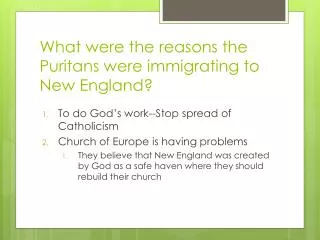
Puritans • Beliefs: • Wanted to reform (purify)the Church of England • Unlike the Pilgrims (Separatists), they DID NOT want to separate • Thought their mission was to create a model society committed to the proper worship of God • Did not like church rituals and authority structures • wanted to be a commonwealth: a community in which people work together for the common good
The Great Migration • Got charter from Massachusetts Bay Company • 1630 1,000 people set off in 11 well-stocked ships • Were well prepared; did not have a starving time • Boston eventually became its capital city • Each town had its own congregation • Town meeting = self government • Only males could vote and hold office • Had to attend church…it was LAW!
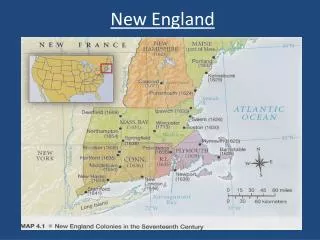
Fundamental Orders of Connecticut • Thomas Hooker led 3 Puritan congregations out of Massachusetts • Founded Connecticut in 1637 • Created the Fundamental Orders of Connecticut • Created a government like the one in Massachusetts BUT voting was NOT limited to just church members • Expanded representative government in the colonies by allowing more people to vote • Limited the power of the governor
Puritan “Rebels”- Roger Williams • Minister in Salem, MA. • Disagreed w/ Massachusetts • They did not give fair compensation($) to Indians • Took land by force • Opposed forced church attendance • In 1635 he was found guilty of preaching new & dangerous opinions and was kicked out • Founded Rhode Island the next year Roger Williams
Puritan “Rebels”- Anne Hutchinson • Intelligent, strong-willed • Seen as threatening to male control of Massachusetts • Believed in “direct revelation” • Believed a person could worship without help of a church, minister, or bible • Preached secretly in her home • Forced to leave Massachusetts • Moved to Rhode Island AnneHutchinson
Rhode Island • Puritans wanted Roger Williams sent back to England to keep him from starting a competing colony • Williams established political freedom in Rhode Island • Universal manhood suffrage (right to vote) • Opposed to special privilege of any kind • Known as the “Sewer” • Seen as dumping ground for religious dissenters by Puritans • More liberal than any other colony!