multiple intelligences essay
>>> How to write an essay? Order on the website: HelpWriting.Net

multiple intelligences essay
E N D
Presentation Transcript
I found the multiple intelligence inventory the most useful because it helped me figure out which intelligences are my strongest. I find some of the activities and tasks I do easy, while others are tough.I have learned what my strongest multiple intelligence are through the inventory and I have realized that I can take advantage of them and use it to help me in different situations. For example, before I had taken the test I had noticed that I am very good at teamwork and that I work better when listening to music. By doing this inventory I have realized that it might be because my strongest multiple intelligence is interpersonal, musical and logical. After recognizing musical as one of my strongest intelligence I have tried to associate information Get more content on HelpWriting.net
Different learning styles are used by different people, with different levels of intelligence and ability. The different learning styles are visual, auditory, and kinesthetic. There are many others depending on who you ask, but those are the basic ones. Depending on how a person is raised, how they individually prefer to learn, and their learning ability. However, if a teacher uses the wrong learning style with a student, it may make the student feel like they cannot learn or that they are inferior to the others in the classroom (Overview of Learning Styles, 2014). Visual learners learn by observing. These people like to read, and they can recall what they read easily. This learning style can use flashcards for reinforcing lessons, and...show more content... They like to build things as well (Weinstein, Witte, & Willingham, 2013). Two other types of learning styles are active and reflective. These are usually grouped in with the aforementioned styles, and they help to further define them. Active learners are impulsive risk takers. They prefer not to take many notes and do not like long lectures where they have to sit and just listen. Active learners are much like kinesthetic learners in that they like to learn by doing. They do well with role playing, and like team competition. Reflective learners are mainly introverts, and they like to think about their solutions before acting on them. These people also prefer writing and like observing and writing about their experiences. Learning logs and personal connections to topics tend to appeal to reflective learners. There is more to teaching to different learning styles than just knowing a learning style. Many factors have to be taken into account in order to successfully teach or learn. These factors include location, whether it is group or solo work, whether there are distractions, and even something as simple as the temperature of the room the students are in (NDT Resource Center, n.d.). In elementary school classrooms there are usually too many students, and the teacher has to fight to stay focused sometimes. Despite their best efforts some teachers cannot effectively teach Get more content on HelpWriting.net
Multiple Intelligences Top Three Intelligences By: Sean Mahoney Strategies for the Technical Professional Professor R. Aragon As stated in our reading there a total of 8 multiple intelligences developed by Howard Gardner. Each type of intelligence is not the same for every person. Everyone has their own unique personality and therefore has their own style of learning or retaining information provided to them. There are certain surveys you can take in order to determine where your particular intelligences fall. I have taken one of these surveys and have chosen three of my top intelligences to explore further and to determine what skills in each type of intelligence are most effective for me to retain new information, not only in my education but...show more content... No matter if you are in school or already in your career. Being able to retain information valuable to your job and understanding it is extremely important and makes you a valuable asset. You can assist your classmates or perform your job near flawlessly as long as you understand the importance to knowing how you learn and the best way to utilize your multiple Get more content on HelpWriting.net
Multiple Intelligences Essays Multiple Intelligences Thought out our lives, we are faced with many different learning experiences. Some of these experiences have made a better impact than others. This can be attributed to everyone's different multiple intelligences or learning styles. A persons learning style is the method though which they gain information about their environment. As a teacher, it is our responsibility to know these styles, so we can reach each of our students and use all of the necessary methods. Howard Gardner, a professor at Harvard, introduced his theory of multiple intelligences in 1983. Multiple intelligence's is a theory about the brain that says human beings are born with single intelligence that cannot be changed, and is measurable by a ...show more content... The bodily kinesthetic learner can often be a problem causer in the classroom. This person has problems sitting still and even does their best work will up and moving around. Activities that involve movement are the best way for these learners to absorb information. They often excel in physical education and enjoy becoming involved in sporting activities. The second most common intelligence is logical mathematical. It involves the ability to use numbers, logic, and reason. These learners learn conceptually, in logic and number patterns. Includes inductive and deductive reasoning skills, as well as critical and creative problem solving. Students who learn logically often ask lots of questions and enjoy doing experiments. Excel especially in mathematics and science. You must help these students in other classes by using groupings and similar characteristics to learn the information. Musical learners obviously have the ability to produce and appreciate music, they think in rhythms, sounds, and patterns. Learners of this nature often critique what they hear. They are sensitive to all sounds they hear, especially what they hear in the environment. Using instruments or their voice, musical learners are capable of reproducing a sound. Musical learners often have difficulty in a regular classroom, so you often find these students using music to Get more content on HelpWriting.net
Literature Review : Multiple Intelligence Theory Literature Review: Multiple Intelligence Theory Leigh Anne Brackett Liberty University Abstract This paper is a literature review relating to the Multiple Intelligence Theory by Howard Gardner. In general, the literature seems to indicate that the Multiple Intelligence Theory is very effective in teaching students. The purpose of this research is to define multiple intelligences, what the strengths are of each intelligence category, and why it is important to use this approach in the classroom. The themes that arose during research were the effectiveness the Multiple Intelligence Theory had with the following students: students with disabilities, minority students, and ESL/EFL students. Keywords: multiple intelligences, multiple intelligences in the classrooms, Howard Gardner, Howard Gardner's multiple intelligences, student centered learning, multiple intelligences and students with disabilities, multiple intelligences and esl student Literature Review Introduction The Multiple Intelligence Theory (MIT) was developed by Howard Gardner in 1983. Dr. Gardner suggests that there are at least eight ways that people have of perceiving and understanding the world as opposed to labeling them with only one specific intelligence. Gardner labels each of these ways a distinct "intelligence." In other words, it is a set of skills allowing individuals to find and resolve genuine problems they face. MIT is an effective way to reach students who do not learn from Get more content on HelpWriting.net
Multiple Intelligences Reflection Paper The target audience for my presentation on multiple intelligences is elementary school teachers. If children's individual capacity to learn is identified, harnessed and encouraged by teachers in grade school, learning will become more enjoyable for them and they will be set up for a positive attitude towards learning as they grow older. Of course an ideal situation would be for all school teachers to understand the concept of multiple intelligences, but starting at the grassroots level ensures an early adoption of a love of learning. The learning objectives in the presentation include why teachers need to know about multiple intelligences and how they can apply their teaching styles and classroom activities to inspire children to give their best through tapping into a child's learning style. I have stated a few points about why I think it is important for teachers to have an idea of how different children learn, including fully understanding a child's capacity to learn, that is, what their intelligence style is. Other reasons include creating an environment that fosters or encourages their different abilities and building a non–judgmental atmosphere in the classroom where children feel safe, able to speak out and answer questions where they do not feel ostracized for asking a question that may not be deemed "intelligent" by some. I also express that creating a classroom setting where children develop a thirst to learn and succeed can be achieved through understanding how Get more content on HelpWriting.net
Multiple Intelligences Self Assessment Quiz I choose to take the Multiple Intelligences Self–Assessment quiz. When I taught preschool and as the trainer for my department I have learned that there are many different methods in which people learn. I have learned to adapt how I teach and train based on what is required by the learner. Due to this I was curious to determine the variety of learning methods that work best for me. I discovered that I have a broad range of ways in which I learn best. I have always excelled at learning and find that I learn fairly quickly, so this is not surprising to me. What did surprise me was that my highest percentage was naturalistic. One question that I often ask is, "Why?" I enjoy having a knowledge of how things work and the ability to understand a variety of subjects, but did not realize how highly it impacted my learning. The few categories where I scored low were music and body kinesthetic. Neither of these surprise me much. When I work and am trying to concentrate I find that music and movement is very distracting. I have learned to eliminate them when focus and concentration is crucial. The rest of the categories I scored from 49% to 63%. I feel this explains my ability to learn a broad spectrum of things quickly no matter what the method of learning is. The two areas where I scored the highest were interpersonal and intrapersonal. This explains my drive for success, ability to gain insight into a variety of situations and people, my solid foundation in who I am and what Get more content on HelpWriting.net
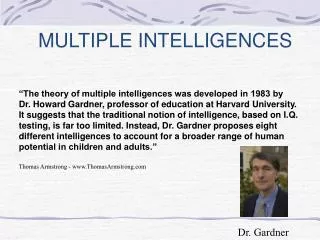
Multiple Intelligence Dr. Howard Gardner also the Professor of Education at Harvard University developed the theory of Multiple Intelligences in 1983 (Campbell 12). This principle is well known to most teachers. Although people disagree with his theory, Gardner believes that rather than a single intelligence, we acquire all seven intelligences in different amounts. All seven Gardner's intelligences should be incorporated in every lesson, to include; linguistic, logical–mathematical, body kinesthetic, spatial, musical, interpersonal, and intrapersonal. Howard Gardner defines intelligences as "the biopsychological potential to process information that can be activated in a cultural setting to solve problems or create products that are of value in a culture"...show more content... Musical intelligence encompasses the capability to recognize and compose musical pitches, tones, and rhythms. (Auditory functions are required for a person to develop this intelligence in relation to pitch and tone, but it is not needed for the knowledge of rhythm) (Helding). Characteristics of musical intelligence are remembering melodies, listening to music, and keeping the beat. Dancers, musicians, and musical composers show high levels of musical intelligence. Children with musical intelligence can easily convey their emotions through music. This intelligence is usually seen at an early age. Individual differences between those with musical intelligence and those without are apparent from the day a child learns to sing (Gardner 16). These students are usually able to read music, to critique performances, and to use musical–critical categories (Steenhagen). Interpersonal intelligence consists of the ability to understand, perceive, and discriminate between people's moods, feelings, motives, and intelligences (Gardner 17). Students with interpersonal intelligence choose professions such as teaching, politics, sales, therapist, and counselor (Steenhagen). These children grow up to be skilled parents. Children with this intelligence enjoy cooperative games, understand the feelings of others, have many friends, and prefer group work. Intrapersonal intelligence is the Get more content on HelpWriting.net
Reflection Paper On Multiple Intelligence I got so excited when I started reading chapter two, because one of the first topics it talks about is multiple intelligence. My first thought was finally they figured out that you can't fit all students into one category. That there is multiple categories and intelligences that determine the way students think and learn. Multiple intelligence is a theory brought about by Dr. Howard Gardner. It is the idea that intelligence is much more than just an IQ test and can and should be measured in different ways. Gardner talks about his multiple intelligences that he has come up with, there are eight different kinds of intelligence. Theirs logical–mathematical, linguistic, bodily–kinesthetic, musical, spatial, interpersonal, intrapersonal, and naturalist. I feel that multiple intelligence is important to me as a future educator because it helps me to one better understand that all children think and learn differently. It also helps me to now see that as a teacher I should have more diverse lesson plans because I will have students of many different intelligences. Another component of this chapter that I also found to be very important is where it talked about different learning styles. It also talked about different ways people respond to situations can show their locus of control. Locus of control is "attributing success or failure to external factors." Or "a sense that they control their fate"(pg 35) This section also talked about different learning styles one being physiological, different things that come up with this style is time of day a student will do the most work, if they are well fed, If they need to interact with materials through touch. Theirs also affective attitudes this is where the locus control came in and just seeing the difference in students that have a good confident attitude compared to students that don't so much. Then there is cognitive, which is information processing. This just shows the difference in organization, and retaining and using information. As a future educator, now knowing more about different learning styles this will help me to once again make more diverse lesson plans, and to also be more understanding if a student is having a rough time because the learning styles could Get more content on HelpWriting.net
personal names I fleetingly recall being in fourth grade and my teacher, Mr. Pox, was instructing us how to tell time. The feeling of trying to overcome this hurdle to recognize the "big hand" is for the minutes and the "little hand" correlates with the hours, was such a great feat for a fourth grader. At the time, that felt like such an accomplishment yet there would be many more and greater to come. According to Howard Gardner's theory of multiple intelligences in his essay "A Rounded Version: Theory of Multiple Intelligences," he contends that we have more intelligence than what a test could prove because we all each excel in different areas of life (Gardner and...show more content... Listening to the other ideas instead of just my own, taught me to compromise. This was a way to work well with people and get things done quickly to get the best grade I wanted. In school I have seen students who are timid than most and feel awkward working with people. They work better by viewing things alone allowing them to excel in individual assignments. They display an Intrapersonal Intelligence guiding them to be self–sufficient. They have a greater sense of their self enabling them to utilize that knowledge. Learning your own self could be said to help you work with others but it helps to look from your own feeling and notice others around you. People get farther working with others than always working alone. Linguistic intelligence is not only the ability to make a proper sentence with error free grammar, but it includes the expertise to formulate words that convey a clear and thoughtful message. Learning a language is a highly sought linguistic intelligence and some might even say very necessary. I have, not mastered yet, learned three languages; Swahili, English and Spanish are in order of what I have been taught first in my life. Mastering these three languages is a long journey far from over. Sometimes in my Spanish class, I feel that I will never learn all of the language in time or be secure when I speak it. I remind myself, though, that there are many words in English that I still have not encountered yet in my life and Get more content on HelpWriting.net
Conclusion Summary Based on the research of intelligence stated in this paper, particularly Howard Gardner's, Theory of multiple intelligences, leads me to the conclusion that Intelligence does need to have its own classification as a characteristic trait. There are far too many levels and complexities of intelligence for it to be grouped within other categories of characteristic traits. Its manifestations are vast, applying to many different characteristic behaviors, not just those described in openness to experience where it is currently categorized. My personal experience confirms many of these different characteristics. Introduction This paper will look at research that has been conducted in the field of intelligence, as it pertains to personality psychology, in an attempt to answer the question: Is intelligence a separate personality trait? Intelligence There are many definitions for the term intelligence several of these are as follows: A term usually refering to a general mental capability to reason, solve problems, think abstractly, learn and understand new material, and profit from past experience. Intelligence can be measured by many different kinds of tasks. Likewise, this ability is expressed in many aspects of a person's life. Intelligence draws on a variety of mental processes, including memory, learning, perception, decision–making, thinking, and reasoning. ("Intelligence," MicrosoftВ® EncartaВ® Online Encyclopedia 2006); (1) the ability to learn or Get more content on HelpWriting.net
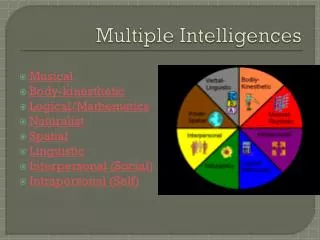
Gardner's Theory of Multiple Intelligences Essay In 1983 an American developmental psychologist, Dr. Howard Gardner, at Harvard University released a document that outlined his theory about multiple intelligences. He believes that everyone has eight different intelligences that, those being linguistic intelligence, logical–mathematical intelligence, musical intelligence, bodily–kinesthetic intelligence, spatial intelligence, interpersonal intelligence, intrapersonal intelligence and naturalist intelligence, with the last one being added later in 1999. Even though everyone has each of these intelligences his theory advises that everyone exceeds or are more attuned more to certain ones than other, but through a long processing of learning we can exceed at any intelligence we choose. In...show more content... They would be more attuned to musical pitches and rhythms. Obviously a person that excelled in this intelligence would be employed in a job as a musician or musical producer. In bodily–kinesthetic intelligence the person would be use the whole body or part of their body to solve problems and would possess the mental ability to coordinate the body's movements. Someone that possessed these abilities would most likely be a professional athlete or dancer and would use the body and coordination to excel in which ever sport they have chosen. In spatial intelligence the person would be able to recognize and use patterns of wide space and more confined areas. I think a person that excelled in this intelligence would be employed as an interior designer or an architect. This person would use their eyes to see the patterns and their brain to create those types of designs. In interpersonal intelligence the person would have the ability to understand the intentions, motivations, and desires of other people. These skills would allow them to effectively work with other people. This is an intelligence that everyone should work toward being better at to effectively communicate with coworkers, friends, or classmates. Someone that excelled in this intelligence would be employed as a teacher, politician, or a salesperson. They would have to use many different parts of their body to communicate well through speech and bodily language. In intrapersonal intelligence the Get more content on HelpWriting.net
To start off with Intelligence is defined as your capacity for learning, understanding for learning, and gathering or distribution of information. Howard Gardner's Theory is based on eight unique theories of how we learn or think. The multiple intelligences are visual–spatial, bodily–kinesthetic, musical, interpersonal, intrapersonal, linguistic, naturalistic, and logical–mathematical. The way we learn or the way that works the best for you to understand the information that is given to you. He believed that we are all possess all eight intelligences although we may tend to favor one or two more than the rest, we also may grow and recede throughout our life. Many self–assessment questionnaires are based on this theory. They are known as VAK or VARK questionnaires. Most assesses 3 or 4 out of the 8 learning preferences. (Visual, Auditory, Read /Write.) The MI assessment uses all 8 of the learning preferences. Here is a link to an assessment: http://literacynet.org/mi/assessment /findyourstrengths.html As the 8 theories each one can tell someone how they may learn or understand things. So, let's look at them and what they mean. Verbal–Linguistic remembering teams easily, mastering foreign language, convince or believe something. Making up some way such as a story or poetry as a way of remembering/ learning. Musical–Rhythmic sensing tonal qualities being sensitive to sounds rhythms, understanding of musical patterns to hear music. They often learn with sounds going on in the Get more content on HelpWriting.net
Multiple Intelligences Research Paper Multiple Intelligences (M.I) was a theory Howard Gardner developed in 1983. This is a theory of intelligences were a good way to explain the different ways that people learn. This theory explains how people learn and others learn in different ways. Intelligence is the ability to understand, learn and problem solve or creativity that are valued within one or more cultural settings". Gardner found that there are eight intelligences and could possibly be more. Howard Gardner attended the University of Harvard, he was originally going to study history. After he attended a year at London school of economics. He started Harvard's developmental psychology doctoral program in 1966 and became part of the Project Zero research team (a long–term study of human intellectual and creative development). His interest in human cognition was influenced by his tutor Erik Erikson. (Butler–Bowdon, 50 Psychology Classics, November 16, 2006) Through his research, he found that there are eight different intelligences or ways in which people learn. Gardner is currently Hobbs professor of cognition, co– director of Harvard's Project Zero. He has received many honorary awards and...show more content... Intelligence includes the ability to verbalize and express our thoughts in intelligible ways. We can do this by using words and numbers, we can also visualize, and we can think in sound and movement. Intelligence also can engage successfully with the practical challenges of the living world. There are eight multiple intelligences linguistic, logical–mathematical, musical, bodily kinesthetic, visual–spatial, interpersonal, intrapersonal and naturalistic these explain the many ways people can learn. Learning styles refer to personality characteristics that are evident in the process of Get more content on HelpWriting.net
Howard Gardner's Theory Of Multiple Intelligences Gardner's Multiple Intelligences. A human's capacity to learn new skills has been researched and studied over the years. Everyone is unique and therefore hard to put into one simple category. Gardner's theory of Multiple Intelligences is one example of the possible ways a human can learn and comprehend their world. In his theory, Gardner has described 8 different capacities of learning ability. In applying his theory, personalized education could be created to tailor to everyone's needs. Howard Gardner proposed the theory of multiple intelligences in 1983, a way to explain and understand human intelligence. The theory shows the many ways one can process, learn, and remember information. Gardner states there are eight types of intelligences...show more content... Bodily intelligences tend to become dancers, builders, or actors. Linguistic–verbal intelligence is the ability to use words well. These individuals are good at memorizing written and spoken information, great at persuasive speeches, and great storytellers. Career choices are usually writer, lawyer, or teacher. Musical learners can think in rhythm and sounds. They appreciate music and tend to enjoy singing or playing instruments. They become musicians, composter, singers, or conductors. The naturalistic find patterns and relationships to nature. This intelligence is a more recent addition to Gardner's theory. Those who are strong in this area are highly aware of changes in their environments. They enjoy the outdoors and would enjoy being a biologist, gardener, or farmer. Logical–mathematical thinkers analyze complex problems. They would thrive as scientist, mathematicians, engineers, or accountants because of their ability to conduct experiments, solve problems, and understand numbers. Gardner states that educational methods should be created and adjusted to be more flexible for students and using the theory of multiple intelligences, benefits would be seen for students, teachers, and society. Gardner also suggests that all intelligences are needed to productively function in society. He also believes that IQ tests cannot fully test a person's intelligence. Using Gardner's theory, teachers could provide different methods of teaching that could be Get more content on HelpWriting.net
Originally when Howard Gardner, a psychologist and professor at Harvard University, developed the multiple intelligence theory in 1983 he had no intention of it being used in the classroom setting (Gardner, 2011). However, this did not stop educators based all over the world from using the theory to help students take control of their learning and better understand their minds. Gardner even came to almost fully accept and support educator's use of his theory. Gardner stated that "Only once did I openly condemn an application of the theory. In the early 1990s, I learned from a colleague about an MI–inspired educational approach in Australia. No doubt well motivated, this approach went way too far and violated both scientific and ethical boundaries (Gardner 2011)." This theory is based on the idea that a person is not limited to one area of intelligence outright. The definition of "intelligence" is as follows, "Ability or abilities to acquire and use knowledge for solving problems and adapting to the world" (Woolfolk, 2004, 107). Intelligence is something that is often measured by tests, such as the IQ test or standardized tests. Multiple intelligences are not something that are tested for. They are experienced, witnessed in real life situations. A person cannot, and should not be defined by a single aspect, such as their intelligence; this is where the idea of multiple intelligences comes in. With the theory of multiple intelligences, people can possess different levels of Get more content on HelpWriting.net
What Is Multiple Intelligence Summary Multiple Intelligences Summarized and Reviewed by Maryam Tello What is intelligence? This question has been asked for centuries, however, the general meaning of intelligence is the ability to acquire and apply skills and the tools which was traditionally used to measure intelligence. The IQ test measures a person's intelligence by calculating the ratio of a person's mental age to their chronological age and multiplying it by a 100. This test has been historically used to estimate who will succeed in life and who won't, and in my opinion, the general definition of intelligence goes hand in hand with this, because to achieve traditional success one must have the ability to acquire and apply skills. But why does our definition of intelligence even matter? It's because along with this one ...show more content... A traditional school (the author has labeled these kind of schools "uniform schools") teach the basic set of facts that everyone should know, however, these types of schools only work for a certain kind of mind (labeled the IQ mind.) while the rest of us aren't that compatible with it, therefore the author has created the "Theory Of Multiple Intelligences. a theory that introduces a pluralistic view of the mind, one that acknowledges and recognizes different types of intelligences. The author believes that all individuals possess, to some extent, a set of cognitive abilities and skills (aka intelligences.) however, all individuals differ in the degree and combinations of skills, I believe that this theory is necessary because it introduces a more humane version of education that works for everyone, and the belief that people learn in different ways. In the following section I will be introducing the intelligences that were proposed in the early 1980s (by Howard Gardner),
Multiple Intelligence Self Assessment After taking the Multiple Intelligences Self–Assessment quiz, I discovered my top three results were interpersonal with 81%, intrapersonal with 75% and linguistic with 67%. The naturally occurring characteristics associated with these intelligences are vital to be an excellent physical therapist. Individuals with a high interpersonal intelligence have a strong comprehension of social interactions and are able to empathize well with others. Empathy is a mutual understanding between the patient and practitioner. By demonstrating empathy for their patients, PTs can build strong patient–therapist relationships, ease apprehension and increase patient satisfaction. In addition to possessing interpersonal skills, excellent PTs must also have strong Get more content on HelpWriting.net
Multiple Intelligence Multiple Intelligence–Final Essay Outline Everybody learns differently: Slow/fast In groups with other people At once/repeatedly Howard Gardner's multiple intelligences Linguistic Like to do Good at... Learn best by... Logical & Mathematical Visual & Spatial Musical Bodily & Kinesthetic Interpersonal Intrapersonal Naturalist Learning Profiles My profile My age/country profile Summary and resources Multiple Intelligence Final Essay As human beings we all learn differently. Some people learn fast while others learn slowly. Others can only learn when they are in groups...show more content... They may also show the ability to empathize and understand other people. These learners have lots of friends and they enjoy talking to people. They join many groups. They are very good at understanding people, communicating and leading others, organizing events, manipulation and mediating conflicts. The best way for them to learn is by sharing, comparing, relating, cooperating, interviewing with people. They are called, "The Socializer". Intrapersonal intelligence involves the ability to reflect, analyze, and contemplate problems independently. A person may look upon himself or herself to assess one's own feelings and motivations. Intrapersonal learners like to work alone. They prefer to pursue their own interests. They are good at understanding themselves. They can focus clearly on their feelings and dreams. They follow their instincts and stay original. The best way for them to learn is by working alone, doing individual projects and self–paced instruction. They are called, "The Individual". Naturalistic Intelligence has to do with the ability to make distinctions in the natural world and the environment. Naturalistic learners like to go outdoors. They enjoy observing natural occurrence, being with animals and collecting natural objects. They are good at categorizing things from the natural world. They are also skilled in using sensory skills, noticing environment, learning about objects and species of natural world. Get more content on HelpWriting.net
Learning Styles And Multiple Intelligences Essay The effect of applying multiple intelligences and learning styles are theories that have been discussed heatedly in educational circles. Firstly, I'm going to introduce two of the learning styles. Kolb's learning style model has settled on four styles: Accommodators: risk–takers who like to involve and try new things; Convergers: problem–solvers who enjoy organizing and hands–on application; Assimilators: passionate readers who learn well with reading and concepts patiently; Divergers: reflective learners who are environment–oriented and human–oriented. (Lowy&Hood, 2004, p.268) Silver's (1997, p.22–23) model also have four dimensions: Self–expressive: learners who use feelings and emotions to create primitive ideas; Mastery: learners who organize materials sequentially and in a solid way; Understanding: learners studying based on logical thinking and reasoning; Interpersonal: learners who socially and interactively process knowledge. The extinction between learning styles and multiple intelligences is the different focus. From the two examples of learning styles above, we can be aware of that learning styles stress on people addressing the problems and finding out the solutions initiatively and internally. For example, for a student who judge something in behalf of helping others, he is possibly an interpersonal style learner. However, multiple intelligences underline the influence of cultural and external effect on our human abilities. For a student who is good at telling Get more content on HelpWriting.net