Understanding Significant Figures in Scientific Notation
Learn about scientific notation, significant figures, and their application in calculations involving atoms, measurements, and operations. Enhance your precision and accuracy skills in science.


Understanding Significant Figures in Scientific Notation
E N D
Presentation Transcript
Significant Figures Unit 1 Presentation 3
The number of atoms in 12 g of carbon: 602,200,000,000,000,000,000,000 The mass of a single carbon atom in grams: 0.0000000000000000000000199 Scientific Notation 6.022 x 10²³ 1.99 x 10-23 N x 10n N is a number between 1 and 10 n is a positive or negative integer
move decimal left move decimal right Scientific Notation 568.762 0.00000772 n > 0 n < 0 568.762 = 5.68762 x 10² 0.00000772 = 7.72 x 10⁻⁶ Addition or Subtraction • Write each quantity with the same exponent n • Combine N1 and N2 • The exponent, n, remains the same 4.31 x 10⁴ + 3.9 x 103 =
Scientific Notation Multiplication (4.0 x 10-5) x (7.0 x 103) = • Multiply N1 and N2 • Add exponents n1and n2 Division 8.5 x 10⁴÷ 5.0 x 109 = • Divide N1 and N2 • Subtract exponents n1and n2
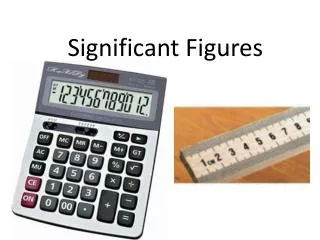
1 2 3 4 5 Significant figures (sig figs) • How many numbers in a measurement mean something • When we measure something, we can (and do) always estimate between the smallest marks.
Significant figures (sig figs) • The more marks the better we can estimate. • Scientists understand that the last number measured is actually an estimate 1 2 3 4 5
Sig Figs • What is the smallest mark on the ruler that measures 142.15 cm? • 142 cm? • 140 cm? • Here there’s a problem: Does the zero count or not? • Scientists needed a set of rules to decide which zeroes count. • All other numbers always count
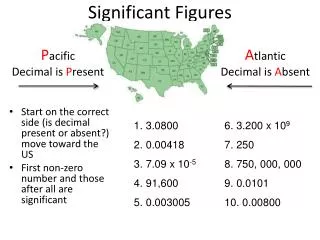
Which zeros count? • Leading zeros never count • 0.045 • Trapped zeros always count • 100365405.057 • Trailing zeros only count if there is a decimal place present • 12400 Here the zeroes do NOT count • 12400. Here the zeroes DO count
Sig Figs • Only measurements have sig figs. • Counted numbers are always exact • A dozen is exactly 12 • A a piece of paper is measured 11 inches tall. • Being able to locate, and count significant figures is an important skill.
Sig figs. • Count the sig figs and the number of significant zeros in the following numbers • 458 g • 4085 g • 4850 g • 0.0485 g • 0.004085 g • 40.004085 g
Adding and subtracting with significant figures • The last significant figure in a measurement is an estimate. • Your answer can not be better (more precise) than your worst (least-precise) estimate. • You have to round it to the least place of precision of the measurement in the problem
27.93 + 6.4 27.93 27.93 + 6.4 6.4 For example • First line up the decimal places Then do the adding Find the estimated numbers in the problem 34.33 This answer must be rounded to the tenths place
Practice • 4.8 + 6.8765 • 520 + 94.98 • 0.0045 + 2.113 • 6.0 x 10² - 3.8 x 10³ • 5.4 - 3.28 • 6.7 - .542 • 500 -126 • 6.0 x 10⁻² - 3.8 x 10⁻³
Multiplication and Division • Rule is simpler • Answer will have the same number of sig figs as the value with the least number of sig figs in the problem • 3.6 x 653 = 2350.8 • 3.6 has 2 s.f. 653 has 3 s.f. • answer can only have 2 s.f. • 2400 • Note that there is NO decimal point present!
Multiplication and Division • Same rules for division • Lets do some practice. • 4.5 / 6.245 • 4.5 x 6.245 • 9.8764 x .043 • 3.876 / 1983 • 16547 / 714