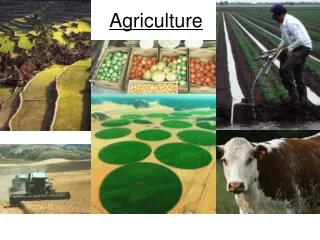
Agriculture
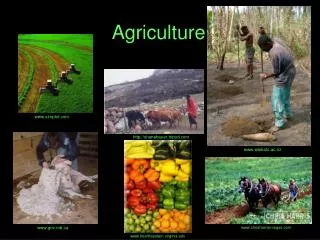
Agriculture has transformed human society through the deliberate modification of the Earth's surface for sustenance and economic gain. From the first agricultural revolution of domestication 10-12,000 years ago to the Green Revolution, agriculture's evolution reflects cultural, social, and economic changes. Key developments include the establishment of settlements, social stratification, labor division, and wealth accumulation. Modern challenges such as food distribution, political instability, and environmental degradation continue to shape agriculture today, particularly in lesser-developed countries (LDCs) and among mixed crop and livestock farming practices.

Agriculture
E N D
Presentation Transcript
Agriculture • Define- Deliberate modification of Earth’s surface through the cultivation of plants and rearing of animals to obtain sustenance or economic gain
II. First agriculture revolution • Hunters and gatherers • 1st agricultural revolution – domestication (10-12,000 years ago) • Animals – evidence, purpose Domesticated after plants
D. Hearth areas 1. Vegetative Southeast Asia, West Africa South America 2. Seeds India / Fertile Crescent East China, Mesoamerica
III. Impact of domestication • Social • 1. Settlements • Social stratification • social evolution • 3. Writing • B. Economic • 1. Division of labor • Accumulation of material goods (wealth) • Wealth = need for security, army
Demographic • Population growth • Sanitation • Epidemics (proximity) • Diet • D. Environmental - • Deforestation • Desertification, salinization • More hours of labor
III. Second agricultural revolution III. Second agricultural revolution • IV. Second agricultural revolution • When • Climate • C. Innovations- techniques, technologies • D. Hearth area, diffusion • E. Impact D New techniques New technologies C. Hearth area, diffusion D. Impact
V. Third - "Green Revolution" A. When B. Innovations C. Diffusion C. Impact - Moral economy
VI. Agriculture in LDCs A. Shifting agr (swidden, slash and burn) B. Pastoral nomadism • Intensive subsistence agr (rice) mulberry, fish, rice system D. Plantations
Labor Force in Agriculture, 2005 Fig. 10-3: A large proportion of workers in most LDCs are in agriculture, while only a small percentage of workers in MDCs are engaged in agriculture.
VII. Agr in MDCs • Mixed crop and livestock • Dairy farming C. Grain farming D. Livestock ranching
World Corn Production, 2005 Fig. 10-7: The U.S. accounts for about 40% of world corn (maize) production. China is the 2nd largest producer. Much of the corn in both countries is used for animal feed.
VIII. Von Thunen Isolated State Model • distance and transport costs • Assumptions • Concentric zones • 1. • 2. • 3. • 4.
IX. Global food supply • A. Distribution • Actual v. relative scarcity • B. International policies • Agricultural monopolies • Biofuels • Political instability • Urbanization • Environmental issues • D. Local instability
Undernourished Proportion Fig. 10-16: The proportion of under-nourished population has declined in most LDCs, but is much higher in sub-Saharan Africa than in other areas of the world.
Farmland Loss in Maryland Fig. 10-1.1: Overlaps of soil quality, environmental & cultural features, and population growth may show areas of greatest threat of farmland loss in Maryland.
http://www.washingtonpost.com/wp-dyn/content/article/2008/04/26/AR2008042602041_3.html?sid=ST2008042602333http://www.washingtonpost.com/wp-dyn/content/article/2008/04/26/AR2008042602041_3.html?sid=ST2008042602333