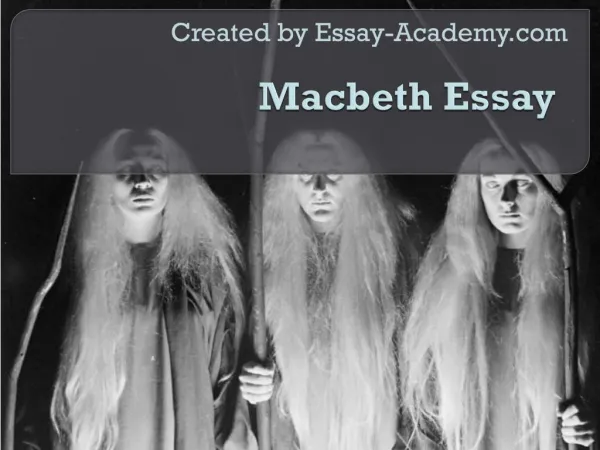
Macbeth Literary Essay
>>> How to write an essay? Order on the website: HelpWriting.Net

Macbeth Literary Essay
E N D
Presentation Transcript
Literary Devices In Macbeth Throughout history, writers have developed a plethora of literary devices. This allows them to essentially spice up their writing, or make it more interesting to the reader. One of the most commonly used and talked about literary devices is theme; theme is a specific idea or lesson that an author is trying to get across. Just a few examples are, ambition, guilt, things may not always be what they seem, or even nature verses the unnatural. In fact, these are common themes used by one of the greatest play writes of all time, Shakespeare. All throughout arguably his most renowned play, Macbeth, we see Shakespeare use each of the four previously listed themes. One of, if not the most common theme that is shown throughout Shakespeare 's...show more content... Also, ambition for a worthy cause is commendable. Along with ambition, guilt is another common theme seen throughout Macbeth. Almost all of the main characters are seen to have some sort of guilt during the course of the play, but two stand out far beyond the rest. That is Macbeth and Lady Macbeth. Since they both were in on the conspiracy to kill King Duncan, they both share it as a heavy burden. They both seem to handle it in different ways however. Macbeth, being the one who has committed the actual murder or one of his close friends, is immediately shown to be full of regret as he states, "Wake Duncan with thy knocking. I would thou couldst"(2.2.75–76). Macbeth shows for a short time that he would go back and "wake," or revive King Duncan if he had the chance. We then see Macbeth start to become somewhat insane, being eaten away by the guilt of this murder. As for Lady Macbeth, she is guilty for a multitude of reasons. Along with Macbeth, Lady Macbeth does share the burden of killing King Duncan, but is also burdened by Macbeth 's growing reign of tyranny. As seen throughout the last few acts, Lady Macbeth is being eaten away by her guilt, feeling that this is all her fault. Right before the scene where Invernous, Macbeth 's castle, is stormed she her guilt drives her to end it all. She commits suicide right before Macbeth 's rule comes to a tragic end. I feel that Shakespeare has used the theme of ...Get more content on HelpWriting.Net...
Literary Analysis of Macbeth Essay Literary Analysis of Macbeth Having a lust for power can cause a loss in many things. It's as if you're in a win–lose situation. In this case, the play Macbeth written by Shakespeare has scholars sayings, "The lust for power by Macbeth and Lady Macbeth led to a loss of humanity." With that said, I totally agree with their view. Both Lady Macbeth and Macbeth went out of their way to even killing King Duncan and burdening the murder on his guardsmen. Even though that's a common human act, you just don't do something like that. It's just so wrong. The acts of both these people are very evil and violent, in which causes Macbeth to move from one act of endangerment to another just to protect himself from a great disaster which I likely...show more content... With the visit to King Duncan, the King announces that his son Malcolm will be heir to the throne. In Macbeth's mind, all he can think about is murdering the King and all that will come along with it. Macbeth sends a letter to his wife telling of all that has happened and to prepare for the King's visit. In order to keep the murder in her mind she doesn't want anything to get in her way, so she even goes to the point of seeking evil and not wanting to be a women–afraid of the feminine ways which will interfere in the murder. When Lady Macbeth says, "Come, you spirits/ That tend on mortal thoughts, unsex me here, / And fill me, from the crown to the toe, top–full/ Of direst cruelty! Make thick my blood; (I v ll. 44–47) it shows how far Lady Macbeth is willing to go to make sure her husband and herself gets to the top. She even goes to the point to call upon the spirits to unsex her and fill her with cruelty to make sure that here feminine ways don't cause the plan to go wrong. A huge act of lusting for power taking place which led to a loss of humanity was when the killing of King Duncan actually took place. The way he died was very unfortunate for Scotland but at least he died without torture. Lady Macbeth's plan was to get King Duncan's guardsmen drunk in which she did. That then led to an open path to walk in and carry out the murder of the King. However, a weakness rose for Lady Macbeth; the resemblance of her father was seen in the King and led her to ...Get more content on HelpWriting.Net...
Macbeth Literary Critic Essay The definition of a tragic hero, as stated on dictionary.com, is a literary character that makes an error in judgment that, combined with fate and external forces, brings on a tragedy. It has been argued for years whether Macbeth from Shakespeare's, The Tragedy of Macbeth, can truly be considered a tragic hero or whether he is solely a villainous tyrant. Although there are some valid arguments for the Macbeth is pure evil viewpoint, by looking at Macbeth in a holistic way you can see the tragic, the heroic, and the tragic hero within him. Macbeth is a tragic hero in every sense of the definition. Macbeth would not be the best first choice of literary character to use as an example of a hero. He is a hero in the beginning of the play and...show more content... This is Macbeth's tragic flaw, he is so worried about what Lady Macbeth thinks of him and wants so badly to please her, because he loves her endlessly, that he is willing to do whatever she says. As Shanley points out, "She [Lady Macbeth] could sway him because she understood him and loved him, and because he loved her and depended on her love and good thoughts of him." affirming that Lady Macbeth was able to convince Macbeth to do anything (308). Lady Macbeth had a very powerful hold over Macbeth. Just by questioning his valor she could shift Macbeth's whole thought process and second–guessing of the murder of Duncan (Booth, 24), and he allows it because he cannot bear to disappoint her. His love for her and need for her approval is what ultimately leads him to commit each and every one of his crimes. She is the center of his world and if she does not see a problem in the murders than why should he. This is naïve ignorance caused by a blindness that is induced by love, and that is both heart breaking and tragic. It takes both the audience's pity and fear to make a tragic and heroic character become a tragic hero. Macbeth earns both. The audience can fear Macbeth because they know that he is capable of murder. He lacks the ability to stand up to Lady Macbeth when he knows something is not morally right and that is frightening, but even after all the pain and suffering of other characters the audience ...Get more content on HelpWriting.Net...
Macbeth Literary Analysis Authors often use different literary elements to create the tragic hero in their writings in a way to appeal to readers. In "Macbeth", William Shakespeare introduces Macbeth, who conflicts with himself and other characters to gain more power. He introduces Macbeth as a man with high hopes who's willing to sacrifice everything and kill due to his high ambition of control. Once told by wicked witches of his fate, he puts it into action and begins to murder victims to make it come true. In his play, Shakespeare uses the different literary element to develop the subject of Macbeth being a tragic hero. In "Macbeth", William Shakespeare uses tone to represent the significant actions that would arouse pity and fear that results in a catharsis of these...show more content... During a meeting with King Duncan, it is obvious he has more respect of Macbeth as a heroic warrior. In appreciation after battle, Duncan states to Macbeth, "Two truths are told, as a happy prologue to the swelling act of the imperial theme, I thank you gentleman"(l. vii, 130–132). Shakespeare uses dramatic irony to show Macbeth has fallen from a humble warrior now aspiring to be a king through murdering someone who admires him most. The audience notices this fall from greatness from an admired warrior for his country and now plans to kill the king for his own selfish reasons. During King Duncan's visit, Macbeth goes to kill him to take the crown. King Duncan is delusional as he states, "Only I have left to say, more is thy due than more than all can pay."( l.vii, 19–20) Shakespeare uses dramatic irony to show the obstruction of Macbeth's downfall as he betrays his king. Shakespeare shows Macbeth's vengeance character greatly throughout the play. Macbeth states to his murderers that "to be thus is nothing but to be safely thus our fears in Banquo stick deep, and in his royalty of nature reigns that which would be feared"(III. i, 49–52). Macbeth is plotting a murder against Banquo, he once only killed for the good of the country, now he had other people kill someone for vindictive reasons. This shows dramatic irony as the audience notices Macbeth's fall from greatness. At the beginning, he felt guilty for killing people for selfish reasons but now he is planning it with no ...Get more content on HelpWriting.Net...
Essay on Macbeth: Summary Macbeth: Summary Macbeth and Banquo, Scottish generals, are returning after crushing a rebellion against Duncan ( King of Scotland ), when they are met by three witches. The witches prophesy that Macbeth will become thane of Cawdor , then later on he will become King. Banquo is told that he will never become King, but will be the father of Kings. Macbeth is horrified, for shortly afterwards a messenger arrives to tell him that Duncan has created him Thane of Cawdor as a reward for his services. Macbeth writes the news to his wife. Lady Macbeth reads the letter from Macbeth, telling her of the prophecies. With reading this she chooses to invite evil spirits into her to take away her womanhood, she wants to lose her tenderness that is...show more content... After the Banquet when everyone goes off to bed, Macbeth murders Duncan. When finding out of the death, Duncan's two sons fled fearing for their lives, Malcolm headed towards England and Donabain to Ireland. Macbeth sends two murderers to kill Banquo, for he fears that the witches prophecies about Banquo will come true too. Macbeth is scared and confused at the second Banquet celebrating the coronation, for he sees the ghost of Banquo sitting in his seat, everyone thinks he is mad, though Lady Macbeth saves her husband from revealing her guilt to the guests. Macbeth goes and visits the witches again asking for another prophecy and they tell him three things. (1) to beware Macduff, (2) not to fear any man born of women, (3) that he will not die unless Birnam Wood moves towards Dunsaine Castle. Macbeth is later informed that Macduff has gone to England, so he then plans to kill all of Macduff's family. Macduffs family are murdered, Macduff hears of the terrible news and plans revenge against Macbeth. The Scottish contingent are marching to meet the English forces led by Malcolm and Macduff, to make their attack on Macbeth. Macbeth learns that there are ten thousand soldiers after him and that his wife had died ( or killed herself ). The English army arrives at Birnam Wood and Malcolm instructs each solider to cut down a branch and carry it in front of them to disguise their approach. A servant tells Macbeth that ...Get more content on HelpWriting.Net...
There have been thousands of British Literature books, stories, epics, and poems written throughout history. All of the stories are unique, much like their authors, and even their surrounding history. Macbeth is a tragedy written by William Shakespeare in 1604; Sir Gawain and the Green Knight was written in the 1300's by an unknown author. The following essay is going to compare and contrast the two stories mentioned above based on historical setting, cultural context, literary styles, and the aesthetic principles of the period in which they were written. Sir Gawain and the Green Knight were written in the late 14th century (1300's) in Northwestern England. During this time, King Arthur was in reign. The story imitates ideology of English Chivalry and how chivalry works in the knighthood, as well as King Arthur's court. Macbeth was written nearly after King James of Scotland took the English throne. The English didn't know much about the Scottish, which brought them into the limelight. During his reign, there was a large amount of political and religious conflict, and the danger of the possible regicide. This historical background could have inspired Shakespeare while writing Macbeth, seeing that the story does contain what seems to be regicide. Although both pieces are somewhat political in nature, they were not intended to change the views of their readers, but to express their own thoughts and opinions on the matter. In Sir Gawain, the concept of chivalry originates from ...Get more content on HelpWriting.Net...
William Shakespeare 's ' Macbeth ' Essay Macbeth English Characters Macbeth Macbeth is a Scottish general and at the beginning of the play he is the thane of Glamis. After three witches tell Macbeth a prophecy of him becoming the king of Scotland he acquires wicked thoughts and ideas. It gets worse after the prophecy of him becoming the thane of Cawdor comes true. Macbeth is a very brave and confident man on the battlefield although he is not as well suited for politics because he lacks the skills necessary to rule without being a tyrant. After his first crim of killing Duncan, all other crimes after that become increasingly easier to do. Lady Macbeth Macbeth 's wife. Lady Macbeth is known in the play as being the ambitious one that wants more, she wants power. Early in the play she asks the murdering ministers to make her more 'evil '. After this point she is having frequent talks to Macbeth about murdering Duncan, questioning his manhood and other very persuasive techniques. The Three Witches The three witches are the first people introduced into this play, the first impressions of the witches are very spooky and mysterious as they are introduced along with thunder and lightning. They prophesise that Macbeth will be the thane of Cawdor and then eventually the king and one of Banquo 's two sons will be kings. (Spoiler alert) Macbeth becomes the thane of Cawdor and then the king, the future of Fleance (Banquo 's son) is unknown but it is thought that he will become the king. These witches are very scary and ...Get more content on HelpWriting.Net...
Macbeth Theme Essay The play, Macbeth, Macbeth and his wife kill the king of Scotland so Macbeth can become king. As a result, of the witches since they told him about the prophecy and how he would become king. He eventually does more evil things which fills Lady Macbeth with guilt. She ends up killing herself and Macbeth ends up dying. In the play, there are numerous of themes that you can see and examples that you can find. There are five themes that we have discussed in class which are ambition, guilt, things are not what they seem, fate versus free will, and nature versus the unnatural. One of the five themes in Macbeth that we discussed is ambition. I believe the meaning of ambition is the desire to do something whether it is bad or good. In addition, I...show more content... The killing of his family is his motivation for him to kill Macbeth because he wants to get revenge. Furthermore, ambition is desire of doing something that is good or bad like revenge. Also, when Malcolm heard what happened to Macduff's family and how Scotland has become after being ruled by Macbeth, it made him want to kill Macbeth. Another theme in Macbeth is guilt. I believe that guilt is feeling bad for something that you have done to someone or something. In addition, guilt can destroy you and/or eat at you. It could even drive you to do something like it did to Macduff. Macduff went to England and left his family behind so that he could get Malcolm to come back and be king. When he left to get Malcolm, Macbeth killed his entire family. He felt guilty for living his family alone in Scotland without protection. Similarly to ambition, his guilt drove him to kill Macbeth. Another example of guilt is Lady Macbeth sleeping walking towards the end of the play. Lady Macbeth and Macbeth killed the king of Scotland (Duncan) and she is feeling guilty for what she has done. Also, she doesn't like what her husband has done like killing Macduff's whole family. She feels as if she was responsible for that. In a result of that she ends up sleep walking and eventually killing herself because she couldn't live with the guilt anymore. The guilt of killing Duncan literally ate at Lady Macbeth and destroyed her to the point of suicide. Macbeth feels guilty for killing Duncan. ...Get more content on HelpWriting.Net...
Who Is Responsible For Macbeth's Downfall Lastly, as the story progress towards the end, Macbeth starts to realize he is losing the war between Scotland and England and Hank, Jacob get into a fight with the sheriff and a fake FBI agent, the brother of the dead pilot, who is here to take the $4.4 million. In the story of Macbeth, Macbeth is told by the witches that he cannot be hurt by anyone who is women–born, so Macbeth becomes overconfident. When the English army breaks into the Macbeth's castle, Macduff challenges him to a fight, Macbeth replies, "Yet I will try the last. Before my body/ I throw my warlike shield. Lay on, Macduff, And damned be him that first cries, "Hold, enough!""(V, viii, 37–39). Macduff challenges Macbeth to a duel, and they start fighting. Macbeth gets killed by Macduff, who is not a woman– born. Macbeth's desire for power causes him to do the most immoral acts involves murdering his own friend and his death becomes the outcome of his ambition. However, Macbeth did achieve his objective, which was to become the King of Scotland and attain the power. From Macbeth's perspective, he did find the right solution to his problem, but it did not last too long. As Macbeth's head hits the ground and rolls down the street, Hank and Jacob get into a fight with the sheriff...show more content... His action of stealing the money only drives him to a murderer, who killed his own brother, and the money does not benefit him in any way. Unlike Macbeth, where he attains the power he wanted and keeps the power for a period of time. However, Macbeth dies in the play, while Hank lives on with his family. Thus, the outcome of both of the character's problems causes them to face a series of consequences. However, Hank's desire for wealth causes him to face less consequences than what Macbeth's desire for power has caused him. Therefore, the desire for wealth and power can cause one to do immoral acts, but one must face a series of ...Get more content on HelpWriting.Net...
Literary Devices In Macbeth Words are powerful. They can express thoughts. They can manipulate. They can drive a man to commit murder. In Shakespeare's Macbeth, Lady Macbeth, through her eloquent diction and rhetoric, compels Macbeth to murder anyone in his way to becoming king. An idea that was once abstract and theoretical becomes a reality. Macbeth, upon returning from battle, encounters three witches. The first witch greets him as Thane of Glamis, a title he currently holds. The second witch greets him as Thane of Cawdor, and the third tells him that he will be king. Macbeth is confused as to how it is possible for him to be Thane of Cawdor and king, knowing that both titles are filled. It is not until Ross tells him that the current Thane of Cawdor is to be executed, that Macbeth considers the validity of the witches' prophecies. He questions his ability to become king, saying " If good, why do I yield to that suggestion whose horrid image doth unfix my hair and make my seated heart knock at my rubs, against the use of nature? Present fears are less than horrible imaginings" (Act 1, scene 3). He is unsure as to whether or not he is capable of killing to become king, to such an extent that the thought of doing anything repulses him. From what we know about Macbeth's character thus far, he is a valiant and honorable hero. When we are first introduced to Macbeth, it is during a conversation between Duncan and a sergeant. The sergeant, covered in blood after returning from battle, tells Duncan ...Get more content on HelpWriting.Net...
Macbeth Literary Essay: "Fair is foul and foul is fair" In the play Macbeth by William Shakespeare, the characters are often mislead by the impression of reality. The quote "fair is foul and foul is fair" (Shakespeare 1.1.12), is said by the three witches. This quote is very significant, as it is an elaborate theme throughout the play. Also, the word "fair" means good, and "foul" means evil. "Fair is foul and foul is fair" is a theme that demonstrates how appearances often differs from reality. This theme can also be described as "Illusion vs. Reality" because within the play, many are blinded by false accusations and have difficulty coming face–to– face with reality. This theme is greatly expressed through the characters Lady Macbeth,...show more content... She welcomes Duncan into her home, only to have him killed by Macbeth. This scene reveals her true personality, as she allows her ambition to take over. Therefore, the theme of "Illusion vs. Reality" is developed through Lady Macbeth's character as she convinces her husband to do wrong, by convincing him it is for his own benefit. She is also pretending to be a good hostess to the King, when in reality she is planning his death. Throughout the play, Macbeth's character is greatly influenced by others, which affect him in the long run. In the article Ambition by Stephen Fonash, it states: "struggling to press through the narrow way of ambition," usually in a desire for honor, popularity, and power. It is perhaps because of these very human qualities–to desire love, honor, knowledge, and power–that the theme of ambition has been so prevalent in literature" (Fonash 2010). This quote relates to Macbeth's character because he craves power and will go above and beyond to succeed. At the beginning of the play, King Duncan views Macbeth as a loyal and trustworthy individual. However, Macbeth allows his ambition to get the best of him and betrays Duncan by murdering him to steal the throne. This is a representation of the theme "Illusion vs. Reality", as it demonstrates Macbeth's unexpected foul behaviour. In the third act, Macbeth worries that Banquo is going to suspect Duncan's murder since he was present when Macbeth found out he is going to become King. Also, Macbeth ...Get more content on HelpWriting.Net...
Macbeth Literary Analysis Essay Macbeth by William Shakespeare This literary analysis is on the character Macbeth, and how much he has in common with Adolf Hitler. How Macbeth and Hitler got into power was similar. The Witches prothosed that Macbeth would be king, and he wanted the power and respect it would bring him. Macbeth murdered the king, so that he would be crowned king. Then he hired people to murder his good friend Banquo, he also want his son Fleance. After this happens Macbeth turns completely evil, his hunger for power and greed, greater than his conscience. Hitler is worse, as it doesn't appear that he ever had a conscience. Hitler won the role of Chancellor in 1933, which was second to only the president. Less than a month after he was elected the ...Get more content on HelpWriting.Net...
Character Analysis of Macbeth Essay "Macbeth" a tragedy written by William Shakespeare, portrays, how the main character Macbeth, transforms from a war hero, to a murdering villain. Macbeth starts out as the thane of Glamis and steadily rises to become King of Scotland. The higher Macbeth rose on his road of power the more corrupt and evil he became. The character change of Macbeth ignites the whole theme of the play. Macbeth is shown as a vigorous war hero in the opening scene. "And fortune, on his damned quarrel smiling showed like a rebel's whore. But all's too weak for brave Macbeth." (1.2 16.18) The captain expressing the braveness of great Macbeth in Scotland's battle with the invading Norway hordes. It didn't take long for the people of...show more content... Macbeth decides that he wont murder the king. Lady Macbeth's determination to become queen influences Macbeth's decision. "If it were done when tis done, then twere it be done quickly" (1.7 1–2) Macbeth is toying with the notion to murder King Duncan. Macbeth would not be satisfied until he ruled all Scotland! An idea turned into a priority, Macbeth wasn't thinking of killing the king he was sure of it. "Is this a dagger which I see before me, the handle toward my hand...."(2.1 42–43) Macbeth's vision turned out to be a false creation of the mind that led macbeth to believe that fate was telling him to kill King Duncan. Near the end of the play Macbeths true evilness comes out. Macbeth paranoia leads him to believe that everyone is out to get him. " So is he mine, and in such bloody distance that every minute of his thrusts against my hear'st life" (3.1 128–130) Macbeth grows suspicious of Banquo. The witch's predictions of Banquo's kids becoming king engulfed all thoughts in Macbeth's head. "I'll make assurance double sure." (4.1 93) Macbeth is making sure Banquo and his son fleance are murdered. Macbeth felt the it was best to hire murders to handle fleance and Banquo. Macbeth is overcome with evil. "From this moment the very firstling of my heart shall be the firstling of my mind" (4.1 165–168) Macbeth's mind no ...Get more content on HelpWriting.Net...
Language Techniques Used In Macbeth Shakespeare uses many language techniques, which tells us exactly what Macbeth, is thinking throughout this act. "Is this a dagger I see before me" – is rhetoric language, which emphasizes his amount of faith in himself. This is the first line of the poem and it shows us the mental state of Macbeth as he is slowly slipping into insanity. Rhetoric language Is language designed to have a persuasive or impressive effect? Art thou not, fatal vision, sensible to feeling as to sight? – This is also rhetoric language as Macbeth is addressing the dagger without saying the word dagger. The word Dagger is used throughout the poem. The dagger symbolizes blood and gore. Mine eyes are made the fools o' the other sense, This is a statement with two ...Get more content on HelpWriting.Net...
Themes in Macbeth Essay In William Shakespeare's play Macbeth evil is conveyed in many ways through characters, themes and settings. Many themes are explored in detail contributing hugely to the sense of evil with characters being used along with these themes to create evil within the characters. These themes and characters are shown in different settings at different times consequently affecting the mood and atmosphere of the play. In relation, Shakespeare uses characters in order to raise the appeal of themes being presented. A character which has the largest influence on the play is Macbeth. Macbeth is someone who is tortured by the pain of the words of those around him. Macbeth is influenced heavily by the three witches who prophesize that he is going to...show more content... She tells the sprits 'Come to my woman breasts/And take my milk for gall' so that she can get rid of all the kindness within her–blood and milk form her breasts– Shakespeare uses 'direst cruelty' to express the desperation running through Lady Macbeth and with this Shakespeare creates a very hell–like picture for the audience. However, eventually Lady Macbeth persuasion overcomes Macbeth and finally he agrees to kill Duncan. 'Let light not see my black and deep desires', this shows Macbeths ambitions are not of good intention and turns to the universe to express this ambition (about how great it is) It also shows that even though he wants to kill Duncan, the audience is still finding Macbeth arguing whether or not to do it. Shakespeare also uses alliteration to emphasize the amount evil involved in this deed. In relation, Shakespeare shows Macbeth willing to jump the hierarchy of position. 'We'd jump the life to come' show the willingness to jump the hierarchy, which instantly shows the relation to the archangel which went against God and the hierarchy of Heaven to create his own land of chaos which is better known as hell. Moreover, Lady Macbeth is shown with even more evil to represent her will for Macbeth to complete the deed, 'I have given suck and know how tender 'tis to love the babe that milks me: I would while it was smiling in my face, Have plucked my nipple from ...Get more content on HelpWriting.Net...
Literary Devices In Macbeth 1) "Fair is foul and foul is fair Hover through the fog and filthy air." (I,I, 11–12) This was spoken by the "weird sisters" or witches early in the play to set the tone of mystery, confusion and suspense. The lines are paradoxical; something which is fair or positive cannot (on the surface), be also foul or dirty. However, this play will show that this can be true, especially once we get to know Macbeth and see his own ulterior motives. Alliteration of the "F" sound is also apparent, making the lines more memorable and cacophonous. 2) "...For brave Macbeth – well he deserves that name – disdaining Fortune.../And fixed his head upon our battlements." (I,ii, 16–23) This was mentioned by the Captain in a conversation with...show more content... The witches see greatness in Macbeth and want everyone to praise him for his action. The lines contain anaphora because each sentence begins with"All hail Macbeth." By doing so, the author allows the lines to become more meaningful and memorable in the reader's mind. This serves as a foreshadow for a possible downfall because it seems that Macbeth enjoys having this power and hearing the witches say this about him only heightens his perspective about himself, but with great power comes great responsibility. 5) "Thou shalt get kings, though thou be none." (I, iii, 67) This was said by the third witch regarding Macbeth and Banquo. She is stating that Banquo's kids will be kings, but those of Macbeth, will not. Banquo, being a son of the King is one of the few who may challenge Macbeth's rise to power because Macbeth's kids will not have his same luck. This serves as a foreshadow because this statement may push Macbeth to eagerly and desperately go after the power he so much desires at all costs. 6) "Glamis, and Thane of Cawdor;/The greatest behind" (I, iii, 117–118) This is said by Macbeth because this is his new title. He was given the position "Thane of Cawdor" and admits that the "greatest" is "behind" meaning that there is no need to fear because he is rightfully the best fit for this position. This could foreshadow his tragic downfall later in the play because the witches were correct ...Get more content on HelpWriting.Net...
Literary Analysis Essay On Macbeth Literary Criticism: Macbeth Macbeth is a tragedy written by William Shakespeare in the year 1606 in England. Shakespeare wrote the play for James I, England's new king, as well as Scotland's prior king. In order to please him, Shakespeare set the play in Scotland. He also used many of James's ancestors and included a subject that James was interested in: Witches. Macbeth is Shakespeare's shortest play; many believe this is because James had a short attention span. Although Shakespeare happens to incredibly famous, little about his personal life is known. Macbeth happens to be a real person, a real king of Scotland during eleventh–century. He gained his inspiration for his character from the Chronicles of Holinshed. Although every detail many not be "historically" correct, it was used for many references. Macbeth is a dark relentless tale of a Scottish general who is war hero with a fatal flaw within himself. He isn't a "bad person" but someone who is too ambitious. King Duncan is the King of Scotland. The time period is the eleventh century (1000–1099). It's the story about the murder of the king, who happens to be his cousin, the revenge of the son Malcolm, three witches who plot against him, and Macbeth's rise and fall. I believe Macbeth is an interesting character to follow. We first meet him as a brave soldier, and later find him as a...show more content... Could she be deemed as the "fourth witch"? I believe so, in a metaphorical sense. She is utterly evil and ruthless. She intimidates and bullies Macbeth until she gets what she wants. She uses her femininity to get her way. In Act 1, Scene 5 she calls upon "spirits that tend or mortal thoughts" in order to get rid of all her humanity. I'm not sure what causes her to finally snap when she seems to have "everything figured out". We learn in Act 5, Scene 5 that this isn't so, when she becomes mentally unstable and confesses her "secrets" while ...Get more content on HelpWriting.Net...
William Shakespeare 's ' Macbeth ' Giantsopoulos 1 George Giantsopoulos ENG3UAAa Ms. Wong July 16, 2015 Macbeth Literary Essay In this 16th century, classic play about a man hungry for power by William Shakespeare there are many intense instances of symbolism used to demonstrate and prove Macbeth's feelings and behaviour throughout the book. Good symbolism makes you feel what the character feels when reading a story. In the story, "Macbeth", Macbeth is shown to be a sly and deceiving person who betrayed his kingdom for his own gain. Three important symbols used to show Macbeth 's greed and deceit are blood, animals, and children. They add description of emotions and events felt by the characters, especially Macbeth. Blood represents the guilt and the horror Macbeth cannot get rid of. Animal's represent the characters characteristics through the book. For example how a mule would represent someone who is stubborn. The children represent responsibility and what is to come. In this play the reappearing imagery of blood is used to show the emotion of guilt and horror Macbeth feels after he kills his king. Throughout this story the main character Macbeth's feelings were wisely shown throughout Shakespeare's play Macbeth. One case of where Macbeth is feeling guilty is right after he kills Duncan. "What hands are here? Ha! They pluck out mine eyes! Will all great Neptune's ocean wash this blood clean from my hand? No; this my hand will rather the multitudinous seas incarnadine, Making the green one ...Get more content on HelpWriting.Net...
Macbeth Literary Devices Shakespeare is well known for incorporating literary devices into his plays. In this speech made by Macbeth, one literary device that is present is an iambic pentameter. An iambic pentameter is a literary devices that involves the first five words of a line having unstressed syllables, then one stressed syllables. The total number of syllables in the line should equal to ten syllables. In Macbeth's speech about the fourth apparition, the iambic pentameter is when he said "Thy crown does sear mine eye–balls: / and thy hair" (4.1.113) which is a reference to Macbeth's reactions towards the kings. This iambic pentameter helps gives the audience a better understand and exaggeration of Macbeth's emotions. Macbeth feels weaken and horrified that ...Get more content on HelpWriting.Net...
Macbeth Literary Analysis An Analysis of Literary Versus Theatrical Elements in Shakespeare's Macbeth Over centuries, there have been numerous depictions of William Shakespeare's world famous plays. One being the most theatrically adapted dramatic productions' is the tragedy of Macbeth, written in the early 1600s. The play is based on the real Macbeth's immoral rise to power with added influence of three witches and hubris which leads to his ultimate downfall and death in the 11th century of Scotland. A recent adaptation of the play is Rupert Goold's film Macbeth. Unlike the original tragedy, the film makes many modifications while adding new elements that essentially Macbeth is left unaccounted for his decisions, thus making the audience feel less sympathetic toward...show more content... Goold's movie is set in 20th century Soviet Union, enhancing the theme of war, hence, reminding the audience of the horrific world wars of the era. Similarly, the original tragedy is set in Scotland 11th century which was a violent and troubled era of society, Ross described it mournfully '...poor country... it cannot be call'd our mother... where sighs and groans and shrieks that rend the air... where violent sorrow seems a modern ecstasy..."(IV.iii.186–192); yet, it compares nowhere near the atrocities of the 20th century and the aftermath of death camps and nuclear bombs. Accordingly Goold's tragic hero Macbeth mirrors Joseph Stalin, a dictator of Soviet Union who ruled by terror, which diminishes any consolation for Macbeth's actions. In addition this is deepened by the theme of the supernatural, the constant battle between fate and free will. In the original, the three witches only appear in four scenes and cease their role with "... this great king may kindly say our duties did his welcome pay" (IV.i.143–144), whereas Goold accentuates their role as nurses throughout the film. Macbeth would've won his battle against Macduff if it weren't for the sudden appearance of the witches. This exposes the fight between fate and free will, which Macbeth tied to his fate, yet is granted free will to ...Get more content on HelpWriting.Net...