An Overview of Animal Kingdom Phyla: Symmetry, Tissues, and Body Plans
This resource provides insights into the major phyla of the animal kingdom, focusing on their defining characteristics such as symmetry and tissue structure. It describes the differences between invertebrates and vertebrates, the evolutionary significance of bilateral and radial symmetry, and the presence of distinct body cavities. Additionally, it highlights the specialization of various animal tissues and their functions. Understanding these foundational elements is key to studying the diversity and adaptability of animals in the natural world.
An Overview of Animal Kingdom Phyla: Symmetry, Tissues, and Body Plans

E N D
Presentation Transcript
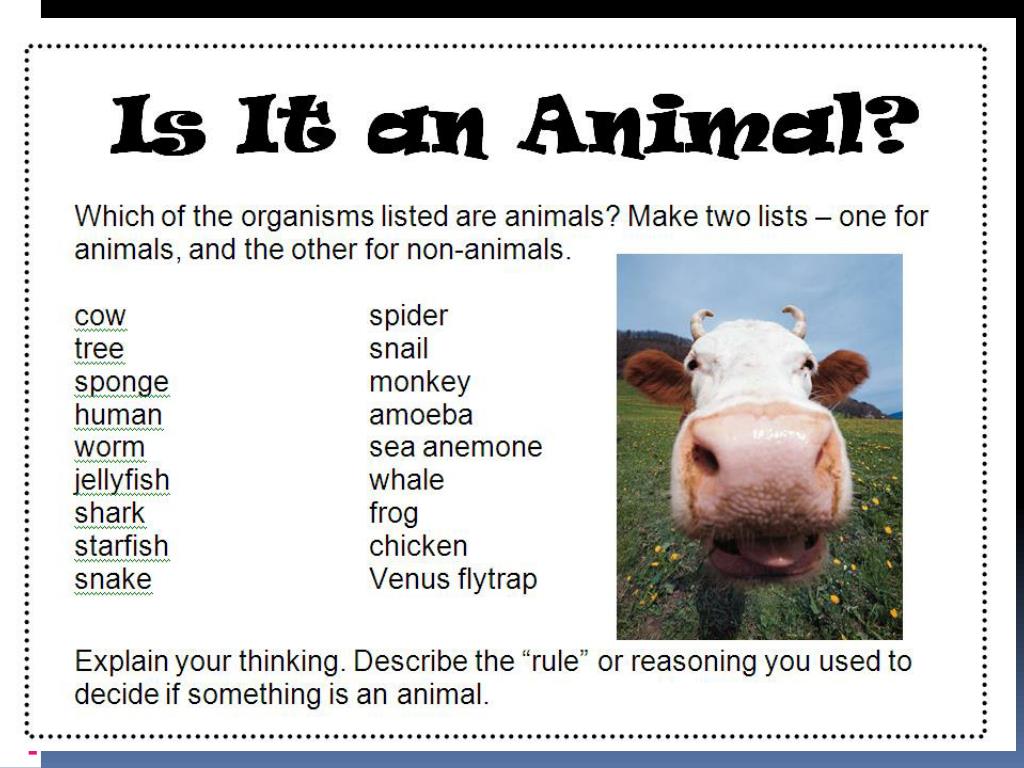
Animals • Heterotrophic • Multi-cellular • Move at some point • No cell walls • Mostly reproduce sexually • Rapidly respond to external stimuli
Most animals have tissues • Tissues are groups of similar cells that carry out a specific function (e.g., muscle) • Sponges are the only modern-day animals that lack tissues
Symmetry • Animals with tissues exhibit either radial or bilateral symmetry Bilateral symmetry Radial symmetry Asymmetry http://www.misterteacher.com/orange%20and%20black%20butterfly.jpg http://www.hope.edu/academic/art/past/VanderBurgh/mapleave.rose2.jpg http://daphne.palomar.edu/design/asymm/jd01asym.jpg
Symmetry • Radial symmetrical animals have two embryonic tissue (germ) layers • Ectoderm, which is an outer layer that covers the body, lines its inner cavities, and forms the nervous system • Endoderm, which is an inner layer that lines most hollow organs • Bilaterally symmetrical animals have three embryonic tissue (germ) layers • A layer of mesoderm between the ectoderm and endoderm forms muscles, and the circulatory and skeletal systems
Bilateral Symmetry • Bilaterally symmetrical animals have heads • Exhibit cephalization, the concentration of sensory organs and a brain in a well-defined head, with definite anterior (head) and posterior (which may feature a tail) regions
Body Symmetry and Cephalization central axis anterior plane of symmetry plane of symmetry posterior (a) Radial symmetry (b) Bilateral symmetry Fig. 23-2
Bilateral Symmetry • Most bilateral animals have body cavities • Fluid-filled cavities between the digestive tube and the outer body wall • Many functions • Can act as a skeleton, providing support for the body and a framework against which muscles can act • Can form a protective buffer between the internal organs and the outside world • Can allow organs to move independently of the body wall
Major Animal Phyla • Animals probably originated from ancestral colonial protists • Present day biologists recognize about 27 phyla of animals • Most animals are invertebrates • Less than 3% of all known animals are vertebrates
Animals • Can be invertebrates or vertebrates • What’s the difference? Invertebrates vs. Vertebrates * No vertebral column * Vertebral column * Often have exoskeletons * Endoskeletons
Invertebrates http://www.sunrise-divers.com/photos/day_trip/photos/nudibranch.jpg
PHYLUM PORIFERATHE SPONGES http://www.richard-seaman.com/Underwater/Belize/StillLifes/TubeSpongesThreeOrange.jpg
Cnidaria http://www.biology4kids.com/misc/photos/cnidaria1.jpg
Cnidaria– Polyp body form http://www.sydneyaquarium.com.au/Downloads/INT/Wallpaper_1024x768_WaratahAnemone.jpg
Platyhelminthes - flatworms Planaria http://www.luc.edu/faculty/jreymon/biolab/planaria.jpg
Marine Flatworms http://members.aol.com/uwphotohi/Images/flatworm.JPG http://www.crazyscuba.com/misc_images/RIMG0121FlatwormCrop.jpg
Nematoda - roundworms http://collections.ic.gc.ca/potato/scitech/nematodes.jpg
Nematoda:Heartworm http://www.greatlakesbcrescue.org/HealthNTraining/heartworms.JPG http://www.dukkha.org/images/heartworm.jpg
Mollusca http://www.wallpaperbase.com/wallpapers/animals/snail/snail_1.jpg http://students.umf.maine.edu/~hustontf/squid.jpg
Annelida – segmented worms http://www.abc.net.au/reslib/200704/r138958_475480.jpg http://www.york.ac.uk/org/ciec/CaringfortheEnvironment.29.4.03/Exxon/Food%20Chain%20images/ExxonPicsLarge/Earthworms.jpg
Bristle Worm http://i30.photobucket.com/albums/c317/greenbaja73/Bristle_worm.jpg
Arthropoda http://xyala.cap.ed.ac.uk/NeglectedGenomes/ARTHROPODA/images/AMC.jpg http://flatrock.org.nz/topics/animals/assets/black_widow_spider.jpg
Arthropoda - CLASS DIPLOPODA GIANT MILLIPEDE http://umdgrb.umd.edu/pretz/images/millipede8.jpg
Echinodermata http://brown.edu/Administration/News_Bureau/2006-07/06-052b.jpg
Echinodermata http://www.marietta.edu/~biol/biomes/images/shores/piaster_ochraceus_4740_A80_800.jpg
http://www.tankedup-imaging.com/images/prickly_red_sea_cucumber.jpghttp://www.tankedup-imaging.com/images/prickly_red_sea_cucumber.jpg http://animals.nationalgeographic.com/staticfiles/NGS/Shared/StaticFiles/animals/images/primary/sea-cucumber-ga.jpg Sea Cucumbers http://www.bubblevision.com/albums/burma-banks/images/sea-cucumber.jpg