Basics of Line Drawing Algorithms for Graphic Systems
Learn about the fundamental algorithms for drawing lines in graphics systems. Understand slope, intercept calculations, DDA and Bresenham's algorithms, advantages, and disadvantages. Ideal for beginners in computer graphics.

Basics of Line Drawing Algorithms for Graphic Systems
E N D
Presentation Transcript
OutPut Primitives By : Engr. Syed Atir Iftikhar Compile by : Engr. Syed Atir Iftikhar
Basic Graphics System Output device Input devices Image formed in FB [Edward Angel, Interactive computer Graphics, 2009] Compile by : Engr. Syed Atir Iftikhar
Raster Graphics Compile by : Engr. Syed Atir Iftikhar
Frame Buffer Compile by : Engr. Syed Atir Iftikhar
Frame Buffer Refresh • Refresh Rate • Usually 30~75 Hz Compile by : Engr. Syed Atir Iftikhar cgvr.korea.ac.kr
Color CRT Compile by : Engr. Syed Atir Iftikhar cgvr.korea.ac.kr
LINE-DRAWING ALGORITHMS Compile by : Engr. Syed Atir Iftikhar
LINE-DRAWING ALGORITHMS Compile by : Engr. Syed Atir Iftikhar
LINE-DRAWING ALGORITHMS • LINE-DRAWING ALGORITHMS • The Cartesian slope-intercept equation for a straight line is • y = m . x + b • with m representing the slope of the line and b as they intercept. Given that the two endpoints of a line segment are specified at positions (x1, y1,) and (x2 , y2), as shown in Fig. we can determine values for the slope m and y intercept b with the following calculations: Y2 Y1 Fig 3.3 x1x2 Compile by : Engr. Syed Atir Iftikhar
LINE-DRAWING ALGORITHMS • m = y2 – y1 eq 3.2 x2 – x1 • b = y1 – m . X1 eq 3.3 • Algorithms for displaying straight lines are based on the line equation(the dotted values) and the calculations is done by above formulas. • For any given x interval x along a line, we can compute the corresponding y interval y from Eq 3.2 as • y = m x Compile by : Engr. Syed Atir Iftikhar
LINE-DRAWING ALGORITHMS • Similarly, we can obtain the x interval x corresponding to a specified y as • x = y m • These equations form the basis for determining deflection voltages in analog devices. Compile by : Engr. Syed Atir Iftikhar
LINE-DRAWING ALGORITHMS • Numerical example of finding slope m: • (Ax, Ay) = (23, 41), (Bx, By) = (125, 96) Compile by : Engr. Syed Atir Iftikhar
Output Primitives • Points • Lines • DDA Algorithm • Bresenham’s Algorithm • Polygons • Scan-Line Polygon Fill • Inside-Outside Tests • Boundary-Fill Algorithm • Antialiasing Compile by : Engr. Syed Atir Iftikhar
Points • Single Coordinate Position • Set the bit value(color code) corresponding to a specified screen position within the frame buffer y setPixel (x, y) x Compile by : Engr. Syed Atir Iftikhar
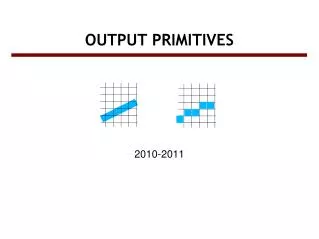
Lines • Intermediate Positions between Two Endpoints • DDA, Bresenham’s line algorithms Compile by : Engr. Syed Atir Iftikhar
DDA Algorithm • The digital differential analyzer (DDA) is a scan-conversion line algorithm based on calculating either y or x, • Case 1: • Consider first a line with positive slope, as shown in Fig. 3-3. If the slope is less than or equal to 1, we sample at unit x intervals ( x = 1) and compute each successive y value as Compile by : Engr. Syed Atir Iftikhar
y2 y1 x1 x2 DDA Algorithm • Digital Differential Analyzer • 0 < Slope <= 1 • Unit x interval = 1 • Subscript k takes integer values starting from 1, for the first point, and increases by 1 until the final endpoint is reached. Since m can be any real number between 0 and 1, the calculated y values must be rounded to the nearest integer. Equation 3.6 Compile by : Engr. Syed Atir Iftikhar
y2 y1 x1 x2 DDA Algorithm • Digital Differential Analyzer • 0 < Slope <= 1 • Unit x interval = 1 • Slope > 1 • Unit y interval = 1 • For lines with a positive slope greater than 1 we reverse the roles of x and y. That is, we sample at unit y intervals ( y = 1) and calculate each succeeding x value as Equation 3.7 Compile by : Engr. Syed Atir Iftikhar
y1 y2 x1 x2 DDA Algorithm • Digital Differential Analyzer • 0 < Slope <= 1 • Unit x interval = 1 • Slope > 1 • Unit y interval = 1 • -1 <= Slope < 0 • Unit x interval = -1 • Equations 3-6 and 3-7 are based on the assumption that lines are to be processed from the left endpointto the right endpoint (Fig. 3-3). If this processing is reversed,so that the starting endpoint is at the right, then either we have x = -1 Equation 3.8 Compile by : Engr. Syed Atir Iftikhar
y2 y1 x1 x2 DDA Algorithm • Digital Differential Analyzer • Slope >= 1 • Unit x interval = 1 • 0 < Slope < 1 • Unit y interval = 1 • -1 <= Slope < 0 • Unit x interval = -1 • Slope < -1 • Unit y interval = -1 or (when the slope is greater than 1) Equation 3.9 we have y = -1 with Compile by : Engr. Syed Atir Iftikhar
DDA Algorithm • Advantages • DDA algorithm is a faster method for calculating the pixel positions than the direct use of line equation. • It eliminates multiplication by making use of raster characteristics. Compile by : Engr. Syed Atir Iftikhar
DDA Algorithm • Disadvantages • DDA algorithm runs slowly because it requires real arithmetic (floating point operations) and rounding operations Compile by : Engr. Syed Atir Iftikhar
DDA versus Bresenham’s Algorithm The Bresenham line algorithm has the following advantages: • An fast incremental algorithm • Uses only integer calculations Comparing this to the DDA algorithm, DDA has the following problems: • Accumulation of round-off errors can make the pixelated line drift away from what was intended • The rounding operations and floating point arithmetic involved are time consuming Compile by : Engr. Syed Atir Iftikhar
Bresenham’s Line Algorithm • Midpoint Line Algorithm • Decision variable • d > 0 : choose NE • : dnew= dold+a+b • d <= 0 : choose E • : dnew= dold+a NE Q M P(xp, yp) E Compile by : Engr. Syed Atir Iftikhar
Bresenham’s Algorithm(cont.) • Initial Value of d • Update d Compile by : Engr. Syed Atir Iftikhar
Bresenham’s Algorithm(cont.) • BRESENHAM’S LINE DRAWING ALGORITHM(for |m| < 1.0) • Input the two line end-points, storing the left end-point in (x0, y0) • Plot the point (x0, y0) • Calculate the constants Δx, Δy, 2Δy, and (2Δy - 2Δx) and get the first value for the decision parameter as: • At each xk along the line, starting at k = 0, perform the following test. If pk < 0, the next point to plot is (xk+1, yk) and: Compile by : Engr. Syed Atir Iftikhar
Bresenham’s Algorithm(cont.) • Otherwise, the next point to plot is (xk+1, yk+1) and: • Repeat step 4 (Δx) times The algorithm and derivation above assumes slopes are less than 1. for other slopes we need to adjust the algorithm slightly. Compile by : Engr. Syed Atir Iftikhar
Adjustment For m>1, we will find whether we will increment x while incrementing y each time. After solving, the equation for decision parameter pk will be very similar, just the x and y in the equation will get interchanged. Compile by : Engr. Syed Atir Iftikhar
Bresenham’s Algorithm(cont.) • EXAMPLE : • To illustrate the algorithm, we digitize the line with endpoints (20, 10) and (30,18). This line has a slope of 0.8, with • x = 10 , y = 8 Compile by : Engr. Syed Atir Iftikhar
(30,18) (20,10) kpk (xk+1,yk+1) 0 6 (21,11) 1 2 (22,12) 2 -2 (23,12) 3 14 (24,13) 4 10 (25,14) 5 6 (26,15) 6 2 (27,16) 7 -2 (28,16) 8 14 (29,17) 9 10 (30,18) Example – Draw a line from (20,10) to (30,18) x = 10 y = 8 initial decision parameter has the value p0 = 2 y – x = 6 Increment for calculating successive decision parameter are 2 y = 16, 2 y – 2 x) = -4 Compile by : Engr. Syed Atir Iftikhar
Bresenham’s Algorithm(cont.) 20 , 10 If pk < 0, the next point to plot is (xk+1, yk) and: Compile by : Engr. Syed Atir Iftikhar
Bresenham’s Algorithm(cont.) • Go through the steps of the Bresenham line drawing algorithm for a line going from (21,12) to (29,16) Compile by : Engr. Syed Atir Iftikhar
Circle : • Drawing a circle on the screen is a little complex than drawing a line. There are two popular algorithms for generating a circle − Bresenham’s Algorithm and Midpoint Circle Algorithm. These algorithms are based on the idea of determining the subsequent points required to draw the circle. Let us discuss the algorithms in detail − • In computer graphics, the midpoint circle algorithm is an algorithm used to determine the points needed for rasterizing a circle. Bresenham's circle algorithm is derived from the midpoint circle algorithm. Compile by : Engr. Syed Atir Iftikhar
A Simple Circle Drawing Algorithm The equation for a circle is: where r is the radius of the circle So, we can write a simple circle drawing algorithm by solving the equation for y at unit x intervals using: Compile by : Engr. Syed Atir Iftikhar
A Simple Circle Drawing Algorithm (cont…) Compile by : Engr. Syed Atir Iftikhar
A Simple Circle Drawing Algorithm (cont…) However, unsurprisingly this is not a brilliant solution! Firstly, the resulting circle has large gaps where the slope approaches the vertical Secondly, the calculations are not very efficient • The square (multiply) operations • The square root operation – try really hard to avoid these! We need a more efficient, more accurate solution Compile by : Engr. Syed Atir Iftikhar
Polar coordinates X=r*cosθ+xc Y=r*sinθ+yc 0º≤θ≤360º Or 0 ≤ θ ≤6.28(2*π) Problem: • Deciding the increment in θ • Cos, sin calculations Compile by : Engr. Syed Atir Iftikhar
(-x, y) (x, y) (-y, x) (y, x) (-y, -x) (y, -x) (-x, -y) (x, -y) Eight-Way Symmetry The first thing we can notice to make our circle drawing algorithm more efficient is that circles centred at (0, 0) have eight-way symmetry Compile by : Engr. Syed Atir Iftikhar
Mid-Point Circle Algorithm Similarly to the case with lines, there is an incremental algorithm for drawing circles – the mid-point circle algorithm In the mid-point circle algorithm we use eight-way symmetry so only ever calculate the points for the top right eighth of a circle, and then use symmetry to get the rest of the points The mid-point circle algorithm was developed by Jack Bresenham, who we heard about earlier. Bresenham’s patent for the algorithm can be vied Compile by : Engr. Syed Atir Iftikhar
6 5 4 3 1 2 3 4 Mid-Point Circle Algorithm (cont…) Compile by : Engr. Syed Atir Iftikhar
6 M 5 4 3 1 2 3 4 Mid-Point Circle Algorithm (cont…) Compile by : Engr. Syed Atir Iftikhar
6 M 5 4 3 1 2 3 4 Mid-Point Circle Algorithm (cont…)
(xk+1, yk) (xk, yk) (xk+1, yk-1) Mid-Point Circle Algorithm (cont…) Assume that we have just plotted point (xk, yk) The next point is a choice between (xk+1, yk) and (xk+1, yk-1) We would like to choose the point that is nearest to the actual circle So how do we make this choice? Compile by : Engr. Syed Atir Iftikhar
Mid-Point Circle Algorithm (cont…) Let’s re-jig the equation of the circle slightly to give us: The equation evaluates as follows: By evaluating this function at the midpoint between the candidate pixels we can make our decision Compile by : Engr. Syed Atir Iftikhar
Mid-Point Circle Algorithm (cont…) Assuming we have just plotted the pixel at (xk,yk) so we need to choose between (xk+1,yk) and (xk+1,yk-1) Our decision variable can be defined as: If pk < 0 the midpoint is inside the circle and and the pixel at yk is closer to the circle Otherwise the midpoint is outside and yk-1 is closer Compile by : Engr. Syed Atir Iftikhar
Mid-Point Circle Algorithm (cont…) To ensure things are as efficient as possible we can do all of our calculations incrementally First consider: or: where yk+1 is either yk or yk-1 depending on the sign of pk Compile by : Engr. Syed Atir Iftikhar
Mid-Point Circle Algorithm (cont…) The first decision variable is given as: Then if pk < 0 then the next decision variable is given as: If pk > 0 then the decision variable is: Compile by : Engr. Syed Atir Iftikhar
The Mid-Point Circle Algorithm MID-POINT CIRCLE ALGORITHM • Input radius r and circle centre (xc, yc), then set the coordinates for the first point on the circumference of a circle centred on the origin as: • Calculate the initial value of the decision parameter as: • Starting with k = 0 at each position xk, perform the following test. If pk< 0, the next point along the circle centred on (0, 0) is (xk+1, yk) and: Compile by : Engr. Syed Atir Iftikhar
The Mid-Point Circle Algorithm (cont…) Otherwise the next point along the circle is (xk+1, yk-1) and: Where 2x k+1 = 2xk + 2 and2yk+1 = 2yk - 2 • Determine symmetry points in the other seven octants • Move each calculated pixel position (x, y) onto the circular path centred at (xc, yc) to plot the coordinate values: • Repeat steps 3 to 5 until x >= y Compile by : Engr. Syed Atir Iftikhar
Mid-Point Circle Algorithm Example To see the mid-point circle algorithm in action lets use it to draw a circle centred at (0,0) with radius 10 Compile by : Engr. Syed Atir Iftikhar