James Joyce Essay
>>> How to write an essay? Order on the website: HelpWriting.Net

James Joyce Essay
E N D
Presentation Transcript
Eveline by James Joyce Essay What is happiness? Does it have anything to do with freedom? Everyone would like to live, think, and act freely. Whenever we make our own decisions, we learn and experience something new whether it is good or bad, we are still happy with it because it is our free choice. We all learn about life by living it. If we are too afraid to take a step we cannot go anywhere. Every other decision is another risk, and every other risk makes our heart beat faster which makes life more desirable. We always need to look forward in life because we cannot go back in time, and change things that are already happened. Our past plays a big role in our future, but we should not get stuck in our memories if they keep us away from moving on. In "Eveline", James...show more content... What if she wanted to break the promise, and move on with her life? She was too young to be responsible for everything, but she did not have any other choices back then. Eveline was a hard worker. She lived in Dublin where people were poor and no one really had a great life. Things were not easy, and a lot of people were hopeless. Eveline had a simple and a boring life until she met Frank. She thought Frank was an amazing man who always had different stories to tell her. He was a sailor, so he traveled around a lot, and his words opened Eveline's eyes. When Eveline's father found out that she was seeing a sailor, he got very upset and had forbidden her to see him. Eveline and Frank would meet up secretly and try to keep their relationship alive. They both wanted to be together, and make each other happy, so they decided to run away, and start a new life together. Eveline was not a child anymore, and she knew what she wanted in her life. She really liked Frank, and she thought if she would go with him, her life would be better. If she would go to Buenos Aires , people would respect her and make her feel important. She knew she deserved a better life, and she did not want to be treated like her mother had been. Things got harder for Eveline after her mother passed away. Her father became more aggressive, and she was afraid of him. He had many rules at home, and Eveline did not feel free at all. She knew that her father loved her and cared for her, but he ...Get more content on HelpWriting.Net...
The Dead by James Joyce The short story the dead is written by James Joyce an Irish writer who lived between 1882–1941,he is best known for his modern writing techniques, with stories such as "The Dead", this story is well known for its deep analogy of Irish culture, history, and how the story relates to life struggles, the difficulties of time and age and dealing to forget the dead ones we have lost. In the story we learn the toughts and voice of a husband who finds out that his wife previous love of her life still remains a huge part of her life,even tough this man no longer physically esxist he is still in his wifes toughts,how she has not been able to overcome that lost,and how this affects this character,his ego and how he learns to deal with the issue. The story opens with Gabriel and wife's arrival at Misses Morkan's Annual Dance," held by his two aunts, Kate and Julian Morkan.There is a great party environment,Gabriel sees lily the maid,and he sees that she is growing up,he asked if she was still going to school,when she replied she was done with school Gabriel asked when her marriage would be"I suppose well be going to your weeding real soon"page 2637.Her quick bitter response "The men that is now is only a palaver"page 2637.This is the first example of Gabriel disconnection with the younger generation. During Misses Morkan's Annual Dance , Gretta is brought flash back memories that remind her of her love with Michael Furey.Gretta Is first reminded of her love story with Michael when ...Get more content on HelpWriting.Net...
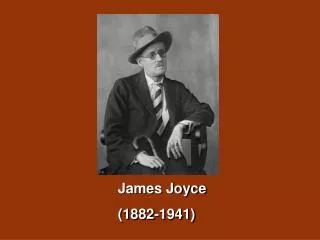
James Joyce Research Paper James Joyce was one of the most famous 20th century writers born on February 2, 1882 in Dublin, Ireland. He is mostly known for his book Ulysses often seen as one of the best books written. James Joyce came from a big family of ten children and, he was the oldest child born to John Stanislaus Joyce and his wife Marry Murray Joyce. His father, was a talented singer but didn't provide a stable a household. He liked to drink and, his lack of attention to the family finances means that James Joyce did not grow up rich. James was smart from a young age and, despite his family being not very well off, they pushed him to get an education. He went to the Irish schools of Clongowes, Wood College, Belvedere College and finally University College Dublin, ...Get more content on HelpWriting.Net...
Use of Language in James Joyce's Ulysses Essay Use of Language in James Joyce's Ulysses In his essay "The Decomposing Form of Joyce's Ulysses," Henry Staten has argued "that Ulysses achieves some of its most characteristic effects by pressing the internal logic of mimesis to the limit, above all through onomatopoeia, which manifests in a peculiarly condensed way the self– contradictory character of the realist project" (Staten 174–5). Mimetic narrative and method are undone by an onomatopoeiac mode, which is conceived by Stephen "as the pure self–expression or self–annunciation of reality" (175): "Signatures of all things I am here to read, seaspawn and seawrack, the nearing tide..." (Ulysses 3.2–3, emphasis added). "Listen: a fourworded speech: seesoo, hrss, rsseeiss, ooos"...show more content... Joyce pushes this process to its limit, rearranging syntax, deranging words and letters in unheard–of combinations. His literary parodying also furthers this process of 'enriching' or 'thickening' the mediated nature of our overdetermined existence. "What Ulysses as a whole imitates ... is not any phenomenal form but rather its making and unmaking at the limit where imitative form becomes indiscernible from deconstruction" (S 178). Language and art are a "cracked lookingglass" (U 1.146). In "Aeolus," newsprinting recasts this Joycean strategy, adding further figures and figuration to the text, each episode recasting the textual play of language: Sllt. The nethermost deck of the first maching [typesetter] jogged forward its flyboard with sllt the first batch of quirefolded papers. Sllt. Almost human the way it sllt to call attention. Doing its level best to speak. That door too sllt creaking, asking to be shut. Everything speaks in its own way. Sllt. (7.174–7) Is "sllt" really "Orthographical" (7.164), or is Joyce joking with the inane futility of our attempts to form a correct system or mode of spelling and lettering? Also, the animate and inanimate in this passage are closely linked, linked by their inscription into the text, their 'speech' inscribed. Joyce's "infidelity" to mimetic language, Staten argues, foregrounds the ambiguity ...Get more content on HelpWriting.Net...
James Joyce Research Paper La voie Joyce The pity is the public will demand and find a moral in my book – or worse, they may take it in some more serious way, and on the honor of a gentleman, there is not one single serious line in it. James Joyce, in an interview to Djuna Barnes, published in Vanity Fair (March 1922) When I saw the January of my 60th birthday approaching, I had an insight: It was mandatory that I celebrate it in Paris. Why Paris? I'd never been particularly connected to the city; I liked the place, it is true, and haven't been there since 1992, worse, plus grave, as Alan had well remembered, and my novel Hierosgamos well confirmed: I had never been there with a lover, I was never in love with anyone on the Seine riverbank, if you know what I mean....show more content... Station 3: Café Polidor, a Quartier Latin institution, the traditional restaurant where, for more than 200 years, artists and writers – from Verlaine to René Clair, including... James Joyce – fed their body and spirit – 41, rue Monsieur Le Prince. Station 4: Hotel Lenox, where Joyce was living with his family when he concluded Ulysses. It was also in this hotel that he wrote much of Finnegan's Wake, but the current manager has no idea of who James Joyce was, believe it or not. The narrow spiral staircase that Joyce must have walked up so many times, often tottering, half drunk, is still there, untouched – 9, rue de L'Université. Station 5: Joyce's apartment near the Eiffel Tower, where the writer used to live when he was barely above the poverty line, at the time when Ulysses was finally released, a quiet place, almost a court; to reach the Italian restaurant where J.J. celebrated with friends and family the costly publication of his book he just needed to cross the street – 7, rue Edmond ...Get more content on HelpWriting.Net...
James Joyce Research Paper James Joyce was born in Dublin, Ireland on February 2nd 1882. Joyce was born into a big family, with 10 brothers and sisters. His mother was loving and dutiful, and his father was charming but developed a drinking problem. Joyce grew up embarrassed of his father's condition. In spite of this, Joyce's father recognized his son's intelligence and had him attend two of the most prestigious schools in Ireland. Giving Joyce the ability to pursue his talent of writing. As Joyce grew older he became more engrossed into the catholic religion, until he lost his virginity to a Dublin prostitute. He was ashamed of his sins and turned to religion but was frightened when he heard a sermon about eternal condemnation for the sinners of the world. Joyce fixated ...Get more content on HelpWriting.Net...
James Joyce:A Portrait of the Artist Essay James Joyce:A Portrait of the Artist Few people, if any, in the twentieth century have inspired as much careful study and criticism as James Joyce. His work represents a great labyrinth which many have entered but none have returned from the same. Joyce himself is a paradoxical figure, ever the artist, ever the commoner. He has been called the greatest creative genius of our century and, by some, the smartest person in all of history. His most famous novel, Ulysses, is considered by many to be the greatest novel ever written. Beyond all of these superlatives lies a perfect case study in the creative mind and process. Joyce was born in a Dublin suburb on February 2, 1882 to John Stanislaus Joyce and Mary Jane Joyce. He was the first...show more content... This was a sharp contrast to Irish society at the time which was, for the most part, very devout. It is also interesting to note that John Joyce's frequency of appearance in his son's books is only second to the appearance of James himself. This demonstrates the influential role which John played in his son's life. Evidence of Joyce's early obsession with language and words can be found in his semi– autobiographical novel, A Portrait of the Artist as a Young Man. In the beginning of this book, young Stephen, the name Joyce chose for himself, wonders about the word "belt." "That was a belt round his pocket. And belt was also to give a fellow a belt," Stephen thinks. The dual meaning intrigues him. In April of 1893 Father John Conmee, who had been the rector at Clongowes and was now prefect of studies at Belvedere College, another Jesuit school, arranged for James and his brothers to attend Belvedere without charge. Here he read voraciously in European literature, discovering the works of Henrik Ibsen, Dante, Flaubert and others who would remain his literary idols for life. Joyce did well at Belvedere, and graduated from there in 1898. That summer was a very important one in Joyce's life. For some time he had been having "impure" thoughts and feelings and decided finally to throw off the hypocrisy of the church. He began visiting brothels in Dublin, experimenting with his awakening sexuality. This ...Get more content on HelpWriting.Net...
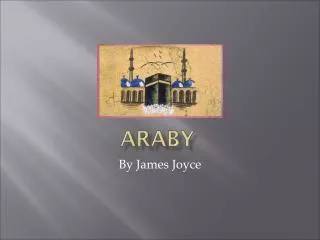
Essay on Araby, by James Joyce In his short story "Araby", James Joyce portrays a character who strives to achieve a goal and who comes to an epiphany through his failure to accomplish that goal. Written in the first person, "Araby" is about a man recalling an event from his childhood. The narrator's desire to be with the sister of his friend Mangan, leads him on a quest to bring back a gift from the carnival for the girl. It is the quest, the desire to be a knight in shining armor, that sends the narrator to the carnival and it's what he experienced and sees at the carnival that brings him to the realization that some dreams are just not attainable. Joyce uses the setting of the story to help create a mood and to develop characters and themes throughout the...show more content... "Every morning I lay on the floor in the front parlor watching her door...At night in my bedroom and by day in the classroom her image came between me and the page I strove to read." This shows the extent to which the narrator desires to be with Mangan's sister. During the narrator's first encounter with Mangan's sister, she "turned a sliver bracelet around her wrist." Picturing this bracelet twisting and spinning around the girl's wrist gives the reader a sense that the narrator's emotions too are spinning round and round as he is finally talking to the girl of his dreams. He describes her " silver bracelet", "the white curve of her neck", and the "white border of a petticoat" to give Mangan's sister a sense of innocence and purity. "If I go, I said, I will bring something for you." This is where the narrator's romantic quest begins. He has committed himself to going to Araby, an exotic carnival of wonder and enchantment, to bring back a gift for the girl he is in love with. What seems to be a simple task: go to the carnival, get a gift and bring it back; turns out to be one upset after another. The day of the carnival the narrator's uncle, who has the narrator's money, arrives home late. In his drunken state, the uncle hands the narrator the money and sends him on his way. "I took my seat in a third class carriage of a deserted train. ...Get more content on HelpWriting.Net...
Essay on James Joyce James Joyce James Joyce, an Irish novelist and poet, grew up near Dublin. James Joyce is one of the most influential novelists of the 20th century. In each of his prose works he used symbols to experience what he called an "epiphany", the revelation of certain revealing qualities about himself. His early writings reveal individual moods and characters and the plight of Ireland and the Irish artist in the 1900's. Later works, reveal a man in all his complexity as an artist and in family aspects. Joyce is known for his style of writing called "stream of consciousness". Using this technique, he ignored ordinary sentence structure and attempted to reproduce the rambling's of the...show more content... After Ulysses in 1922, he was left a lot of money from an Englishwoman, and then spent his time working on his writing full time. This book A Portrait of the Artist as a Young Man in 1916, was an autobiographical novel about his youth and his home life. The main character's name in this is Stephen Dedalus. It shows a clear cut , advocary of an artists right to defy inhibiting forces like, family, church and nation. When Stephen, was in the university he talks about hi dislike for his classmates who just bend their heads and write in their notebooks, "the points they were bidden to note, nominal definitions, essential definitions and examples or dates of birth or death, chief works, a favorable and unfavorable criticism side by side," Joyce's views of Irish education weren't very good. Stephen in this book scorns his family, and his fathers attributes. He thinks that he has failed in his effort to unite his will and the will of God, to love God the way he feels is expected. He feels this because he will not serve God. He wants to live his life his way. He talks about how he knew he couldn't be accepted, "it wounded him to think that he would never be but a shy guest at the feast of the world's culture and that the monkish learning, in terms of which he was striving to forge out an esthetic philosophy, was held no higher by the age he lived than the subtle and curious jargons of heraldry ...Get more content on HelpWriting.Net...
James Joyce Essay In selecting James Joyce's Ulysses as the best novel of the twentieth century, Time magazine affirmed Joyce's lasting legacy in the realm of English literature. James Joyce (1882–1941), the twentieth century Irish novelist, short story writer and poet is a major literary figure of the twentieth–century. Regarded as "the most international of writers in English¡K[with] a global reputation (Attridge, pix), Joyce's stature in literature stems from his experimentation with English prose. Influenced by European writers and an encyclopedic knowledge of European literatures, Joyce's distinctive writing style includes epiphanies, the stream–of–consciousness technique and conciseness. Born in Rathgar, near Dubtin, in 1882, he lived his...show more content... Hauptmann's comprehensive version of the portrait of an artist helped Joyce develop his own interpretation. A further clarification was provided by the German philosopher Friedrich Nietzche (1844–1900). Joyce adapted Nietzsche's concept of the Superman in developing his portrait of an artist. Although Joyce rejected the Catholic Church all his life, Reynords, in Joyce and Dante: The Shaping Imagination clams that the Italian poet and the greatest of Catholic poets Dante Alighier (1265–1321) "whose influence pervades all Joyce's writing is never cowed by authority" (Attridge p. 56–57). Perhaps that is why Joyce was attracted to Dante's writing. 	Of all his literary countryman, the only Irish literary who's left a profound impression on Joyce was that Irish nationalist poet, James Clarence Mangan (1803–1849). In the short story "Araby," Joyce pays tribute to the poet by naming the narrator's classmate, Mangan. Joyce identified with Mangen because of his linguistic skill and knowledge of the literature of Italy, Spain, France and Germany. Furthermore, Mangan was disdained by his Irish contemporaries––a gesture Joyce considered an act of treachery. 	Joyce's use of the stream–of consciousness technique first appeared record these epiphanies with extreme care, "seeing that they themselves are the moments." (Kalasty, p.199) Although all the stories ...Get more content on HelpWriting.Net...
Paralysis In James Joyce's Dubliners Hopefully this Essay is Slightly More Intelligible than Finnegan's Wake: Dubliners Essay "To be or not to be, that is the question." Hamlet's famous quotation implies only two solutions: to be, or to not be. However, there is another option that Shakespeare never explored: to remain paralyzed between the two states, unable to commit to either. James Joyce's Dubliners is a collection of short stories first published in 1914, that follows the inhabitants of Ireland. Published nearly a half a century before the Republic of Ireland would be recognized as an independant country, many of Joyce's short stories in Dubliners explore the theme of Irish paralysis, that Joyce found afflicted both the whole of Ireland and its individual citizens. Many...show more content... One of the key aspect of modernism was portraying the mundane and average in an honest (and often depressing) light, so it is unlikely Joyce would have made the choice to have a young narrator express himself in such an advanced and unusual way. Throughout the story, the narrator seems to have underlying animosity toward the event that took place. At the beginning of the story, the narrator describes how his evenings were spent, "When we met in the street the houses had grown sombre. The space of sky above us was the colour of ever–changing violet and towards it the lamps of the street lifted their feeble lanterns. The cold air stung us and we played till our bodies glowed" (19). Even when describing fun activities, like playing outside with neighbors, the narrator uses negative language. Typically, a memory about a failed childhood crush would be met with a shrug, but the narrator still has feelings of anger toward this event all these years later. This is because this story illustrates what was likely one of the the first instances of paralysis the narrator encountered in his life. The story has value because of the implications it has on the future of the narrator. The negative tone of the story reflects how the narrator still feels disgust toward this event many years later because it was the first in a ...Get more content on HelpWriting.Net...
Essay on Ulysses by James Joyce Ulysses by James Joyce Many novelists directly reflect their life stories and personal circumstances in their works, so closely that the works may seem autobiographical. Although there are autobiographical parallels between James Joyce's life and that of his characters in Ulysses, the novel's scattered autobiographical details are more in the line of delightful puzzles to be ferreted out, rather than direct insights into Joyce's life. What is really important in Ulysses is not the ties to Joyce's personal experience; it is the way he uses his distinctively Irish experience to comment on the human condition in general. We think of Joyce as an Irish writer, and it may be surprising to learn that he left his native land as a...show more content... Joyce called his novel Ulysses as a conscious attempt to thematically evoke Homer's Odyssey, whose hero Ulysses (today generally called Odysseus) also made an epic journey of self–discovery. Yet it is not only the Greek classics to which Joyce has turned for inspiration, but the medieval Irish classics as well. One has only to read any cycle of medieval Celtic myth (such as the Irish Noinden Ulad, or the Welsh Mabinogen) to observe the same extraordinary structure at work there. The episodic formlessness of the Irish mythological epics heavily influenced the choice of form –– or, some would say, the lack thereof –– that was begun in Joyce's earlier works and brought to full fruition in Ulysses. The story line in either of these cycles flits from one anecdote to another in a manner that foreshadows Joyce's own stream–of–consciousness technique. In addition, Joyce's words are arranged not in a rational manner but with a wild, intuitive Irishness, with as much emphasis on the magic of language as there is on its intellectual logic. We can see an example of this in Molly Bloom's ruminations in the final chapter, which consists of one single sentence extending for forty pages, with thought falling on thought like leaves piling up in the autumn. Consider just a fragment of that passage: "Yes because he never did a thing like that before as ask to get his ...Get more content on HelpWriting.Net...
James Joyce Research Paper Carol Bruce Jason Chism Comp II 22 February 2016 James Joyce This paper examines the back ground of how James Joyce became a writer. In this paper we will learn about his Irish Identity. It will provide a new approach for understanding the dramatic development of Joyce's oeuvre and how he had contributed to the modernist avant–garde, which he was one of the most influential but yet important authors. Some of his childhood travels to other countries, money–making schemes, and the death of his mother. His struggles of growing up without his mother between France and the Ireland there is a long history. I will touch a little on his religion of Irish Catholicism. It rejected his attitude and sexual morality that is why he left the Catholic church family, hating it fervently. It looks as if most of his life revolved around his story of Dublin, Ireland. James...show more content... South of Dublin in a suburb called Rathgar. The son of John Stanislaus Joyce, an impoverished gentleman, who failed in a distillery business and tried all kinds of professions, including politics and tax collecting. Joyce's mother, Mary Jane Murray, was ten years younger than her husband. She was an accomplished pianist, whose life was dominated by the Roman Catholic Church. The family bloodlines that of Irish nobility. As their diminishing wealth and income, the Joyce family was forced to move. His father's unemployment and his drinking and spending habits, made it hard to retain their social standings. In 1888 at the age of six, James was sent to the Clongowes Wood College, at Clane, Ireland. He later earned marks at Clongowes Wood College and Belvedere College in Dublin (1893–1897) where he continued. At this time he was to join the priesthood, which would have pleased his parents. But as James met with various members of the "Irish Literary Renaissance," his interest changed. He became critical of Ireland and it's elements, especially the ...Get more content on HelpWriting.Net...
Essay about James Joyce's The Dead James Joyce's The Dead In The Dead, James Joyce lets symbolism flow freely throughout his short story. James Joyce utilizes his main characters and objects in The Dead to impress upon his readers his view of Dublin's crippled condition. Not only does this apply to just The Dead, Joyce's symbolic themes also exude from his fourteen other short stories that make up the rest of Joyce's book, Dubliners, to describe his hometown's other issues of corruption and death that fuel Dublin's paralysis. After painting this grim picture of Dublin, James Joyce uses it to express his frustration and to explain his realistic view that the only solution to the issues with Dublin depends on a move to the West and towards a new life, rather than...show more content... Coupled with his depiction of Dublin's immobile status through his characters, James Joyce also exemplifies his theme of paralysis through snow. In Daniel R. Schwarz's psychoanalytic criticism of The Dead, he explains that "the snow imagery focuses our attention on a world outside Gabriel...where as ice, it suggests the emotional sterility of a world reduced to social gestures, empty talk, and loveless relationships" (Schwarz 123). However, I disagree with Schwarz and believe that James Joyce uses snow to symbolically represent the cold and dead Dublin due to its uncertain political period. When Gabriel first enters his aunt's party, "A light fringe of snow lay like a cape on the shoulders of his overcoat and like toecaps on the toes of his galoshes; and as the buttons of his overcoat slipped with a squeaking noise through the snow–stiffened frieze, a cold fragrant air from out–of–doors escaped from crevices and folds" (The Dead 23). This symbolism comes back at the end of The Dead through Gabriel's later thoughts on how the snow "was falling on every part of the dark central plain, on the treeless hills...falling upon every part of the lonely churchyard," and touching both the living and the dead, symbolizing that not only Gabriel, but his entire country, both the living and the lifeless had been united in ...Get more content on HelpWriting.Net...
Araby By James Joyce Essay James Joyce, an Irish writer, is regarded as one of the most influential and important authors of the 20th century. Joyce was raised as a Catholic and attended a boarding school, Clongowes, run by Jesuits priests. Unfortunately, Joyce withdrew from school because of family debt. Joyce kept up his studies and was eventually able to attend University College in Dublin, also operated by Jesuits. By the time Joyce was in college he had had renounced Catholicism, mainly because of its unbending rules and strict enforcement of them. In many of his writing Joyce depicts the lives of Dubliners and subtly shows religion as a big part of their lives. In his short story, "Araby," Joyce depicts the values, aspirations, and habits of Irish Catholic Church...show more content... Just like Joyce, the narrator attends a Catholic school. Harry Stone, author of "'Araby' and the Writings of James Joyce," wrote that "Araby" is "a portrait of the artist [Joyce] as a young boy" (376), meaning that the short story could possibly be autobiographical of Joyce. During the time period of the story, just like the narrator, the people of Ireland are immersed within the Catholic religion. It is unclear how strongly the narrator's religious beliefs are, however Catholic values play a large role in his upbringing. The narrator often explains things through Catholic ideas and imagery. For example, the narrator over and over again thinks about and describes his crush, Mangan's sister, in religious terms. During the story, he compares her to a "chalice" that he is protecting from a "throng of foes," a reference that seems to compare her to the Holy Grail. Additionally, throughout the story the narrator literally seems to worship her: "Her name sprang to my lips at moments in strange prayers and praises which I myself did not understand." The fact that the narrator does not understand his "prayers and praises" to Mangan's sister implies that he is not idolizing her on purpose. Instead, the narrator's idolization seems to be a product of his catholic ...Get more content on HelpWriting.Net...
The Dead By James Joyce Essay James Joyce emerged as a radical new narrative writer in modern times. Joyce conveyed this new writing style through his stylistic devices such as the stream of consciousness, and a complex set of mythic parallels and literary parodies. This mythic parallel is called an epiphany. "The Dead" by Joyce was written as a part of Joyce's collection called "The Dubliners". Joyce's influence behind writing the short story was all around him. The growing nationalist Irish movement around Dublin, Ireland greatly influences Joyce's inspiration for writing "The Dubliners". Joyce attempted to create an original portrayal of Irish middle class life in and around Dublin at the end of the 19th century and beginning of the 20th century. The historical...show more content... Through the idea of stream of consciousness he captured his characters arbitrary manners including their thoughts and feelings. This allowed Joyce's writing to be more understandable and convincing then previous writers. Joyce's writing technique with the use of the epiphany, religious symbolism, and stream of consciousness gave the reader access to a deeper understanding of human experience by using subconscious associations along with the conscious thoughts of narrative for his characters. All of these literary elements are portrayed in Joyce's "The Dead". His story depicts aspects of everyday life in the Irish capital of Dublin. Joyce portrays the parochialism and piety as well as the repressive conventions of everyday life. Joyce's characters dream of a better life against a dismal and impoverishing background where the cumulative effects of life are full of despair and hopelessness. Through Joyce's modernist approach to narrating he uses a structure of symbolic meanings and revelatory moments called "epiphanies". Joyce viewed Dublin as the "Centre of Paralysis" in Ireland (Puchner, Martin 177). Joyce viewed Dublin as a city of blunted hopes and dreams that were lost in the sea of misery. A city Joyce viewed that was filled with poor who were desperate to move out of the slums that they spent their entire lives living in. Dublin's population was constantly growing and not enough jobs ...Get more content on HelpWriting.Net...
The Theme of Escape in James Joyce's Dubliners In James Joyce's Dubliners, the theme of escape tends to be a trend when characters are faced with critical decisions. Joyce's novel presents a bleak and dark view of Ireland; his intentions by writing this novel are to illustrate people's reasons to flee Ireland. In the stories "Eveline, "Counterparts", and the "Dead", characters are faced with autonomous decisions that shape their lives. This forlorn world casts a gloomy shadow over the characters of these stories. These stories are connected by their similar portrayal of Ireland. They clearly represent Joyce's views on people's discontent with Ireland. In the story "Eveline", Joyce's main character...show more content... He belittles his daughter and is unappreciative to her contributions to the family. This is the main reasoning behind Eveline's desire to escape her life and Ireland. Eveline states, "The promise to her mother, her promise to keep the home together as long as she could" (32, 33). She unselfishly chooses her priorities and commitments over her own happiness and future. In the story "Counterparts", the main character Farrington is irresponsibly leading his life to disaster. Farrington is a careless employee who neglects his work and disrespectful towards his supervisors. "Mr. Alleyne began a tirade of abuse, saying that two letters were missing" (86,87). Farrington is creating unnecessary stress in his life; his relationship with his family is not to promising. Joyce states, "Now, you'll let the fire out the next time! said the man, striking at him viciously with a stick" (94). He is abusive towards his son and desires relations with other women. Farrington is constantly creating an unpleasing life for himself; he has made the decision to be irresponsible in all aspects of his life and has now sealed his own fate. Farrington feels that he can escape his life by drinking. He believes that he can solve his problems in this matter. Throughout the story he concentrates most of his mind and efforts on becoming inebriated. Joyce states, "The man recognized that sensation and felt that he must ...Get more content on HelpWriting.Net...
Essay on James Joyce Genius In short stories the narrator plays the most crucial role in the interaction between writer and reader. The choice of a narrator should help smoothly transfers the author's intentions. Joyce's story "Araby" is narrated in past tense and in first person by the protagonist. Joyce's decision to tell the story through this mouthpiece creates an avenue for Joyce to drive home his more complicated themes running through the story. The institution of religion is found throughout the entire plot as well as broader occult relations. Joyce uses a mature narrator with acquired wisdom to present the information. The narrator's language gives insight to the thematic mood Joyce wishes to create. The wisdom and understanding acquired by...show more content... The detachment from reality makes the reader be dependent on the narrator because he is operating outside of the ordinary realm and his translation of the events is all the reader has to understand. It is important that the reader trust and follow the narrator in order for Joyce to complete his project. The movement and atmosphere of the boy's romance is the critical focus Joyce maintains. The dynamic romance of the boy and its consequences are what Joyce is pointing to with the use of his narrator. The romance is introduced in a boyish manor of adoration but then quickly accelerates. Immediately upon learning of the attraction to the girl next door the narrator begins to attribute occult qualities to the relationship. The boy believes his affair to be a scared pursuit. He protects his romance from a "throng of foes" in the market place fearing their unholy interactions would profane his sacred "chalice." Reports of strange things happening to the boy are given for example, "Her name sprang to my lips at moments in strange prayers and praises which I myself did not understand. " His "eyes were often full of tears (I could not tell why) and at times a flood form my heart seemed to pour itself out into my bosom." The reports are all characteristic of religious and occult practices. Joyce reemphasizes the religious nature of the boy's affair by leading his readers to the back room of the boy's house that is charged with ...Get more content on HelpWriting.Net...
The Dead By James Joyce Point Of View The short story "The Dead" by James Joyce presents an insight into the character of Gabriel. Joyce reveals many parts of Gabriel's character to the audience and to Gabriel himself. Joyce utilizes imagery, point of view, and diction to show the indifference in Gabriel's character. First of all, Joyce uses point of view the same way throughout the entire passage. The point of view being used is third–person omniscient because Joyce is using third–person pronouns such as he, she, his, and her. The point of view is omniscient because the speaker knows what the character Gabriel is feeling and knows what everyone else is feeling as well. For instance, "He did not like to say even to himself that her face was no longer beautiful but he knew that it was no longer the face for which Michael Forey had braved death." This sentence shows exactly what Gabriel is feeling about the situation. A man died for Gabriel's wife and he didn't feel bad about it. "It hardly pained him now to think how poor a part he, her husband, had played in her life." This sentence shows that Gabriel is indifferent about his emotions and...show more content... Imagery often appeals to the audience by describing the five senses of touch, sight, smell, hearing, and taste. In this case, Joyce appeals to the audience by using sight to describe something. "His eyes moved to the chair over which she had thrown some of her clothes. A petticoat string dangled to the floor. One boot stood upright, its limp upper fallen down: the fellow of it lay upon its side." During this seemingly unnecessary image of what Gabriel is seeing, the author gives an importance to all the details of Gabriel's actions. While Gabriel is looking at the chair with clothes, he is wondering about his emotions he showed an hour before. After the image, Joyce proceeds to stating what Gabriel had been feeling that hour ...Get more content on HelpWriting.Net...
James Joyce Research Paper Gage Myers Mrs. Goddard Accelerated English 10 16 May 2017 James Joyce Sunny Jim or Herr Satan in his later life is considered the most important and influential literary figures of the first half of the twentieth century (DISCovering Authors, par. 1). He is widely considered to be the writer to redefine the form of the modern novel, critics even compare him to authors such as John Milton and the great William Shakespeare. This is the story of James Joyce, one of the most prominent twentieth century novelist/poets. James Augustine Aloysius joyce was born to a middle class family on February 2nd, 1882 in Dublin, Ireland (EXPLORING Novels, par. 1). Joyce was born to John Stanislaus Joyce and Mary Jane 'May" Murray. His father John Joyce...show more content... Joyce is considered to be one of the first writers to do what Picasso did with images. He was a groundbreaking modernist who showed literary modernism could be done, and done well. Although he's more important than influential because Joyce didn't revolutionize writing. Joyce isn't a Shakespearean figure whose example every writer has to come to terms with. But without Joyce, it's hard to imagine the careers of certain writers, like Thomas Pynchon, Gabriel García Márquez, or David Foster Wallace. So I don't think Joyce changed literature in any everlasting way, but he expanded its possibilities in a way that only a few have managed. "As his earlier works, Joyce's style endows Ulysses with kinetic force. Its evolving form helps the reader to participate in the creation of the text by attempting to bring meaning (though not certitude) to it. The novel's introductory chapters establish its tone in a fairly conventional, if sometimes baroque, manner; but after progressing through the first third of the work, Joyce begins to vary the form of succeeding episodes, continually shifting narrative perspective and compelling his audience to reconstruct standards for interpretation" (DISCovering Authors, par. 6). Within chapters Joyce shows readers the disjointed impressions of the main characters through various forms of monologue. Joyce ...Get more content on HelpWriting.Net...