Download
1 / 22
240 likes | 386 Vues
This chapter explores the history and science of viruses, starting from Edward Jenner's smallpox vaccine in 1796 to the advancements in virology such as the crystalization of tobacco mosaic virus in 1935. It covers the definition and characteristics of viruses as non-living entities, their structures, modes of entry, and infection cycles including lytic and lysogenic pathways. The chapter also discusses various types of viruses, including bacteriophages, retroviruses, and prions, alongside innovative viral control methods like vaccines and antiviral drugs.

E N D
The Genetics ofViruses Chapter 18
Discovery of Viruses • 1796 – Edward Jenner developed the smallpox vaccine • 1897 – Beijerinck coined the term “virus” meaning poison • 1935 – Wendell Stanley crystalized sap from tobacco leaves with TMV and found that viruses were made of nucleic acid and protein
Virology • Study of viruses • Deadly viruses are virulent • Viruses couldn’t be seen until the electron microscope was invented
Viral Characteristics • Non-living • Non-cellular • Cannot grow or reproduce on its own • No metabolism • Cause disease • AIDS, colds, flu, measles, mono • Cause cancer • Cervical, leukemia
Viral Structure • Genetic material • DNA or RNA • Capsid • Protein coat surrounding nucleic acid • Envelope • Some; comes from host cell membrane • Mode of entry • Spikes, receptors, etc.
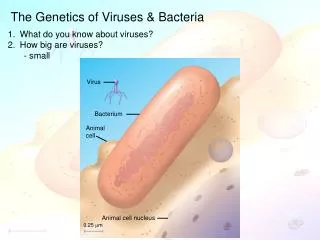
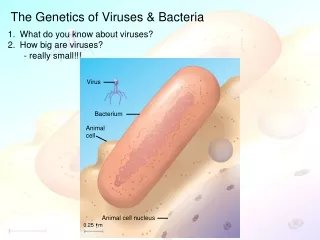
Virus Specificity • Host range: • Broad: West Nile • Mosquitoes, birds, humans, horses • Narrow: Measles • Humans • Viruses are small
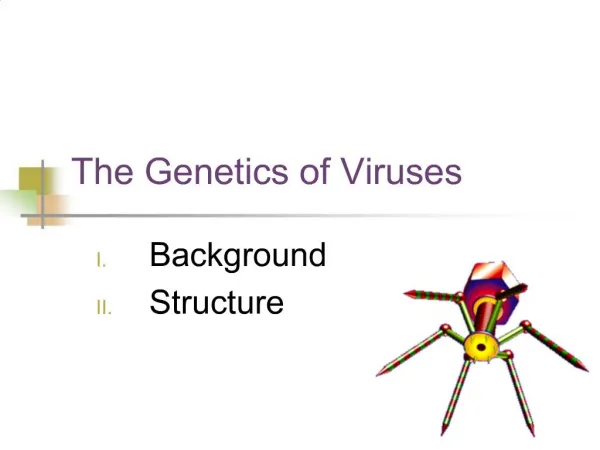
Bacteriophages or T-Phages • Among the most complex viruses • Attack bacterial cells • Composed of a head, tail, base plate, & tail fibers • Long DNA molecule is inside the head • Tail helps inject the viral DNA into host cell • Tail fibers used to attach to host
Lytic Cycle • Viral replication that rapidly kills the host cell causing it to lyse or burst • Involves 5 steps • Adsorption --- phage attaches to cell membrane of host • Injection --- nucleic acid (DNA) of virus injected into host cell • Replication --- viral DNA inactivates host cell's DNA & uses host's raw materials & ribosomes to make viral DNA, capsids, tails, etc. • Assembly --- new viral parts are combined to make new phages • Lysis --- enzymes weaken & destroy the cell membrane causing it to lyse releasing new viruses that infect other cells
Lysogenic Cycle • Bacteriophage infects bacteria cell and injects its DNA • DNA becomes incorporated into bacterial chromosome • Prophage • Bacteria reproduces, making more copies of viral DNA • Lytic cycle can be triggered
Animal Viruses • Two key variables in classifying viruses that infect animals: • DNA or RNA? • Single-stranded or double-stranded?
Retroviruses • Contain RNA • Reverse transcriptase enzyme uses the RNA to make DNA • Use the host cell's ribosomes & raw materials to make viral proteins • Cause some cancers & AIDS
Viroids • Smallest particle able to replicate • Made of a short, single strand of RNA with no capsid • Cause disease in plants
Prions • Infectious protein • protein particles that have folded incorrectly • No nucleic acid or capsids • Attacks the central nervous system • Cause animal diseases in cows (Mad Cow disease), sheep, & humans
Viral control • Interferon are proteins made by cells to fight viruses • Two types of viral vaccines exist --- inactivated & attenuated • Inactivated virus vaccines don't replicate in the host's system • Attenuated viral vaccines have been genetically altered so they can't cause disease • Antiviral drugs (AZT, acyclovir, & azidothymidine) interfere with viral DNA synthesis • Protease Inhibitors interfere with viral capsid production