Understanding Percent Extraction and Chromatography Concepts
This quiz focuses on key concepts related to extraction efficiency and chromatography. Participants will calculate the percentage of an analyte extracted into octanol from an aqueous solution, and understand the significance of peak area in chromatography, peak resolution, and the impact of diffusion on retention times. Each question is designed to challenge your knowledge and application of these essential concepts in analytical chemistry. Show your work for calculations to reinforce learning.

Understanding Percent Extraction and Chromatography Concepts
E N D
Presentation Transcript
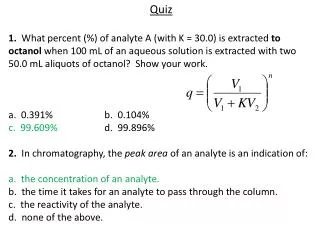
Quiz 1. What percent (%) of analyte A (with K = 30.0) is extracted to octanol when 100 mL of an aqueous solution is extracted with two 50.0 mL aliquots of octanol? Show your work. a. 0.391% b. 0.104% c. 99.609% d. 99.896% 2. In chromatography, the peak area of an analyte is an indication of: a. the concentration of an analyte. b. the time it takes for an analyte to pass through the column. c. the reactivity of the analyte. d. none of the above.
Quiz 3. The term that is used to describe how well two peaks in a chromatogram are separated is: a. resolution. b. plate height. c. capacity. d. diffusion. 4. Diffusion results in: a. shorter average retention times. b. longer average retention times. c. narrower peak widths. d. wider peak widths.