
SlideServe
Menu
Préférences
© SlideServe · v2026

Chapter 14 – Human Remains

fritz avatar
18 diapositives · 515 Views · Jul 18, 2014

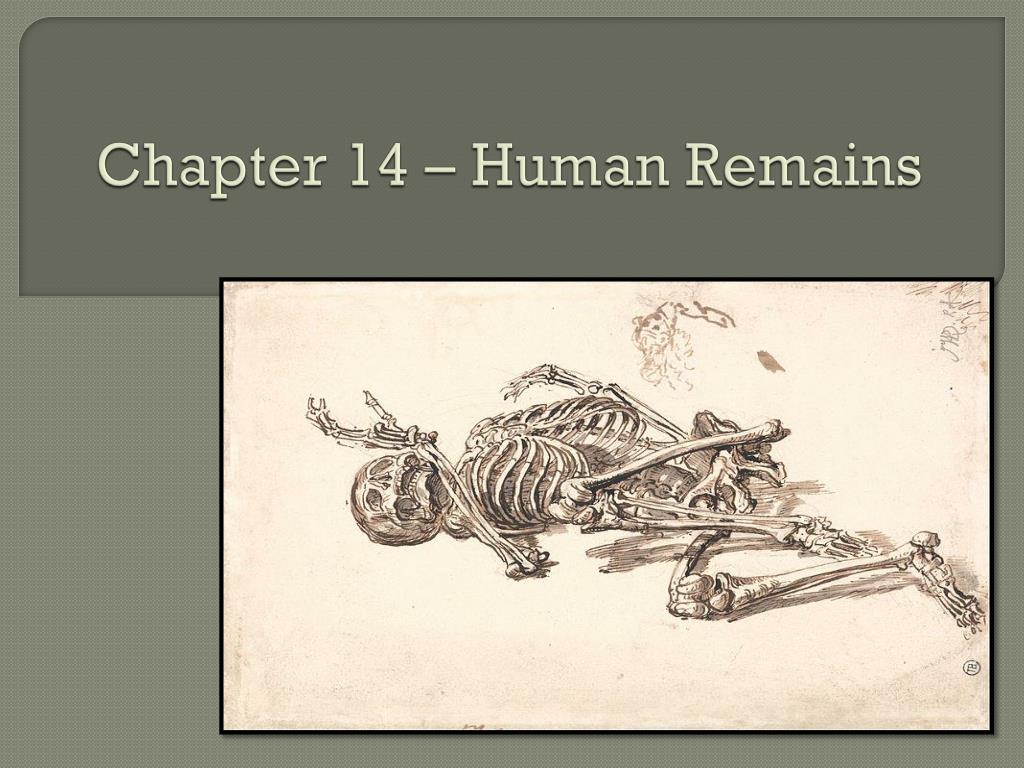
Chapter 14 – Human Remains. Learning Objectives. Learn how anthropologists use bones to determine whether remains are human; to determine the age, sex, and race of an individual; to estimate height; and to determine when death could have occurred. Bones.
Chapter 14 – Human Remains - slide 1
01 / 18Chapter 14 – Human Remains
1 / 17

Télécharger la présentation

Chapter 14 – Human Remains
Une image / un lien ci-dessous est fourni (tel quel) pour télécharger la présentation

Politique de téléchargement : le contenu du site vous est fourni TEL QUEL pour votre information et votre usage personnel ; il ne peut être vendu, concédé sous licence ni partagé sur d’autres sites sans l’accord de son auteur.Le contenu vous est fourni TEL QUEL, pour votre information et votre usage personnel uniquement. Téléchargez la présentation en cliquant sur ce lien. Lors du téléchargement, si vous ne parvenez pas à télécharger une présentation, l’éditeur a peut-être supprimé le fichier de son serveur.Pendant le téléchargement, si vous ne parvenez pas à obtenir une présentation, le fichier a peut-être été supprimé par l’éditeur.

F I N

Plus de contenu associé

Transcription de la présentation
  1. Chapter 14 – Human Remains

  2. Learning Objectives Learn how anthropologists use bones to determine whether remains are human; to determine the age, sex, and race of an individual; to estimate height; and to determine when death could have occurred.

  3. Bones Referring back to the episode of Bones where the remains of a person was discovered in a suit case – when there is so little remains left, how do forensic scientists go about identifying an unknown individual, and what information can yield information about that person’s fate?

  4. Forensic anthropology A type of physical anthropology that specializes in the human skeletal system. Identifies victims and sometimes cause of death. Examine bodies that have decomposed, been badly burned or mummified. Conclusions reached are used in a court of law

  5. Possible inferences Are remains human? One individual or several? When did death occur Gender, age, and race. Cause of death-homicide, suicide, accident, or natural cause Height, body weight, and physique. Can a facial reconstruction be performed?

  6. Human Skeleton Provides structure and rigidity. Protects soft tissue and internal organs. Protects the brain. Provides attachment site for muscles, tendons, and ligaments. Produces red blood cells. Serves as storage for minerals.

  7. Human skeleton Long bones are longer than wide – arms, legs, feet. Short bones are as long as wide –wrist and ankle. Flat bones are flat and enclose soft organs – skull, scapula, sternum, hip, ribs. Irregular bones are irregularly shaped – vertebrae and some bones of skull.

  8. Human Skeletal System http://www.youtube.com/watch?v=UPrxQkjjExI

  9. Estimating height Forensic scientists can estimate height by examining one or more of the long bones – femur, tibia, humerus, radius. Separate formulas for male and female height.

  10. Estimating height Male Height, H Female Height, H H = femur  2.23 + 69.08 H = tibia  2.39 + 81.68 H = humerus  2.97 + 73.57 H = radius  3.65 + 80.40 H = femur  2.21 + 61.41 H = tibia  2.53 + 72.57 H = humerus  3.14 + 64.97 H = radius  3.87 + 73.50 Do not copy, find the resource page 416

  11. Sex determination Determining sex using bones – os pubis, sacrum, and ilium, shape of the skull, the shape of the manidible, and the size of the occipital protuberance. Three areas that can be examined on the pelvic region are; the width of the pubic arch the width of the pubic body the presence of a well-defined ventral arc in females.

  12. Determining age • Different indicators can be used, but investigator use multiple sites on the skeleton and give age ranges. • Sites used; • Erupting teeth • Epiphyses – growth plates • Closure of the cranial sutures 25-30 years old.

  13. Epiphyses – bone development

  14. Estimating age based on cranial structures The bones of the skull join along serrated joints called sutures. The sagital suture is found on top of the skull and separates left from right side. The coronal suture runs from the temporal area on one side over the top of the skull to the other side. In males, the sagital suture is closed around 26-32 ya, and females 29-35 ya.