The Impact of Black Civil Rights in the USA and Canada: A Comparative Analysis
370 likes | 491 Vues
This comprehensive analysis explores the evolution of Black civil rights from the 1600s to the present, juxtaposing the experiences in the United States and Canada. Beginning with the first African slaves in Virginia and the emergence of Black Loyalists in Canada, the timeline covers critical events, such as the abolition of slavery, the Civil War, and the Civil Rights Movement. It examines how differing historical contexts shaped the civil rights landscape, revealing both tensions and progress in the struggle for equality and justice in both nations.


The Impact of Black Civil Rights in the USA and Canada: A Comparative Analysis
E N D
Presentation Transcript
Black Civil Rights The United States story compared and contrasted to the Canadian story
1600s – new arrivalsUSA Canada • 1619 – first shiploads of African slaves to Jamestown, Virginia • Used for farming economy • 1605 – First named black person in Canada free man • 1685 – King Louis’ Code Noir • Slavery for economic purposes • 1689 – slavery permitted in N. France
http://www.youtube.com/watch?v=Mo79PHVI-ck&feature=related (1:25)
1700s – Independence for whom?USA Canada • 1775 – Lord Dunmore’s Declaration that “every person capable of bearing arms. . . report for duty” • “Ethiopian Regiment” • 1777 – Vermont abolishes slavery stress between north and south • 1776 – Canada a safe • haven for black • loyalists • 1784 – First race riot • Nova Scotia – black • loyalists seen as a threat • on the job scene hostility • 1790 – Imperial Statute – settlers could bring slaves • 1792 – Loyalists leave
1800s – Tensions RiseUSA Canada • 1820 – Missouri Compromise – slavery abolished north of the Missouri • 1849 – Harriet Tubman escapes slavery in Maryland • 1812 – War of 1812 • fought for British • Fear of returning to • slavery • 1819 – veterans granted tracts of land • 1830 – Uncle Tom helps American slaves escape
1800s (cont’d)USA Canada • 1833 – Brit. Parl’t abolishes slavery • 1851 – Canadian Anti-Slavery Society • number of abolitionists grew to influence public opinion • 1861-65 – Civil War • 11 Southern States try to secede from the Union to maintain slavery as a “southern way of life” • 1863 – Emancipation Proclamation • Declaration of freedom for any slave by Lincoln • 1867- 77 – Reconstruction – resolving the aftermath of the Civil War
1800s (cont’d)USA • 1868 – 14th Amendment to American Constitution Blacks given full citizenship • 1870 – Black males given right to vote with conditions • 1875 – Civil Rights Act – equal treatment in public and on public transportation • 1877 – Jim Crow laws – segregation in public facilities “separate but equal”
1900 - 1940USA Canada • 1909 – NAACP • 1929-41 – Roosevelt’s New Deal (first fired never hired) • 1946 – Supreme Court bans segregation • 1911 – Frank Oliver – tighter restrictions on immigration • 1916 – WWI - all-Black battalion with Cdn. Forestry Corps. • 1939 – originally rejected and later accepted
1930 – 40Canada • 1939 – Brotherhood of Sleeping Car Porters assumed responsibilities for those overseas labour unions • 1944 – Ontario – Racial Discrimination Act • Prohibited publication and display of any signs that expressed ethnic, racial or religious discrim. • 1946 – Viola Desmond – NSAACP – supported Desmond in case against theatre
1950s – Violence EruptsUSA Canada • 1954 – Brown vs. Board of Education • 1955 – Montgomery Bus Boycott, Rosa Parks, MLK Jr. • Emmet Till – murdered and perpetrators found NOT guilty by all white jury • 1954 – ongoing discrimination despite laws against Dresden, Ont. • Restaurant • Testers
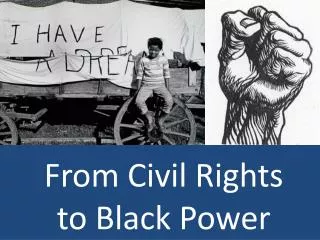
“I have a dream” Speech • http://www.youtube.com/watch?v=TiF2aAx0kds&feature=related
1950s (cont’d)USA • 1957 – Civil Rights Act (again) – all important parts blocked by southern States • 1959 – Little Rock Nine – nine black students blocked from entering school Eisenhower sends in the National Guard to intervene
1960sUSA Canada • 1961 – Freedom Riders – test new laws attacked • 1963 • Birmingham Bombings • March on Washington “I Have a Dream • Medgar Evars murdered • Brutality on TV • 1960 – Bill of Rights • 1963 – 1st Black person elected to Parliament in Ontario • 1964 – Africville “ghetto” demolished • 1965 – Klan established in Amherstville cross burnings and vandals
1960sUSA Canada • 1967 – immigration • points system – seen • as an improvement • 1964 – Malcolm X “Ballot or Bullet” speech • 1964 – Civil Rights Act (again) – fed. gov’t right to enforce desegregation • 1964 – 24th Amendment – abolishes poll tax
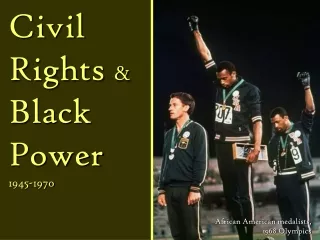
Black Power • http://www.youtube.com/watch?v=5pEVkv2tEVQ
1960s (cont’d)USA • 1965 – Bloody Sunday – Montgomery and police brutality on protesters • 1965 - Voting Rights Act – took away literacy tests, tax and other restrictions • 1966 – Black Power organizations – fight for liberation • 1968 – MLK Jr. assassinated • 1968 – Civil Rights Act (again) – sale and rental of housing
70s, 80s, 90s and presentUSA Canada • 1992 – jury acquits white police officers for beating Rodney King • 1970 – Canada’s multicultural policy changes in reaction to “bicultural and bilingual” focus • 1982 – guaranteed equality rights in s. 15 of the CCRF
Present Issues • Overpopulation of Black Americans in jail, in poverty and receiving sub standard educations • Reaction of US President GW Bush after Hurricane Katrina • Uniake Square, NS (police discrimination) • Jamaican immigrants to Toronto