Impact of Global Warming on the Quasi-Biennial Oscillation and Stratospheric Circulation
10 likes | 134 Vues
This study explores how global warming influences the Quasi-Biennial Oscillation (QBO) and stratospheric circulation. Utilizing a high-resolution version of the Model for Interdisciplinary Research on Climate (MIROC), the research simulates 30 years of equatorial zonal wind under both current and double CO2 conditions. Results reveal a weaker QBO, characterized by longer and more irregular periods, suggesting significant implications for seasonal mean climate patterns, spanning both the stratosphere and troposphere. Understanding the QBO's response to climate change is vital for accurate climate modeling.


Impact of Global Warming on the Quasi-Biennial Oscillation and Stratospheric Circulation
E N D
Presentation Transcript
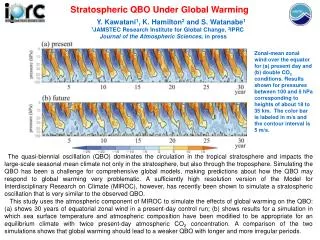
Stratospheric QBO Under Global Warming • Y. Kawatani1, K. Hamilton2 and S. Watanabe1 • 1JAMSTEC Research Institute for Global Change, 2IPRC • Journal of the Atmospheric Sciences, in press Zonal-mean zonal wind over the equator for (a) present day and (b) double CO2 conditions. Results shown for pressures between 100 and 5 hPa corresponding to heights of about 18 to 35 km. The color bar is labeled in m/s and the contour interval is 5 m/s. The quasi-biennial oscillation (QBO) dominates the circulation in the tropical stratosphere and impacts the large-scale seasonal mean climate not only in the stratosphere, but also through the troposphere. Simulating the QBO has been a challenge for comprehensive global models, making predictions about how the QBO may respond to global warming very problematic. A sufficiently high resolution version of the Model for Interdisciplinary Research on Climate (MIROC), however, has recently been shown to simulate a stratospheric oscillation that is very similar to the observed QBO. This study uses the atmospheric component of MIROC to simulate the effects of global warming on the QBO: (a) shows 30 years of equatorial zonal wind in a present-day control run; (b) shows results for a simulation in which sea surface temperature and atmospheric composition have been modified to be appropriate for an equilibrium climate with twice present-day atmospheric CO2 concentration. A comparison of the two simulations shows that global warming should lead to a weaker QBO with longer and more irregular periods.