DIGESTIVE SYSTEM
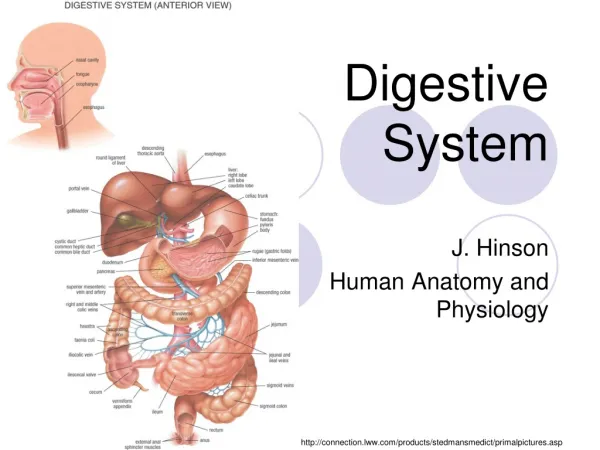
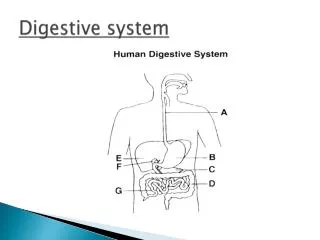
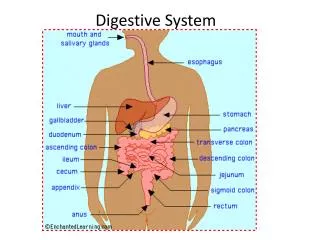
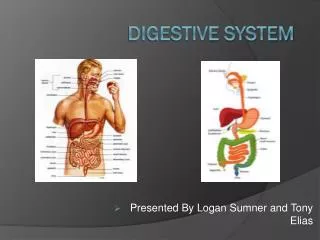
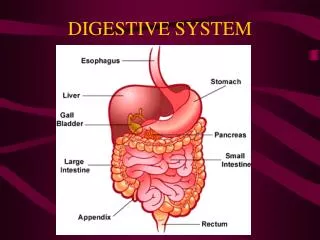
The digestive system has three primary functions: breaking down food into usable molecules, absorbing those molecules into the bloodstream, and eliminating waste. The process begins in the mouth, where mechanical (chewing) and chemical (enzymes) digestion occurs. Food travels through the esophagus to the stomach, where more digestion takes place. The small intestine is where most chemical digestion and nutrient absorption occur. The liver, gallbladder, and pancreas play supportive roles by producing bile and digestive enzymes. Waste is ultimately prepared for exit in the large intestine.

DIGESTIVE SYSTEM
E N D
Presentation Transcript
FUNCTIONS • THERE ARE THREE FUNCTIONS OF THE DIGESTIVE SYSTEM: • BREAKS DOWN FOOD INTO MOLECULES THE BODY CAN USE • THE MOLECULES ARE ABSORBED INTO THE BLOOD AND CARRIED THROUGHOUT THE BODY. • WASTES ARE ELIMINATED FROM THE BODY
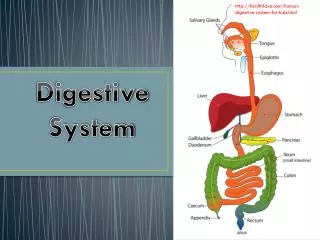
MOUTH THE MOUTH IS RESPONSIBLE FOR MECHANICAL AND CHEMICAL DIGESTION. MECHANICAL – TEETH BREAK DOWN AND GRIND THE FOOD CHEMICAL – Salivary Amylase (enzyme that breaks down carbs.)
Mouth • Teeth • Incisors • Canines • Molars • Does Food Pass Through Here? • Yes
Salivary Glands • Has Enzymes that break down carbohydrates in food (Amylase) • Produces saliva to begin chemical digestion and to make it easier to swallow • Food does not pass through here.
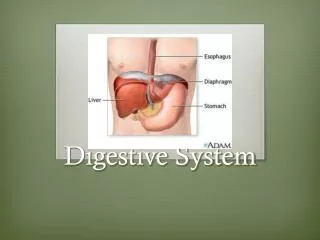
Epiglottis • Flap that covers your windpipe • Nothing is broken down here • Food does NOT pass through here
Esophagus • A muscular tube that connects mouth to stomach • Peristalsis: Contractions to push food downward • Mucus thick slippery substance • Nothing is broken down here. • Food does pass through here.
STOMACH • Holds 2 liters of food • J shaped muscular pouch • Mechanical and Chemical Digestion
Stomach • Mechanical and Chemical • HCL Acid and enzymes break down protein and carbs.
SMALL INTESTINE 6 meters long MOST chemical digestion MOST absorption takes place here
Small Intestine • Protein, Carbohydrates, and Fats are digested here • Food DOES pass through here.
Gall Bladder • Stores Bile (substance that breaks up fat) • Connected to the small intestine • Food does NOT pass through here • Nothing is broken down here but the bile breaks down fat in the S.I.
Liver • Makes Bile • Largest and Heaviest organ inside body • Nothing passes through the Liver • The liver breaks down nothing
Pancreas • Makes enzymes needed to digest proteins, fats, and carbohydrates • Connected to the S.I. • Food does not pass through • Nothing is broken down HERE
LARGE INTESTINE 1 ½ meters long Absorbes water and readies waste for exit.
Rectum • Waste material is compressed into a solid form. • Anus is a muscular opening
THE DIGESTIVE SYSTEM http://kidshealth.org/misc_pages/bodyworks/digest.html http://kidshealth.org/kid/body/digest_noSW_p7.html