### Understanding Inventory Transactions and Accounting Entries ###
In managing inventory, various transactions affect the cash and stock accounts in a business. When stock is sold, money is added to the cash account while deducting the same value from the inventory, impacting profitability. This overview illustrates different scenarios involving inventory purchases, sales, and returns, highlighting accounting entries for cash and credit transactions. It covers scenarios such as purchasing inventory on credit, cash purchases, and recording returns, with clear illustrations of the affected accounts and the underlying principles of inventory management. ###

### Understanding Inventory Transactions and Accounting Entries ###
E N D
Presentation Transcript
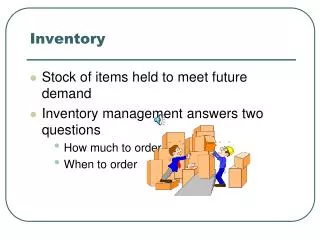
Inventory So far we have learnt that when a business sell stock, we put money into the cash account and take the same value out of the stock account. Cash account Cr Stock account Cr Dr Dr 1 Jan Cash £300 1 Jan Stock £300 However, this is not the case, how would the business ever make a profit? Stock is sold at a high price.
Purchase inventory on credit • On 1 August 2012, goods costing £165 are bought on credit from D.Henry: • The inventory account is increased. (however we now call this a ‘purchase account’ • There is an increase in the liability to D.Henry because the goods purchased have not been paid for yet. • Purchases a/c Cr • D.Henry a/c Cr Dr Dr Aug 1 2012 Purchases £165 Aug 1 2012 D.Henry £165
Purchase inventory for cash • On 3 August 2012, goods costing £310 are bought using cash • The inventory account is increased. (however we now call this a ‘purchase account’ • There is a decrease in the cash account • Purchases a/c Cr • Cash a/c Cr Dr Dr Aug 3 2012 Purchases £310 Aug 3 2012 Cash £310
Sales of inventory on credit • On 4 August 2012, goods were sold on credit for £375 to J.Lee • The debtor account is increased (J.Lee owes us money) • There is a decrease in the inventory, however we record this in the sales account • J.Lee a/c Cr • Sales a/c Cr Dr Dr Aug 4 2012 J.Lee £375 Aug 4 2012 Sales £375
Sales of inventory for cash • On 4 August 2012, goods were sold for £55 cash • The cash account is increased • The inventory account is decreased, but again we record this in the sales account • Cash a/c Cr • Sales a/c Cr Dr Dr Aug 4 2012 Cash £55 Aug 4 2012 Sales £55
Returns ‘inwards’ • On 5 August 2012, goods which had previously been sold to F.Lowe for £29 have been returned to our business. • There is an increase in stock, however we debit the ‘returns inwards account’. • There is a reduction in cash, as you give F.Lowe his money back. • Returns Inwards a/c Cr • F.Lowe a/c Cr Dr Dr Aug5 2012 Returns Inwards £29 Aug 5 2012 F.Lowe £29
Returns ‘outwards’ • On 6 August 2012, you returned goods, as you do not need them anymore. You sell them back to K.Howe for £96. • There is an decrease in the money we owe K.Howe. The liability account needs to be debited. • There is a reduction in inventory, which is recorded in the returns outwards account • K.Howe a/c Cr • Returns outwards a/c Cr Dr Dr Aug6 2012 K/Howe £96 Aug 6 2012 returns outwards £96
Homework Stick sheet in book