Innovative VR Glove for Astronaut Rover Control on Mars
250 likes | 342 Vues
Addressing long time delays in extravehicular activities during manned Mars missions by introducing a Virtual Reality glove as a precise and efficient control system for rover-based exploration. Enhancing mobility, response time, and training ease for astronauts. Project includes gesture recognition, state selection, and device-specific output. Integration into the spacesuit for seamless operation. Improved navigation and target selection. Results from obstacle course testing show promise for future developments.


Innovative VR Glove for Astronaut Rover Control on Mars
E N D
Presentation Transcript
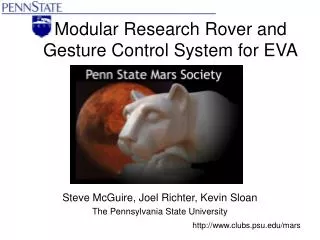
Penn State Mars Society RASC-AL 2003 Integrated Astronaut Control System for EVA
Problem Statement • Future of space exploration: manned missions to Mars • Exploration issues • Long time delay from Earth • EVAs far from home base • These issues never previously encountered fully
Exploration Applications • Soil and rock samples • Surveying the Martian terrain • Scientific observation
Spacesuit • Bulkiness makes mobility difficult • Lack of flexibility • Gloves • Hand fatigue • Difficult to grasp objects • Solution: Rover accompanies astronaut
Rover Assisted Exploration • Rovers: tried and true Martian explorers • Useful toolkit for astronauts on EVAs • On-site rover control by astronauts • Variety of rover control systems • Joystick • Trackball • VR glove
Rover Control • Past: Control from Earth • Supercomputers • Delay due to transmission over large distance • Joystick control • Future: On-site control by astronaut • Joystick and trackball not practical • VR Glove
Design Requirements • Fine-tuned control • No overlap between commands • Efficient response to commands • Simplicity and ease of training • Transmission efficiency (range and power) • Multitasking
Virtual Reality Gloves • Simulates the environment for practical purposes • Flight training • Education • Capabilities • Six degrees of freedom • Many more states than conventional controllers • Feedback Data
Integration into the Spacesuit • Characteristics: • Mobility & Flexibility • Robust Function • Simple & Reliable • VR Glove is small • Lightweight • Thin fibers • Best Place to Install: • Max. sensitivity to hand motions • Between first and second layers
Our Solution • 5DT Data Glove • ActivMedia Pioneer 2-AT rover • SmileCam camera • Steering and camera control by VR glove
Gesture Control System • Data Input and Filtering • Gesture Recognition • State Selection • Device-Specific Output
Data Input and Filtering • Independent Input and Filter per hand • Raw glove data calibrated to user's range of motion • Exponential filter to smooth noisy data • Muscle Twinges • Cardiovascular pulses
Gesture Recognition • Hand sensor readings • 7.2e16 possible combinations! • Effect of finger dependencies with imprecise control: Not this many are realistic • Continuous Control: Mealy Model • Discrete Control: Moore Model • Hybrid Control
State Selection • Each hand operates independently • Certain states locked out to other hand • Root state allows external operation
Device-Specific Output • Translates gesture state into reasonable device output • Models exist for pan/tilt cameras, motion bases, and external microcontrollers
Player/Stage • Player: Robot device server • Abstracts device specifics from control class • Designed for networked operation from any language that supports TCP/IP • Stage: Simulator for Player controllers • Provides simulated environment for controller development • Utilizes same binary interface as Player
Rover Navigation • Uses Player's PositionDevice class • Translates glove finger position and roll into rotational and translational velocities
Target Selection • Translates glove gestures to control PanTilt device class • Manages selection of interesting targets
Testing Obstacle Course requires: 1. Figure Eight 2. Arcing Turn 3. Reverse 4. Slalom Three Input Devices: Glove Joystick Trackball
Course Results • User B has more training than User A • Joystick is the fastest method • Trackball is significantly slower
Results Analysis • Results analyzed in the context of remote operations • Joystick is faster, but the glove has other advantages
Future Developments • Touch Sensors • Force Feedback • More useful user feedback • Menuing • Sounds • Force Feedback • Autonomy in Tracking and Navigation