Seeing vs. Hearing: Reactions to the 2004 Presidential Debates without Video
10 likes | 155 Vues
This quasi-experimental study examines how audio and visual elements influenced reactions to the 2004 Presidential Debates. 175 participants were either viewers or listeners during debates, with findings suggesting few differences in their perceptions of the candidates. Both groups favored candidates who appeared most "presidential" and eloquent. The study reinforces that debate performance heavily relies on perceived attributes over substance. Factors like looks, nervousness, and presentation style significantly correlated with ratings, with implications for future debate evaluations.


Seeing vs. Hearing: Reactions to the 2004 Presidential Debates without Video
E N D
Presentation Transcript
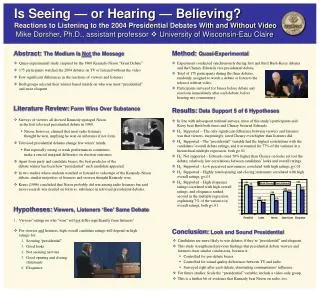
Is Seeing — or Hearing — Believing? Reactions to Listening to the 2004 Presidential Debates With and Without Video Mike Dorsher, Ph.D., assistant professor University of Wisconsin-Eau Claire Abstract: The Medium Is Not the Message Method: Quasi-Experimental • Quasi-experimental study, inspired by the 1960 Kennedy-Nixon “Great Debate” • 175 participants watched the 2004 debates on TV or listened without the video • Few significant differences in the reactions of viewers and listeners • Both groups selected their winner based mainly on who was most “presidential” and most eloquent • Experiment conducted synchronously during first and third Bush-Kerry debates and the Cheney-Edwards vice presidential debate. • Total of 175 participants during the three debates, randomly assigned to watch a debate or listen to the telecast without video. • Participants surveyed for biases before debate and reactions immediately after each debate, before hearing any commentary. Literature Review: Form Wins Over Substance Results: Data Support 5 of 6 Hypotheses • Surveys of viewers all showed Kennedy upstaged Nixon in the first televised presidential debate in 1960. • Nixon, however, claimed that most radio listeners thought he won, implying he won on substance if not form. • Televised presidential debates change few voters’ minds. • But especially strong or weak performances sometimes make a crucial marginal difference on election outcomes. • Apart from party and candidate biases, the best predictor of the debate winner has been how “presidential” each candidate appeared. • In two studies where students watched or listened to videotape of the Kennedy-Nixon debate, similar majorities of listeners and viewers thought Kennedy won. • Kraus (1996) concluded that Nixon probably did win among radio listeners but said more research was needed on form vs. substance in televised presidential debates. • In line with subsequent national surveys, most of this study’s participants said Kerry beat Bush both times and Cheney bettered Edwards. • H1: Supported -- The only significant difference between viewers and listeners was that viewers, surprisingly, rated Cheney even higher than listeners did. • H2: Supported --The “presidential” variable had the highest correlations with the candidates’ overall debate ratings, and it accounted for 77% of the variance in a hierarchical multiple regression, both p<.01 • H3: Not supported – Edwards rated 50% higher than Cheney on looks yet lost the debate; relatively low correlations between candidates’ looks and overall ratings. • H4: Supported – Low perceived nervousness correlated with high ratings, p<.01 • H5: Supported – Highly rated opening and closing statements correlated with high overall ratings, p<.01 • H6: Supported – High eloquence ratings correlated with high overall ratings, and eloquence ranked second in the multiple regression, explaining 7% of the variance in overall ratings, both p<.01 Hypotheses: Viewers, Listeners ‘See’ Same Debate • Viewers’ ratings on who “won” will not differ significantly from listeners’ • For viewers and listeners, high overall candidate ratings will depend on high ratings for: • Seeming “presidential” • Good looks • Not seeming nervous • Good opening and closing statements • Eloquence Conclusion: Look and Sound Presidential • Candidates are more likely to win debates if they’re “presidential” and eloquent. • This study strengthened previous findings that presidential debate viewers and listeners draw similar conclusions, because it: • Controlled for pre-debate biases • Controlled for sound quality differences between TV and radio • Surveyed right after each debate, eliminating commentators’ influence • For future studies: Scale the “presidential” variable; include a video-only group. • This is a further bit of evidence that Kennedy beat Nixon on radio, too.