EEM 561 Machine Vision Lecture 5 Linear Filtering
460 likes | 486 Vues
Learn about linear filters for image denoising, convolution properties, handling edges, practical examples, including blurring and sharpening. Explore Gaussian kernels and separability in filtering.


EEM 561 Machine Vision Lecture 5 Linear Filtering
E N D
Presentation Transcript
EEM 561 Machine VisionLecture 5LinearFiltering Spring 2019 Assist. Prof. Dr. Onur Kılınç EskisehirTech. Uni., Dept. EEE Slides Credit: Frank (Qingzhong) Liu
Motivation: Image denoising • How can we reduce noise in a photograph?
1 1 1 1 1 1 1 1 1 “box filter” Moving average • Let’s replace each pixel with a weighted average of its neighborhood • The weights are called the filter kernel • What are the weights for the average of a 3x3 neighborhood? Source: D. Lowe
f Defining convolution • Let fbe the image andgbe the kernel. The output of convolving f with g is denoted f * g. Convention: kernel is “flipped” • MATLAB functions: conv2, filter2, imfilter Source: F. Durand
Key properties • Shift invariance: same behavior regardless of pixel location:filter(shift(f)) = shift(filter(f)) • Linearity:filter(f1 + f2) = filter(f1) + filter(f2) • Theoretical result: any linear shift-invariant operator can be represented as a convolution
Properties in more detail • Commutative: a * b = b * a • Conceptually no difference between filter and signal • Associative: a * (b * c) = (a * b) * c • Often apply several filters one after another: (((a * b1) * b2) * b3) • This is equivalent to applying one filter: a * (b1 * b2 * b3) • Distributes over addition: a * (b + c) = (a * b) + (a * c) • Scalars factor out: ka * b = a * kb = k (a * b) • Identity: unit impulse e = […, 0, 0, 1, 0, 0, …],a * e = a
Dealing with edges • What is the size of the output? • MATLAB: filter2(g, f, shape) • shape = ‘full’: output size is sum of sizes of f and g • shape = ‘same’: output size is same as f • shape = ‘valid’: output size is difference of sizes of f and g full same valid g g g g f f f g g g g g g g g
Dealing with edges • What about missing pixel values? • the filter window falls off the edge of the image • need to extrapolate • methods: • clip filter (black) • wrap around • copy edge • reflect across edge Source: S. Marschner
Dealing with edges • What about missing pixel values? • the filter window falls off the edge of the image • need to extrapolate • methods (MATLAB): • clip filter (black): imfilter(f, g, 0) • wrap around: imfilter(f, g, ‘circular’) • copy edge: imfilter(f, g, ‘replicate’) • reflect across edge: imfilter(f, g, ‘symmetric’) Source: S. Marschner
0 0 0 0 1 0 0 0 0 Practice with linear filters ? Original Source: D. Lowe
0 0 0 0 1 0 0 0 0 Practice with linear filters Original Filtered (no change) Source: D. Lowe
0 0 0 0 0 1 0 0 0 Practice with linear filters ? Original Source: D. Lowe
0 0 0 0 0 1 0 0 0 Practice with linear filters Original Shifted left By 1 pixel Source: D. Lowe
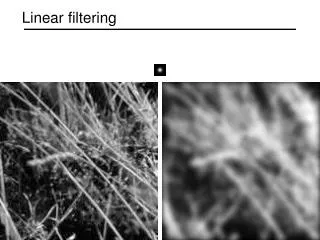
1 1 1 1 1 1 1 1 1 Practice with linear filters ? Original Source: D. Lowe
1 1 1 1 1 1 1 1 1 Practice with linear filters Original Blur (with a box filter) Source: D. Lowe
0 1 0 1 1 0 1 0 1 2 1 0 1 0 1 0 1 0 Practice with linear filters - ? (Note that filter sums to 1) Original Source: D. Lowe
0 1 0 1 1 0 1 0 1 2 1 0 1 0 1 0 1 0 Practice with linear filters - Original • Sharpening filter • Accentuates differences with local average Source: D. Lowe
Sharpening Source: D. Lowe
= detail smoothed (5x5) original Let’s add it back: + = original detail sharpened Sharpening • What does blurring take away? –
Smoothing with box filter revisited • What’s wrong with this picture? • What’s the solution? Source: D. Forsyth
Smoothing with box filter revisited • What’s wrong with this picture? • What’s the solution? • To eliminate edge effects, weight contribution of neighborhood pixels according to their closeness to the center “fuzzy blob”
Gaussian Kernel • Constant factor at front makes volume sum to 1 (can be ignored when computing the filter values, as we should renormalize weights to sum to 1 in any case) 0.003 0.013 0.022 0.013 0.003 0.013 0.059 0.097 0.059 0.013 0.022 0.097 0.159 0.097 0.022 0.013 0.059 0.097 0.059 0.013 0.003 0.013 0.022 0.013 0.003 5 x 5, = 1 Source: C. Rasmussen
Gaussian Kernel • Standard deviation : determines extent of smoothing σ = 2 with 30 x 30 kernel σ = 5 with 30 x 30 kernel Source: K. Grauman
Choosing kernel width • The Gaussian function has infinite support, but discrete filters use finite kernels Source: K. Grauman
Choosing kernel width • Rule of thumb: set filter half-width to about 3σ
Gaussian filters • Remove high-frequency components from the image (low-pass filter) • Convolution with self is another Gaussian • So can smooth with small- kernel, repeat, and get same result as larger- kernel would have • Convolving two times with Gaussian kernel with std. dev. σis same as convolving once with kernel with std. dev. • Separable kernel • Factors into product of two 1D Gaussians • Discrete example: Source: K. Grauman
Separability of the Gaussian filter Source: D. Lowe
Why is separability useful? • Separability means that a 2D convolution can be reduced to two 1D convolutions (one along rows and one along columns) • What is the complexity of filtering an n×n image with an m×mkernel? • O(n2 m2) • What if the kernel is separable? • O(n2 m)
Noise • Salt and pepper noise: contains random occurrences of black and white pixels • Impulse noise: contains random occurrences of white pixels • Gaussian noise: variations in intensity drawn from a Gaussian normal distribution Source: S. Seitz
Gaussian noise • Mathematical model: sum of many independent factors • Good for small standard deviations • Assumption: independent, zero-mean noise Source: M. Hebert
Reducing Gaussian noise Smoothing with larger standard deviations suppresses noise, but also blurs the image
Reducing salt-and-pepper noise • What’s wrong with the results? 3x3 5x5 7x7
Alternative idea: Median filtering • A median filter operates over a window by selecting the median intensity in the window • Is median filtering linear? Source: K. Grauman
Median filter • Is median filtering linear? • Let’s try filtering
Median filter • What advantage does median filtering have over Gaussian filtering? • Robustness to outliers Source: K. Grauman
Median filter • MATLAB: medfilt2(image, [h w]) Median filtered Salt-and-pepper noise Source: M. Hebert
Gaussian vs. median filtering 3x3 5x5 7x7 Gaussian Median
Sharpening revisited Source: D. Lowe
= detail smoothed (5x5) original Let’s add it back: + α = original detail sharpened Sharpening revisited • What does blurring take away? –
unit impulse Gaussian Laplacian of Gaussian Unsharp mask filter image unit impulse(identity) blurredimage
Application: Hybrid Images • A. Oliva, A. Torralba, P.G. Schyns, Hybrid Images, SIGGRAPH 2006
Application: Hybrid Images • A. Oliva, A. Torralba, P.G. Schyns, Hybrid Images, SIGGRAPH 2006 Gaussian Filter Laplacian Filter
Review: Image filtering • Convolution • Box vs. Gaussian filter • Separability • Median filter