Download
1 / 2
20 likes | 187 Vues
This study guide for 6th graders covers essential concepts such as elements, compounds, and chemical reactions. Students will learn about the number of elements, atoms, and the ratios in chemical formulas. It also outlines the four indicators of chemical reactions, the formula for density, and a practical problem on calculating density. Students will follow a lab procedure and discuss the proper disposal of chemicals used. Additionally, they will engage in identifying chemical changes through observation and matching chemical formulas to names.

E N D
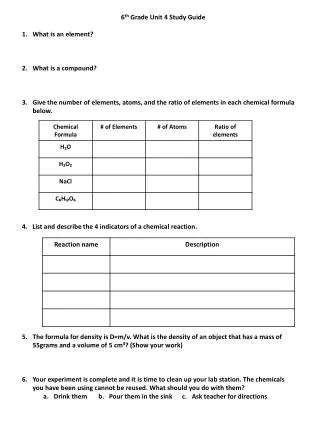
6th Grade Unit 4 Study Guide What is an element? What is a compound? Give the number of elements, atoms, and the ratio of elements in each chemical formula below. 4. List and describe the 4 indicators of a chemical reaction. • The formula for density is D=m/v. What is the density of an object that has a mass of 55grams and a volume of 5 cm³? (Show your work) • Your experiment is complete and it is time to clean up your lab station. The chemicals you have been using cannot be reused. What should you do with them? • Drink them b. Pour them in the sink c. Ask teacher for directions
7. Cameron designed an experiment to measure the amount of a precipitate produced during a chemical reaction. The steps of the experiment are listed in the box, but are not in the correct order. What is the correct order of the lab procedure. A} 6, 1, 4, 3, 2, 5 B] 6, 2, 5, 4, 3, 1 C} 6, 5, 2, 3, 4 ,1 D} 6, 4, 2, 3, 1, 5 • What reusable laboratory equipment would be needed to find the density of an unknown irregular shaped object? • Balance and ruler c. Graduated cylinder and ruler • Graduated cylinder and Balance d. Ruler and Water • Jose had a beaker with a small amount of baking soda. He added a few drops of Vinegar to the baking soda and observed fizzing and bubbling. Based on his observation, which of these can Jose determine about the new substance formed by mixing the baking soda and vinegar? • A. A chemical reaction produced a solid. B. A chemical reaction produced a gas. • No chemical reaction took place. D. Only a physical change happened. • Match the chemical formulas with the chemical name. • NaCl Hydrogen Oxide • H₂O₂ Sodium Chloride • Na₃Ca Hydrogen Peroxide • HO TrisodiumCalcide