Reflections on EU projects
This article provides a comprehensive overview of EU projects related to Technology-Enhanced Learning (TEL), creativity, and roadmapping, reflecting on historical initiatives and future prospects. It discusses the challenges faced by these projects, including low impact and investment returns, while highlighting successful collaborations and the need for innovative funding strategies. The paper also reviews the evolution of TEL research, examining past experiences and the implications for future funding, in light of the changing European landscape for educational research and collaboration.

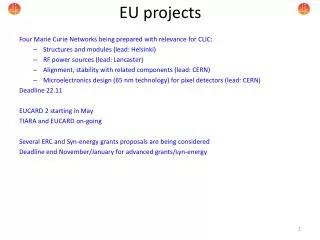
Reflections on EU projects
E N D
Presentation Transcript
Reflections on EU projects Research in Technology-Enhanced Learning, Creativity, and Roadmapping Lampros Stergioulas SISCM, Brunel University
Overview • A historical walkthrough of projects in TEL, Creativity, and Roadmapping • Outlook of EU research funding – current perspective and future prospects • Reflections on EU bids
European TEL research: Home truths and family secrets • Past research (in TEL, & often beyond): • Delivery of TEL below its weight • High expectations, but low impact • Low return on investment, low exploitation • Disillusionment, disappointment • Failing so far to establish EU as a global leader • Good transnational research collaboration • But pan-European, transnational, trans-cultural TEL still elusive
European TEL research: Home truths and family secrets • What future for TEL research funding? • Current trend: A smaller share of a smaller pie; stock taking – New focus on large practice-based trials • Current & future funding squeeze • Politically too important to cut off funding • More focus on industry / exploitation of research • Need for new strategy / new approach to funding programme design • Foresight, Roadmapping, strategic planning
The beginning – how it started • 1996 Research Associate at Cambridge University – partly funded from an EU project • 1998 Joined a consortium in its making • 1999 First proposal – success! – UNIVERSAL project (Lecturer at the University of Manchester, then Lancaster) • €170,000 (overall project grant: ca. €5M)
The UNIVERSAL IST project • 20 institutions from around Europe • Big idea: A common platform to enable Europe’s Universities to share learning resources (still relevant!) • Great fun - Research into semantic web, ontologies, use of metadata, evaluation of e-learning resources • http://zope.cetis.ac.uk/content/20020823174106
The legacy of UNIVERSAL • Seminal project – relatively high impact • The Universal Brokerage platform powers the educanext.org portal • Spawned a variety of other projects on the management and sharing of learning resources
Roadmapping projects • IST Project 2002-2004 • European Roadmap for Professional eTraining – (Lancaster & Brunel) • IST Project 2003-2009 • Network of Excellence in Professional Learning • ESAEO Project 2007-2009 Social dialogue for the European Banking sector
My first role as coordinator • European Digital • Literacy Network • funded by the programme (2007) • www.estart-net.org • Proposal ranked 2nd out of 167 • Network, evaluation, roadmap • Total of €300,000 – largely underfunded
Recent & current projects • eContentPlus project (2008) • Interoperable Content for Performance in a Competency-driven Society www.icoper.org • eContentPlus project (2008) • Skill based scouting of open • user-generated and community-improved content for management education and training • DYRECT - Marie Curie Project (2010) • DYnamic Roadmapping with application for EduCation and Training (eval. 96/100) • Open Discovery Space – started April 2012
Recent projects • Future gazing Technology Enhanced Learning the roadmap for the unknown learning landscape • FP7 project, €2.2M • Brunel coordinates - 10 partners www.telmap.orgProvides direct input to TEL decision making • EC Negotiations: Despite a score of 14.5, tight race to the last minute
Web portal:learningfrontiers.eumaking the invisible visible Aprofessional web portal to monitor and support the research developments/achievements on and the results/impact in TEL. Current features offer: roadmapping space, landscape of researchers, project fact files, and stories of impact
Open Education Europa • ODS is part of this initiative: • http://ec.europa.eu/education/news/20130925_en.htm • The Commission launched 'Opening up Education' to boost innovation and digital skills in schools and universities • (and address the “implementation gap”) • http://openeducationeuropa.eu • Technology and Open Educational Resources as opportunities to reshape EU education
New projects in C&I • FET-ART • explores the interaction between ICT and Art • (started June 2013) • Publicity in Vilnius ICT2013 event • www.ict-art-connect.eu • CRe-AM (Technology Enhanced Creativity) • Roadmapping for the EU creative industries – bridging the creative sectors with the ICT communities. • www.cre-am.eu
Creativity REsearch Adaptive roadMap (CRe-AM) Roadmaps for future research and innovation www.cre-am.eu This publication reflects the views only of the author/project consortium, and the Commission cannot be held responsible for any use which may be made of the information contained therein.
Aim of CRe-AM Aim: to provide a collaboration bridge between the communities of ICT and creative sector, and to provide consultation and support to both ICT and creative sector stakeholders and communities via a long-term Roadmapping service with which they can actively engage The main target users will be: individual creators/workers and professionals, as well as SMEs, creative groups, communities, and organizations. www.cre-am.eu / info@cream.eu
Outlook of EU research funding • current perspectives and future prospects
HORIZON 2020 objectives Industrial leadership SocietalChallenges Excellent Science • 3 key objectives • Integrating the knowledge triangle • Provides scientific and technical support to the European policy
ICT 2013: Create, Connect, Grow 6-8 November 2013, Vilnius ICT in Horizon 2020 the EU's Framework Programme for Research and Innovation for 2014-2020. Specific objectives: A meeting point for potentialproposers; A big policy conference; Understanding change from FP7. See: https://ec.europa.eu/digital-agenda/en/ict-2013
Upsides and downsides • + (what’s in it for me?) • Fund your research • Research autonomy • Build interdisciplinary research • Meet a lot of good people – even if not successful, networking helps • Build broader, lasting collaborations & networks • Team up and work with the best • Take your research to an international level • It’s money for doing something that you like doing anyway! • Get to travel, go to conferences
Upsides and downsides • - (what will I need to avoid/ compromise with?) • Research too prescriptive • Communication can be difficult • Coordinator usually overloaded • Administration can be burden (and time consuming) • Get to travel too much
Observations on success • Clarity and consistency about your vision, pursue it methodically with patience, persevere in the face of failure • Big better than small! – organic approach • Make-up of team (spirit, coverage, capacity mix, size) – early team engagement • Coordination gives you far better control over the final outcome, but not for everyone • Negotiations are crucial decider • A successful proposal is quite different from a successful project (EU eval., recruitment)
Observations on EU bids • Fair game, reasonable success rates • No magic wand, no universal rules • Overall team effort • Management support/buy-in • Research admin support helps a lot • Early communication with EC • Project management • - not to be underestimated • - focus on substance, not on admin • - critical vs superficial
Reflections on research • Openness and collaboration is key: We can only get that far as lone scholars… • Team ethos: honesty, trust, sharing, open, supportive research environment, coaching & mentoring, but agile/loose/variable – a creative mess! • Good use of human resource – “factory of ideas” • Continuity: build on previous success
Reflections on academic success • International collaborations are important for success of a research University • Healthy community of PhD students is equally important for success • Funding is not that important for doing research (but it certainly helps!) – focus more on output, rather than input
Thank you Ahlia University, Bahrain 29/8/2013