Propellantless Electric Propulsion System Development Proposal
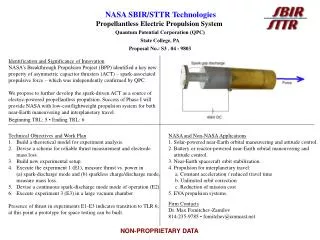
Quantum Potential Corporation (QPC) is leading an innovative project to advance a new type of propulsion based on asymmetric capacitor thrusters (ACT) identified in NASA’s Breakthrough Propulsion Project. This proposal outlines the development of a spark-driven ACT for electric-powered, propellantless propulsion suitable for near-Earth maneuvering and interplanetary travel. Phase I aims to establish a reliable thrust measurement system, build an experimental setup, and execute key experiments, ultimately transitioning to Technology Readiness Level 6 for prototype space testing.

Propellantless Electric Propulsion System Development Proposal
E N D
Presentation Transcript
NASA SBIR/STTR Technologies Propellantless Electric Propulsion System Quantum Potential Corporation (QPC) State College, PA Proposal No.: S3 . 04 - 9803 Identification and Significance of Innovation NASA’s Breakthrough Propulsion Project (BPP) identified a key new property of asymmetric capacitor thrusters (ACT) – spark-associated propulsive force – which was independently confirmed by QPC. We propose to further develop the spark-driven ACT as a source of electric-powered propellantless propulsion. Success of Phase I will provide NASA with low-cost/lightweight propulsion system for both near-Earth maneuvering and interplanetary travel. Beginning TRL: 5 • Ending TRL: 6 • Technical Objectives and Work Plan • Build a theoretical model for experiment analysis. • Devise a scheme for reliable thrust measurement and electrodemass loss. • Build new experimental setup. • Execute the experiment 1 (E1), measure thrust vs. power in(a) spark-discharge mode and (b) sparkless charge/discharge mode,measure mass loss. • Devise a continuous spark-discharge mode mode of operation (E2) • Execute experiment 3 (E3) in a large vacuum chamber • Presence of thrust in experiments E1-E3 indicates transition to TLR 6; • at this point a prototype for space testing can be built. NASA and Non-NASA Applications 1. Solar-powered near-Earth orbital maneuvering and attitude control. 2. Battery or reactor-powered near-Earth orbital maneuvering and attitude control. 3. Near-Earth spacecraft orbit stabilization. 4. Propulsion for interplanetary travel: a. Constant acceleration / reduced travel time b. Unlimited orbit correction c. Reduction of mission cost 5. EVA propulsion systems. Firm Contacts Dr. Max Fomitchev-Zamilov 814-235-9785 • fomitchev@comcast.net NON-PROPRIETARY DATA