Sensation & Perception
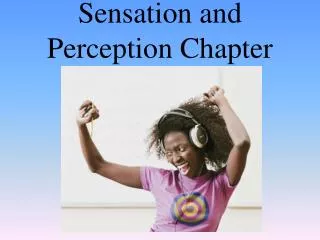
This article explores the relationship between loud music exposure and sensory perception, particularly focusing on its contribution to increased hearing loss among teens. It discusses how sensation and perception differ, and emphasizes the role of music in our sensory experiences. The text outlines evidence from studies suggesting a significant rise in hearing loss due to the use of personal audio devices. It raises questions about potential laws to regulate music volume in public spaces, encouraging reflections on individual experiences with music's loudness.

Sensation & Perception
E N D
Presentation Transcript
Sensation & Perception Unit III: How do you see the world?
10/24/2011 Bellringer • How loud do you listen to your music? Does it bother you when people around you listen to extremely loud music? Why or why not? (Minimum 3 Sentences)
Article Analysis • You are to read the article and complete the following: • In 20 words or less give a summary of the main point of the article. • What evidence listed in the article supports this main point? (minimum 3 pieces of evidence) • Do you think there should be laws limiting the level of volume you can listen to music in public? (Minimum 6 sentences)
Article Analysis • Despite arguments to the contrary, circumstantial evidence points to increased use of music players contributing the rise in hearing loss. • Evidence • American Medical Association Study – Hearing loss in teens up 30% from the 1980’s & 1990’s. • “One problem is that adolescents don’t report well whether the music they’re listen to is loud” (Dr. Josef Shargorodsky, 2011). • An “increase in the use of personal audio devices” that have longer battery lives and enable longer listening periods to loud music (Dr. Paul Kileny).
Article Analysis • TURN IN BOTH THE ARTICLE AND YOUR WORK AT THE END OF THE PERIOD.
Bellringer For 10/26/2011 • What is sensation? List 5 examples. • What is perception?
Sensation • Sensation – The stimulation of sensory receptors by stimuli and the transmission of sensory information to the central nervous system (CNS). • Sensory receptors are located in the sensory organs. • Ex. Eyes & Ears • The stimulation of the senses is automatic.
What if we could sense everything? • It would “overload” our brain with too much information. • We only “take in” or interpret a small percentage of what we sense.
10/27/2011 Bellringer • Name 3 areas where sensory receptors may be located.
Perception • Perception – The process through which we organize & interpret sensory stimulation. • Allows us recognize meaningful objects & events. • Perception reflects learning, expectations, & attitudes. • Involves our experiences.
Bellringer For 10/31/2011 • What is the difference between pre-attentive & attentive processing?
Perception • Two Types: • Pre-attentive Processing – Method of automatically gathering information from the environment. • Attentive Processing – Not automatic. Focuses on the most important information in the environment.
Perception • For this upcoming activity DO NOT read the words. Say the color they are printed in as fast as you can.
Perception • Stroop Effect – Pre-attentive processes act as an interference. • Stroop Test – Involves labeling color’s names (ex. Blue, green, red) as different than the color of the text (ex. The word “blue” is colored red). • The pre-attentive processes slow reaction time down.
Four Concepts That Affect Sensation & Perception • Absolute Threshold • Difference Threshold • Signal-Detection Theory • Sensory Adaptation
1. Absolute Threshold • The weakest amount of a stimulus that can be sensed. • Ex. Beeps for a hearing test • Dog’s sense of smell vs. Human’s sense of smell • Owl’s vision vs. Human’s vision • Absolute threshold can differ from person to person. • Differences result from psychological & biological factors
1. Absolute Threshold • Absolute Thresholds For Humans • Vision – A candle flame viewed from a distance of about 30 miles on a dark night. • Hearing – The ticking of a watch from about 20 feet away in a quiet room • Smell – About one drop of perfume diffused throughout a small house. • Taste – About 1 teaspoon of sugar dissolved in 2 gallons of water • Touch – The wing of a fly falling on a cheek from a distance of about .4 inch
2. Difference Threshold • The minimum amount of difference that can be detected between two stimuli. • People’s individual difference thresholds vary slightly. • Is the car midnight blue or black?
3. Signal-Detection Theory • A method of distinguishing sensory stimuli that takes into account both their strengths and the following: • The setting • Your physical state • Your mood • Your attitudes • Focus on what we consider important. • Ex. Friend in a noisy cafeteria or at a party.
4. Sensory Adaptation • The process of becoming more sensitive to weak stimuli & less sensitive to unchanging stimuli. • Movie Theater • Noise in the city vs. the country • Your bedroom