Download
1 / 18
180 likes | 293 Vues
This study examines the formation and implications of cold-air pools (CAPs) in Salt Lake City, focusing on persistently stable atmospheric conditions due to strong inversions and topographical effects. CAPs can lead to significant local emissions buildup, affecting air quality by trapping pollutants. Using advanced meteorological modeling techniques over a specific period in early January 2011, the research highlights the limitations of current models in accurately capturing pollution events. Increased model resolution shows improvement, emphasizing the need for better initialization datasets to refine predictions.

E N D
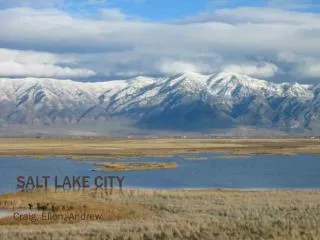
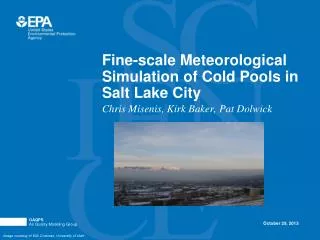
Fine-scale Meteorological Simulation of Cold Pools in Salt Lake City Chris Misenis, Kirk Baker, Pat Dolwick Image courtesy of Erik Crosman, University of Utah
Overview & Air Quality Implications • Cold-air pool (CAP) formation occurs due to strong inversions within topographical deformations. • Persistent CAPs are due to restricted ventilation (deeply stable) and lack of horizontal displacement (orographic forcing). • CAPs in dense urban locations can lead to significant stagnation and a build-up of local emissions (vehicles, industrial, home heating). • Current meteorological models tend to be too diffusive, leading to chemical models failing to capture pollution (PM2.5 in SLV, O3 in Upper Green River Basin) buildup.
PCAPS • Persistent Cold-Air Pool Study • Intensive field campaign ran from December 2010 through early February 2011, centered over the Salt Lake Valley • Will focus on early January 2011 period. • Strongest, most polluted period during PCAPS (1/1-1/9)
Modeling Setup • WRF v3.3 • 12/4/1km (only 4 & 1km shown) • 12/6/2010 – 3/15/2011 • NAM-12 Initialization • USGS landuse • Noah land-surface • Mellor-Yamada-Janjic PBL • Goddard SW, RRTM LW • Thompson microphysics • 35 layers up to 50 mb, 20-m lowest layer • Nudging of T, Q and winds above PBL
Runs to be evaluated against 7 ISFS stations (temperature, winds, shortwave radiation)
Temperature – 4km CAP ends Playa River
Wind Speed – 4km Playa River
Temperature – 1km Playa River
Wind Speed – 1km Playa River
Summary Statistics • While having overall low biases, simulations using NARR initialization had worse model performance per RMSE. • In terms of model error, performance improves when increasing resolution from 1 to 4-km. • Initialization dataset has greater impact than model physics.
Vertical Profile NAM1KM PX1KM
Vertical Profile NAM1KM PX1KM
Vertical Profile NAM1KM PX1KM
Thoughts and Future Work • During periods of cold pool formation, WRF: • tends to overestimate surface temperature and wind speeds, with slight improvements as resolution is increased. • overestimates incoming shortwave radiation • typically erodes the deeply stable layers too soon, per vertical profiles. • Further analysis of initialization datasets required to better understand biases and possible corrections • Broad community working to better understand current issues • Lareau et al., 2013 • Silcox et al., 2012