Exploration of New Cell Lines: Characterization and Antibody Use in Macrophage Studies
This work focuses on the evaluation of seven cell lines, including J774A.1 and Raw 264.7, to explore their responsiveness to various stimuli. High ectopic expression of proteins was achieved using lentiviral methods, while RNA interfering showed effectiveness in macrophage lines. Preliminary assessments of AfCS assays have confirmed second messenger responses. Current antibody cocktails are prepared for macrophage use, and no issues with lipid analysis are anticipated. This study emphasizes improving throughput and fidelity of primary cell isolation compared to cultured cells.

Exploration of New Cell Lines: Characterization and Antibody Use in Macrophage Studies
E N D
Presentation Transcript
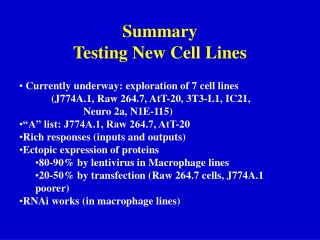
SummaryTesting New Cell Lines • Currently underway: exploration of 7 cell lines • (J774A.1, Raw 264.7, AtT-20, 3T3-L1, IC21, • Neuro 2a, N1E-115) • “A” list: J774A.1, Raw 264.7, AtT-20 • Rich responses (inputs and outputs) • Ectopic expression of proteins • 80-90% by lentivirus in Macrophage lines • 20-50% by transfection (Raw 264.7 cells, J774A.1 poorer) • RNAi works (in macrophage lines)
SummaryTesting New Cell Lines • Preliminary assessment of AfCS assays • Second messenger responses (Ca, cAMP) verified • Current antibody cocktails are ready for use in macrophage lines • Macrophage lines suitable for microscopy • Anticipate no problems with lipid analysis • MA analysis should not be problematic • Protein trap – Expression levels higher than WEHI cells
SummaryTransition from Current Focus • Higher throughput anticipated • Cultured cells vs isolation of primary cells from mice • Delays • Characterization of cell line stability • New libraries for Yeast 2 hybrid • Development of new assays • (chemotaxis, phagocytosis, secretion, etc.) • Data handling/display (transparent) • Ligand list
Ligand List RAW264.7 (Literature) Other responses TGF-b c-Fms (M-CSF-R) IL-1b TNF IL6 Il-10 RANKL BNP IFN-g Fcg cAMP responses Ter (b-adrenergic) PGE2 (EP2, EP3, and EP4) VIP PACAP Ca responses MCP-1 (CCR2) C5a (C5a-R) UTP LPA Estrogen/Androgen
GPCR List RAW264.7 (MA analysis) Adenosine A2b Adrenomedulin GRPbombesin Cannabinoid 1 Chemokine C-C 2 (Cmkbr2) Chemokine CCX CKR Chemokine C-X-C 3 (Cmkar3) Chemokine C-X3-C R1 (similar to) Cysteinyl leukotriene 1 Dopamine 3 Endothelin B Estrogen LPA (vzg-1) LPA 2 Malanocortin 5 Nerotensin 2 (B) NPY –Y1 PACAP 1 PGE 1 PGE EP2 P2Y 4 P2Y5 P2Y 12 PGE 4 5-HT 1B 5-HT 2C Somatostatin 2 SDF1 Stromal Cell Derived factor 2 V1a arginine vasopressin
Ligand List for Cell Lines on “A List” Pathway Gs Gi Gq Other GPCR Other Rec. Toll-like, Cytokine, Tyr Kinase, Adh, other Total Raw 264.7 5 4 3 3 16 31 J774A.1 3 5 4 2 12 26 AtT-20 4 4 1 2 10 21