Download
1 / 8
80 likes | 193 Vues
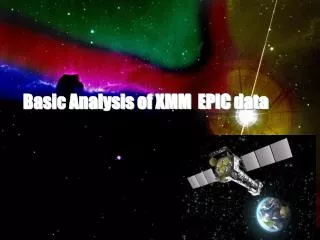
This document outlines the basics of analyzing data from the European Photon Imaging Camera (EPIC) as part of the XMM-Newton spacecraft mission. It covers the specifications of EPIC, including its field of view, energy ranges, and angular resolution. The data preparation steps include processing raw event files, cleaning and filtering data, as well as producing counts images and exposure maps. Finally, it discusses creating a triple-color image for better visualization of different energy ranges, highlighting the significance of effectively analyzing XMM-EPIC data for astrophysical studies.

E N D
Introduction of EPIC (European Photon Imaging Camera) • EPIC • FOV: 30 arcmin • Energe rage:0.2kev~15kev • Angular resolution: 6 arcsec FWHM • MOS camera • 7 planes • energy range: 0.2keV~10 keV • one pixel covers 1.1 x 1.1 arcsec • PN camera...
Process the MOS data Data Preparation 1.Process the ODFs raw event files 2.Clean & filter the data (rate, time)(expression:patten<=12 & PI in[200:12000]) Produce image 1.Extract counts images 2.Create Exposure Map 3.Adaptively Smooth the Image 4.Plotting Images (3 Color) ....
Triple Colour Image 5 • Red:0.5keV~2keV • Green:2keV~4keV • Blue:4keV~12keV
Red:0.5keV~2keV • Green:2keV~4keV • Blue:4keV~12keV