Understanding Multicasting: Efficient Data Transmission Techniques
This guide explores the concept of multicasting in data communication, highlighting its advantages over unicasting and broadcasting. Multicasting conserves bandwidth by sending a single data stream to multiple recipients, ensuring efficient network traffic management. The document details the types of casting, the application of User Datagram Protocol (UDP), IP addressing for multicast groups, and routing techniques. Additionally, it covers real-world applications such as video conferencing and corporate communications, showcasing how multicast technology enhances performance and reduces costs.

Understanding Multicasting: Efficient Data Transmission Techniques
E N D
Presentation Transcript
Multicasting AbdulRahman AbdulSalam Ahmad AlHammar Yousef Yateem
Types of Casting • Unicasting: • One-to-one • Easy to implement • Will waste bandwidth if many people demand the same data. • Broadcasting: • Multicasting:
Types of Casting • Unicasting: • One-to-one • Easy to implement • Will waste bandwidth if many people demand the same data. • Broadcasting: • One-to-all • Good when all request the same data • Bad if some don’t want it • Multicasting: • One-to-group • Solves both the problems above • More complicated than the two above
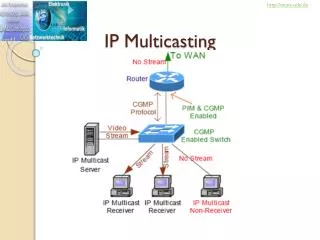
The Basic Idea of Multicasting Instead of sending a separate copy of the data for each recipient, the source sends the data only once, and routers along the way to the destinations make copies as needed.
Why Multicasting? • Conserves Bandwidth • Consider stats from Victoria Secrets • More than 1 million web hits during the 1st hour • 283% increase in web traffic during event. • Enhanced Efficiency: • controls network traffic and reduces CPU loads • Optimized performance: • eliminates traffic redundancy • It’s all about the Cost • more bandwidth more costs
Multicast vs. Unicast Bandwidth Usage for Clients Listening to an 8 Kbps Audio Stream
Multicasting at Transport Layer • Multicasting uses UDP (User Datagram Protocol) as its underlying transport protocol. • No retransmission of packets or acknowledgment in the TL . • Any reliability must be engineered-in at higher level. • The more reliable Multicasting forms, do have negative acknowledgments.
Multicasting at Network Layer(IP Multicasting) • Addressing • IP addresses Class D • Address the message to Multicast group • GroupManagement • Uses Internet Group Management Protocol (IGMP) 3.Routing • Message goes to Rendez-vous Points (RP) • RPs forward message to devices in domain and other RPs. • The Multicast Routing Protocol used is (PIM-SM)
Shortest Path Tree Source Group Member 1 Group Member 2
Rendezvous Point Tree RP Tree Shortest Path Trees Source 1 Rendezvous Point Source 2 Group Member 1 Group Member 2
Applications that use Multicasting: • Video conferencing • Corporate communications • Distance learning • Distribution of software • Stock quotes • News
Sources and refrences • http://www.savetz.com/mbone/ch3_1.html • http://en.wikipedia.org/wiki/Multicasting • http://abilene.internet2.edu/services/multicast.html • http://www.multicasttech.com/ • http://www.internet2.edu/resources/infosheetmulticast.pdf • http://mcast-wiki.internet2.edu/index.php?n=Main.MulticastCookbook • http://www.tcpipguide.com/free/t_IPMulticasting-2.htm • http://www.cisco.com/warp/public/779/largeent/learn/technologies/multicast.html. • http://www.cisco.com/warp/public/cc/pd/iosw/prodlit/ipimt_ov.htm • http://www.answers.com/topic/multicast?method=22 • http://www.uoregon.edu/~joe/understanding-mpeg1-multicast.pdf • http://www.cisco.com/application/pdf/en/us/guest/products/ps6552/c1161/cdccont_0900aecd80310883.pdf • ftp://ftpeng.cisco.com/ipmulticast/networkers00/IntroToIPMulticast.pdf • www.iana.org/assignments/multicast-addresses. http://www.sprintlink.net/multicast/faq.html#JoiningGroups