SlideServe
Menu
Préférences
© SlideServe · v2026

Innovative Solar Power Plant Design: The HELIANTHUS System for Efficient Sunlight Trapping

garret avatar
8 diapositives · 216 Views · Oct 13, 2014

This paper explores the HELIANTHUS solar power plant, designed by Paolo Zozzaro and Roberto De Luca, focusing on a three-dimensional arrangement of sunlight traps. The HELIANTHUS system harnesses solar radiation to heat water using encapsulated black bodies, allowing concentrated solar energy with minimal environmental impact. The advantages of this innovative approach include reduced space usage and limited harm to wildlife. This study concludes with the potential for optimizing sunlight trapping technology while addressing environmental concerns and future energy sustainability.
Innovative Solar Power Plant Design: The HELIANTHUS System for Efficient Sunlight Trapping - slide 1
01 / 8Innovative Solar Power Plant Design: The HELIANTHUS System for Efficient Sunlight Trapping
1 / 17

Télécharger la présentation

Innovative Solar Power Plant Design: The HELIANTHUS System for Efficient Sunlight Trapping
Une image / un lien ci-dessous est fourni (tel quel) pour télécharger la présentation

Politique de téléchargement : le contenu du site vous est fourni TEL QUEL pour votre information et votre usage personnel ; il ne peut être vendu, concédé sous licence ni partagé sur d’autres sites sans l’accord de son auteur.Le contenu vous est fourni TEL QUEL, pour votre information et votre usage personnel uniquement. Téléchargez la présentation en cliquant sur ce lien. Lors du téléchargement, si vous ne parvenez pas à télécharger une présentation, l’éditeur a peut-être supprimé le fichier de son serveur.Pendant le téléchargement, si vous ne parvenez pas à obtenir une présentation, le fichier a peut-être été supprimé par l’éditeur.

F I N

Plus de contenu associé

Transcription de la présentation
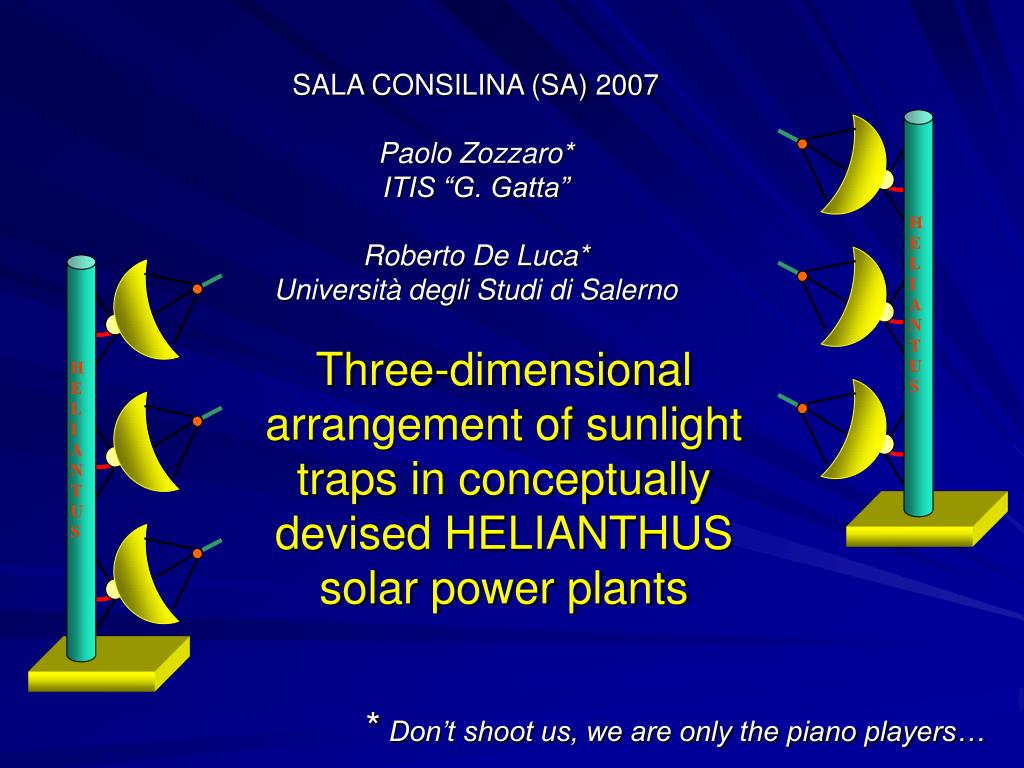
  1. HEL I ANTUS HEL I ANTUS SALA CONSILINA (SA) 2007 Paolo Zozzaro*ITIS “G. Gatta”Roberto De Luca*Università degli Studi di Salerno Three-dimensional arrangement of sunlight traps in conceptually devised HELIANTHUS solar power plants *Don’t shoot us, we are only the piano players…

  2. Secondary mirror z Primary mirror M1 q to a black body y M2 Light sensor A solar trap: the Planckon system Is it possible to trap solar radiation? The answer is affirmative [1] [1] R. De Luca, F. Romeo, P. Zozzaro, Capturing sunlight, Eur. J. Phys. 27 (2006) 347-352

  3. No convection liquid to heat water A black body can be used to store radiating energy Perfectly reflecting inner walls Black metallic nucleus containing water Rotating mechanical system Opening for solar radiation intake

  4. HEL I ANTUS Therefore, if we are able to concentrate sunlight in a small region in space and we are able to let this radiating energy enter, through a small hole, a cavity with highly reflecting inner walls, we can say we have trapped sunlight. In the PLANCKON system, sunlight is used to heat water in a spherical chamber. We can now extend this concept to black bodies of different shapes, in order to heat water or generate steam, as in an HELIANTHUS column.

  5. solar collector HELIANTHUS: How does it work? Let us take a look inside… hollow cylindrical insulating layer metal jacket Steam pipe hollow cylindrical insulating layer metal jacket containing water water

  6. HELIANTUS HELIANTUS HELIANTUS HELIANTUS HELIANTUS HELIANTUS HELIANTUS HELIANTUS What the advantages? Three-dimensional arrangement of solar collectors. A rough estimate for power output of a single helianthus column under partly cloudy sky conditions: P = N r A N=5; r =500 W/m2; A=10 m2, so that P = 25 kW.

  7. fiber Other applications? PV cells inside PV cell Diffusing system and filter

  8. IN CONCLUSION: Is sunlight trapping convenient as far as environmental issues are concerned? • No need of convection fluids • Saving horizontal space on Earth surface • Confined energy (almost no harm to flying species, almost no physical impact on ground fauna) • DRAWBACKS: it does not exist yet… Please let future life on Earth be possible!