Pythagorean Theorem: The Geometric Formula Linking Altitude, Base, and Hypotenuse
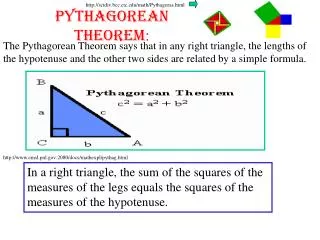
The Pythagorean Theorem states that in a right triangle, the square of the length of the hypotenuse is equal to the sum of the squares of the other two sides. This theorem is fundamental in geometry and has wide applications in various fields. Learn how to apply it effectively!

Pythagorean Theorem: The Geometric Formula Linking Altitude, Base, and Hypotenuse
E N D
Presentation Transcript
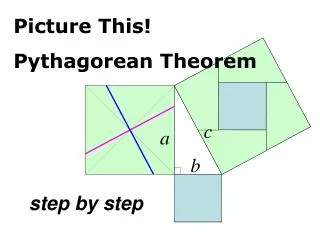
a = altitude b = base c = hypotenuse c a b
a = altitude b = base c = hypotenuse
a = altitude b = base c = hypotenuse
a = altitude b = base c = hypotenuse
a = altitude b = base c = hypotenuse Area of each rectangle is ab
a = altitude b = base c = hypotenuse Sum of areas = 2ab
a = altitude b = base c = hypotenuse
a = altitude b = base c = hypotenuse Sum of areas = 2ab
a = altitude b = base c = hypotenuse Sum of areas = 2ab
a = altitude b = base c = hypotenuse Sum of areas = 2ab
a = altitude b = base c = hypotenuse Sum of areas = 2ab
a = altitude b = base c = hypotenuse Sum of areas = 2ab
a = altitude b = base c = hypotenuse Sum of areas = 2ab
a = altitude b = base c = hypotenuse Sum of areas = 2ab
a = altitude b = base c = hypotenuse a - b Sum of areas = 2ab
a = altitude b = base c = hypotenuse a - b Sum of areas = 2ab Area = (a - b)2
a = altitude b = base c = hypotenuse a - b Sum of areas = 2ab Area = (a - b)2 Total area = c2
a = altitude b = base c = hypotenuse Sum of areas = 2ab Area = (a - b)2 Total area = c2 c2 = (a - b)2 + 2ab
a = altitude b = base c = hypotenuse Area = (a - b)2 Total area = c2 c2 = (a - b)2 + 2ab c2 = a2 - 2ab + b2 + 2ab c2 = a2 + b2 Sum of areas = 2ab