Pythagorean Theorem
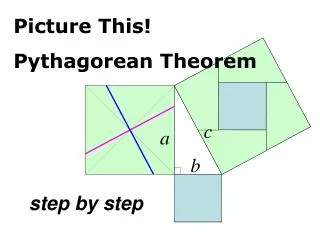
Explore the Pythagorean Theorem with this detailed, step-by-step guide using right triangles. Start by labeling the sides of the triangle as a, b, and c. Construct squares on each side, find the center by drawing diagonals, and create a parallelogram that demonstrates the theorem visually. This method shows that the sum of the squares of the legs (a² + b²) equals the square of the hypotenuse (c²). Perfect for visual learners, this explanation breaks down the theorem into easy-to-follow steps.

Pythagorean Theorem
E N D
Presentation Transcript
Picture This! Pythagorean Theorem c a step by step b
label the sides c a b
find the center of the square on a by drawing its diagonals c a b
Then copy side c c a b
and slide it over−parallel to side c c a b to the center of the square on a
The 2 perpendicular bisectors at the center divide the square into c a b 4 equal parts
c c c c 2 2 2 2 The length of each arm radiating out from the center c is equal to half of side c
Sliding side c along the baseto the center of the square c also makes a parallelogram
So side b of the triangle plus the shortest side of the quadrilateral b c b is equal to the long side of the quadrilateral.
The insides fit because each one equals side b plus the short side c a b
The square on b fills the space in the middle of the square on c c a b so we’re done!
We had to cut up the square on side a to do it, but we proved that c a b for right triangles...
a2 + b2 = c2 c a b