Understanding Biology: Key Concepts, Definitions, and Processes Explained
270 likes | 397 Vues
This comprehensive guide delves into essential biological concepts, including the study of life, cell structure, genetics, evolution, ecology, and macromolecules. It defines common prefixes and suffixes, such as "hetero-" and "homo-," and elucidates the roles of different cell organelles. The text also covers essential topics like cellular processes, definitions of organisms, genetic variation, and ecological interactions, providing a thorough understanding for biology students and enthusiasts. Explore the building blocks of life and the interconnectedness of biological systems.


Understanding Biology: Key Concepts, Definitions, and Processes Explained
E N D
Presentation Transcript
Biology Review Study of life
Prefixes/Suffixes Hetero- – different Heterozygous Homo- – same Homozygous Hydro- – water Hydroponic Pseudo- – false Pseudopod Lys-, Lyso-, -Lyse – Split Lysosome, Hydrolysis a-, an- - without Anaerobic - pod, -ped – foot Gastropod - philia – love of Hydrophilic, Philadelphia - phobia – fear of Arachnophobia - Cyto – cell Cytochrome Chrom, chromo Chromatophore logy – study of Biology zoo, zoa – animal Protozoa
To be an Organism (living) • It must react to environment • It must use energy • It be made of cells • It must reproduce • It must grow and develop • Homeostasis= all 5 conditions met and vital signs are stable
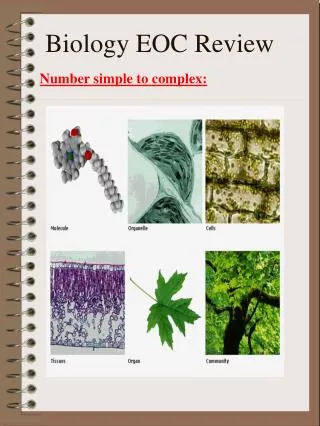
The Cell • Cells are made up of Macromolecules • Prokaryotes (bacteria) have no membrane organelles • Eukaryotes (plants and animals) have membrane organelles
Macromolecules • Carbohydrates, Proteins, Lipids, and Nucleic Acids • Monomers- smaller unit building block • Polymers -repeated chain of monomers • Dehydration synthesis- building (makes water) • Hydrolysis- cutting up (water incorporated)
Carbohydrates Elements present C, H, O Monomer-Monosaccharide Ex. glucose Polymer-Polysaccharide Ex. Cellulose Nutrition- Fast energy source
Lipids Elements present- C, H, O Monomer fatty acids Polymers triglycerides, phospholipids, waxes, steroids Nutrition Energy storage
Proteins Elements present- C, H, O, N, S Monomer- amino acids ex. Glycine Polymer- Polypeptides (protein) Nutrition Main building blocks of your body tissues Enzymes Catalyst Specific to reactions
Nucleic Acids Elements present- C,H,O, N, P Monomer nucleotide Polymer DNA and RNA Nutrition- Components for energy storage and info storage ATP Energy currency- make and break phosphate bonds
Organelles • Nucleus • control center • Cell membrane • outside barrier controlling what enters and exits • Cell wall • rigid outer layer providing structure • Cytoskeleton • support • Cytoplasm • thick, clear liquid holding organelles.
Organelles • Smooth endoplasmic reticulum • make and process lipids (detoxifies) • Rough endoplasmic reticulum • Channels covered with ribosomes used in the synthesis and processing of proteins • Golgi apparatus • Stacked membranes with vesicles used for secretion • Ribosome • responsible for protein synthesis • Lysosome • Digest materials
Organelles • Mitochondria • energy production • Cilia/flagellum • hair/tail-like projection used for movement • Vacuole • storage • Chloroplast- • photosynthesis • Centrioles- • Used in animal cell reproduction
Membrane Transport Passive transport- NO energy Active Transport- energy Ion pump- low to high Endocytosis- intake large material in vesicles Exocytosis-release large material in vesicles • Diffusion- high to low • Osmosis- water • Facilitated Diffusion- High to low through transport protein
Photosynthesis • CO2 + H2OC6H12O6 + O2
Cellular Respiration • C6H12O6 + O2CO2 + H2O
Cell Reproduction Mitosis- body cells Meiosis- sex cells Prophase I Metaphase I Anaphase I Telophase I Prophase II Metaphase II Anaphase II Telophase II 4 cells - half the # of chromosomes • Prophase • Metaphase • Anaphase • Telophase • 2 cells -exact copies
Genetics • -genes determine the physical appearance of organisms and the proteins that their cells manufacture • Phenotype – what an organism “looks” like. Proteins that are made • Genotype – an organism’s combination of alleles – what it got from it’s parents. • Heterozygous –different version of each gene from parents. Generally show the dominant trait. Aa • Homozygous – got two of the same version of a gene…one from each parent these individuals either show the recessive trait or the dominant trait. AA or aa
Genetics • Chromosomes (made of DNA) are the unit of heredity (genetics) • Central Dogma- DNARNAProtein • Any change to the DNA is a mutation • ATTCG • ATCG – deletion • ATTGCG – addition • ATTGG- substitution
Evolution • Change over time • Caused by natural selection • Strongest/smartest survive and have the most kids • “good” traits are passed on and dominate
Evidence • Fossils • Homologous structures- similar internal structures different external appearance • Vestigial Structures- left over structures • Embryology- similar development • DNA • Controlled Experiments- bacteria
Ecology • Interaction in nature • Biotic- living • Abiotic- nonliving • If you change one part of the environment something else will have to change in response • We are all connected
Succession in an ecosystem moves to the CLIMAX COMMUNITY for that SPECIFIC area - in temperate forest, this is forest. In grassland, it would be…grass. Abiotic factors are non-living or once living – rain, rocks, fallen logs, wind Biotic factors are LIVING – animals, plants, moss, plankton Ecology – study of the interaction of organisms and their environment Organism – one member of a species Population- every member of a single species in an area Community- all LIVING things in an area (BIOTA) Ecosystem –all living and non living components in an area (BIOTA and ABIOTA) Biosphere – all the ecosystems on earth Organisms can only live within a range of conditions that we refer to as the TOLERANCE RANGE.
Biomes of the world • a biome is a land area that has certain characteristics • Temperate deciduous forest – our biome. 4 seasons. Moderate rainfall. Mostly broadleaf trees • Taiga-The swampy coniferous forest of high northern latitudes, esp. that between the tundra and steppes of Siberia and North America. • Tundra - essentially a desert-very little rainfall >10” 2 seasons – cold and warm • soil is frozen year round – PERMAFROST. Plants are generally small • Desert – very little rainfall >10” poor soil. Reptiles / insects dominate the animal • life. Plants are water storers, and generally protected by spines, poisons, etc • Rainforest – lots of rainfall <200” per year in some locations. Lush plant growth • Temperate-latitudes like ours Tropical-located between the tropics • Grasslands- less rainfall than temperate deciduous forests, frequent fires. Seasonal rainfall is common with distinct wet and dry seasons. A.K.A. Prarie, veldt, pampas, steppe
Life forms • Kingdoms • Animals • Plants • Fungi • Protist • Eubacteria • Archaebacteria
Plants • Plants carry out photosynthesis