Utilizing Context Clues to Infer Word Meanings in Reading
Readers can enhance their understanding of unfamiliar words by using context clues found within sentences. By identifying synonyms, antonyms, explanations, or examples in the text, one can infer the meanings of unknown terms. Punctuation and type style can also provide hints, such as quotation marks to indicate special meanings or parentheses for definitions. Recognizing these elements helps readers decode complex vocabulary and improve overall comprehension, leading to a richer reading experience.

Utilizing Context Clues to Infer Word Meanings in Reading
E N D
Presentation Transcript
Context Clues How can a reader use the situation of a word, description, or phrase to infer meaning?
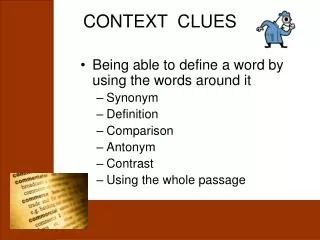
Synonym • A synonym, or word with the same meaning, is used in the sentence. • My opponent's argument is fallacious, misleading – plain wrong.
Antonym • A word or group of words that has the opposite meaning reveals the meaning of an unknown term. • Although some men are loquacious, others hardly talk at all.
Explanation • The unknown word is explained within the sentence or in a sentence immediately preceding. • The patient is so somnolent that she requires medication to help her stay awake for more than a short time.
Example • Specific examples are used to define the term. • Celestial bodies, such as the sun, moon, and stars, are governed by predictable laws.
Punctuation • Readers can also use clues of punctuation and type style to infer meaning, such as quotation makes (showing the word has a special meaning), dashes, parentheses or brackets (enclosing a definition, and italics (showing the word will be defined). • Tom’s father was a haberdasher, or men’s shop keeper, in the story. • Tom’s father was a haberdasher (men’s shop keeper) in the story. • In the story, Tom’s father was a haberdasher-or men’s shop keeper. • Tom’s father was a “haberdasher”. He had a clothing store for men.