
SlideServe
Menu
Préférences
© SlideServe · v2026

Two receptor classes

gary avatar
18 diapositives · 531 Views · Aug 27, 2014

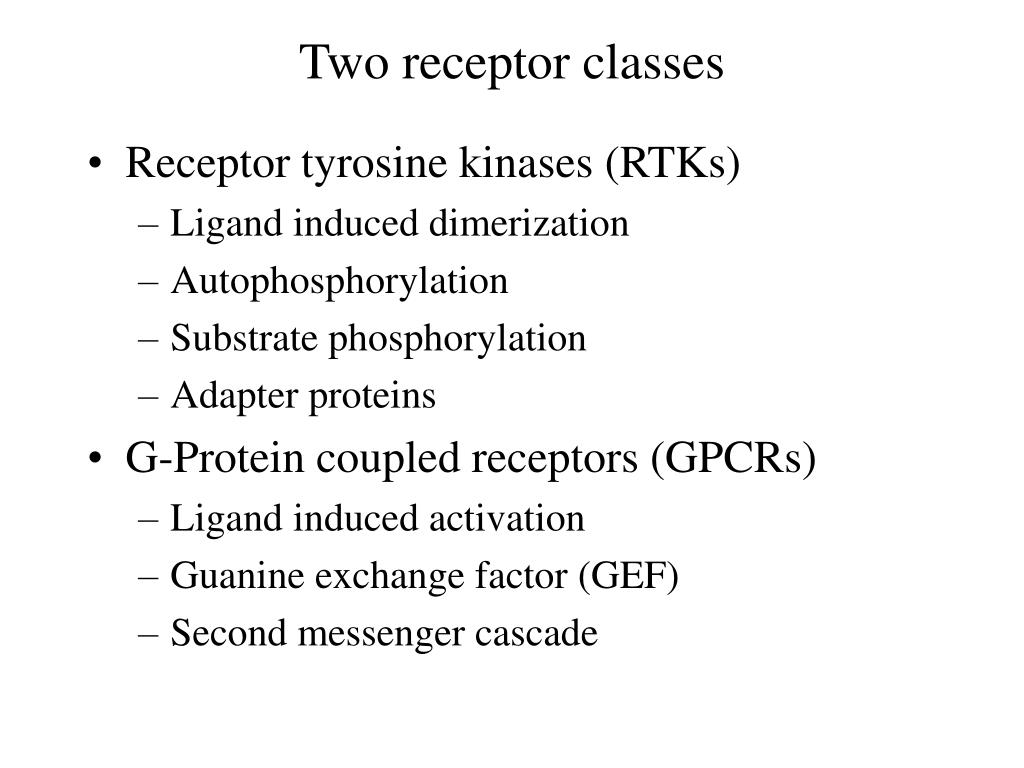
Two receptor classes. Receptor tyrosine kinases (RTKs) Ligand induced dimerization Autophosphorylation Substrate phosphorylation Adapter proteins G-Protein coupled receptors (GPCRs) Ligand induced activation Guanine exchange factor (GEF) Second messenger cascade. Nucleotide cyclases.
Two receptor classes - slide 1
01 / 18Two receptor classes
1 / 17

Télécharger la présentation

Two receptor classes
Une image / un lien ci-dessous est fourni (tel quel) pour télécharger la présentation

Politique de téléchargement : le contenu du site vous est fourni TEL QUEL pour votre information et votre usage personnel ; il ne peut être vendu, concédé sous licence ni partagé sur d’autres sites sans l’accord de son auteur.Le contenu vous est fourni TEL QUEL, pour votre information et votre usage personnel uniquement. Téléchargez la présentation en cliquant sur ce lien. Lors du téléchargement, si vous ne parvenez pas à télécharger une présentation, l’éditeur a peut-être supprimé le fichier de son serveur.Pendant le téléchargement, si vous ne parvenez pas à obtenir une présentation, le fichier a peut-être été supprimé par l’éditeur.

F I N

Plus de contenu associé

Transcription de la présentation
  1. Two receptor classes • Receptor tyrosine kinases (RTKs) • Ligand induced dimerization • Autophosphorylation • Substrate phosphorylation • Adapter proteins • G-Protein coupled receptors (GPCRs) • Ligand induced activation • Guanine exchange factor (GEF) • Second messenger cascade

  2. Nucleotide cyclases Kinases Phospholipases Hierarchical overview Signaling molecule G-Protein coupled receptor Receptor tyrosine kinase Second messengers Effector kinase cascades Gene expression Protein activity Phenotypic behavior

  3. eg: Insulin • Generated by pancreas • Acts on muscle & other tissues • Multiple mechanisms • Multiplicative mechanisms IR IRS-1 Shc Glut4 translocation GRB2 PI3-K PKC Protein synthesis Raf mTOR Akt MEK Gene transcription Elk-1 MAPK

  4. eg: Prostaglandin E2 • Locally generated • Inflammatory mediator • Labor EPR Gq Gi L-type Ca2+ Potentiation AC PLC PKC In/Decreased Contractility Raf CaM Ca2+ MEK Gene transcription Elk-1 MAPK

  5. Receptor tyrosine kinases • Single pass transmembrane protein • Ligand induces dimerization • Kinase activity • Autophosphorylation • Complex formation FGF receptor binding FGF FGF Cytoplasmic

  6. Phosphotyrosine binding • Phospho-Tyrosine Binding (PTB) • Src homology (SH2, SH3) domain • Common amino acid motif • Phosphotyrosine binding pocket • Phosphorylation dependent association Interaction with both pY and nearby residues Sh2 domain from Itk PDB:2etz xnnletyewy nksisrdkae kllldtgkeg afmvrdsrtp gtytvsvftk aiisenpcik hyhiketnds pkryyvaeky vfdsiplliq yhqynggglv trlrypvcg

  7. Phosphotyrosine binding • Recruit biologically active molecules • Phospholipases, PI3-K • GTPase modulators (Sos, DOCK180) • Adapter proteins (Grb-2, Shc, Nck, Crk) • Increase effective availability of substrate • Membrane phospholipids • Other pY-bound proteins • Increase biological activity • Phosphorylation dependent activation • pY-binding dependent activation

  8. eg: FGFR phosphorylation FGF DNA Synthesis cdc related kinase Crk Y463 Y583 Shc Y653 PLC Y730 GRB2 Y766 IP3+DAG Ca2+, motility Sos MAPK growth

  9. Modulation & Termination • Modulation • Receptor antagonists • Combinatorial control • Termination • Protein Tyrosine Phosphatases (PTPs) • Internalization • Ubiquitinylation

  10. G-Protein Coupled Receptor • GPCR are 7 pass transmembrane proteins • Rhodopsin/b-adrenergic • Secretin/vasointestinal peptide • Metabotropic glutamate • Ga Guanine exchange factor (GEF) • Heterotrimeric G-Protein • Ga - Gbg binding • Can function monomeric • Also dimerize

  11. GPCR • Receptor ligation catalyzes GDP-GTP exchange on Ga • GTP bound Ga dissociates from Gbg • Ga modulates secondary signaling • Gbg may also modulate secondary signaling Unligated Receptor Bound Receptor Ga-GDP Ga-GTP Gbg Gbg

  12. G-a mediated signaling • Acylated, membrane bound Ga and target • Ga allosterically regulated by GTP • Target allosterically regulated by Ga • Membrane association decreases diffusion distance Gas Adenylate cyclase GTP Substrate ATP

  13. G Protein Classes Metabotropic neurotransmitter receptors are all GPCRs

  14. General Scheme • Agonist binding triggers nucleotide exchange • G subunits dissociate • Ga binds effectors • GTP hydrolysis restores inactive state • Effector may be a GAP

  15. eg: Synaptic remodeling • Rearrangement of neural networks • Synaptic reinforcement • Long term potentiation • Remodeling of dendritic spines • Calcium dependent cell motility Stimulation of cultured neuron with NMDA results in rapid development of a new dendritic spine Goldin, et al., 2001

  16. Glutamate - Ga12/13 • Metabotropic glutamate receptor 1 is Ga12 coupled GPCR • Ga12 is a Rho-GEF • RhoA small GTPases • RhoA, Rac1 and Cdc42 • Subcellular transport • Cytoskeletal remodeling • Actin filament growth(mDia) • Stress fiber anchorage (ROCK) Kinectin ROCK mDia

  17. Receptor regulation, negative feedback • Activity depends on association of intracellular loops • Rapid desensitization • G-protein coupled Receptor Kinases (GRK) • PKA, PKC • Internalization • Arrestin • Clathrin/caveolae • Long-term desensitization • Downregulation • G-Protein deactivation

  18. G-Protein regulation • In vivo signaling much faster than reconstituted systems • Regulator of G-protein Signaling (RGS) • Ga GAP • Esp Gi, Gq • PLCb, RhoGEF are RGS • Kinetics • Ga: minutes • Ga-RGS: tenths of second