Understanding Mathematical Tools: Exponents, Logarithms, and Scalar Calculus
In this chapter, we delve into essential mathematical tools, focusing on exponents and logarithms, and their applications in scalar calculus. We cover a variety of concepts, including properties of logarithms, such as ( ln(ab) = ln a + ln b ), and differentiation rules for scalar functions. Additionally, we'll explore partial derivatives, demonstrating how to find derivatives for linear combinations and quadratic forms. This foundational knowledge is vital for advanced studies in mathematics and its applications in various scientific fields.

Understanding Mathematical Tools: Exponents, Logarithms, and Scalar Calculus
E N D
Presentation Transcript
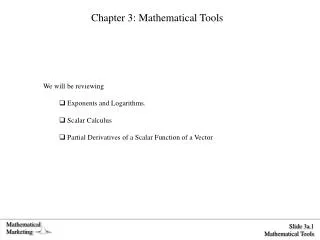
Chapter 3: Mathematical Tools • We will be reviewing • Exponents and Logarithms. • Scalar Calculus • Partial Derivatives of a Scalar Function of a Vector
The Ln Function • ln ab = ln a + ln b • ln (a/b) = ln a – ln b • ln ab = b ln a • ln ea = a • ln e = 1 • ln 1 = 0 ln a = c if ec = a
Rules for Exponents ab· ac = ab+c a½ = √a a-1 = 1/a We often say exp(a) instead of ea.
The Derivative Is the Limit of a Slope at a Point (x + x)2 x2 x x + x
Some Rules for Scalar Derivatives Function Derivative f(x) = c d(c)/dx = 0 f(x) = cx dcx/dx = c f(x) = x2 dx2/dx = 2x f(x) = xm f(x) = exp(x)
Compound Functions The derivative of a sum The derivative of a function of a function The derivative of a function of an exponent
Partial Derivatives By definition A very simple example:
The Transpose of a Derivative Is the Derivative of the Transpose