Download
1 / 1
10 likes | 133 Vues
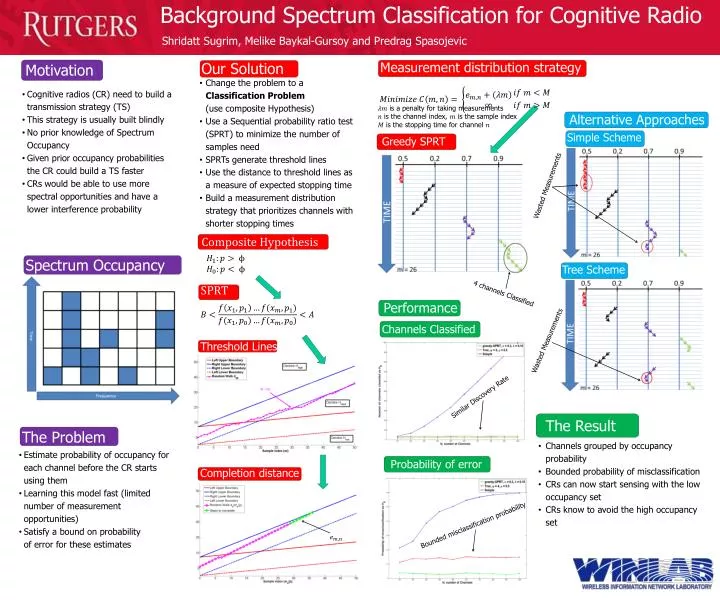
This research presents a novel measurement distribution strategy to enhance spectrum classification in cognitive radios (CRs). By reformulating the problem as a classification issue, we employ a Sequential Probability Ratio Test (SPRT) to effectively minimize the number of required samples. Our approach generates threshold lines that measure expected stopping times, allowing CRs to prioritize channels with shorter stopping times. By leveraging prior occupancy probabilities, we improve transmission strategies, enabling CRs to optimize spectral opportunities while reducing interference risks. The method promises to enhance operational efficiency in dynamic spectrum environments.

E N D
Background Spectrum Classification for Cognitive Radio Shridatt Sugrim, Melike Baykal-Gursoy and PredragSpasojevic Measurement distribution strategy Our Solution Motivation The Problem • Change the problem to a Classification Problem(use composite Hypothesis) • Use a Sequential probability ratio test (SPRT) to minimize the number of samples need • SPRTs generate threshold lines • Use the distance to threshold lines as a measure of expected stopping time • Build a measurement distribution strategy that prioritizes channels with shorter stopping times • Cognitive radios (CR) need to build a transmission strategy (TS) • This strategy is usually built blindly • No prior knowledge of Spectrum Occupancy • Given prior occupancy probabilities the CR could build a TS faster • CRs would be able to use more spectral opportunities and have a lower interference probability is a penalty for taking measurements is the channel index, is the sample index is the stopping time for channel Greedy SPRT Wasted Measurements Alternative Approaches Performance The Result Spectrum Occupancy Tree Scheme Simple Scheme Composite Hypothesis 4 channels Classified Wasted Measurements Similar Discovery Rate SPRT Threshold Lines • Estimate probability of occupancy for each channel before the CR starts using them • Learning this model fast (limited number of measurement opportunities) • Satisfy a bound on probabilityof error for these estimates Channels Classified Probability of error • Channels grouped by occupancy probability • Bounded probability of misclassification • CRs can now start sensing with the low occupancy set • CRs know to avoid the high occupancy set Completion distance Bounded misclassification probability