Download
1 / 5
50 likes | 174 Vues
In this chapter, we explore the fundamental building blocks of matter—atoms. Atoms are defined as the smallest units of an element that cannot be divided further, a concept rooted in Greek philosophy. We discuss John Dalton's 1808 atomic theory and the modern understanding of atomic structure. Atoms consist of protons, neutrons, and electrons, with protons carrying a positive charge and electrons a negative charge. Additionally, we introduce Bohr's model of atomic structure and examine the Periodic Table, which organizes elements according to atomic numbers and properties.

E N D
Atoms and the periodic Table Chapter 4
Atomic structure Atoms are: • The building blocks of molecules. • Definition-”unable to be divided”~Greek • Our conceptual model based on John Daltons 1808 theory.
What is an atom? • Made of protons, neutrons, and electrons. • The center is called the nucleus. • We think that electrons move around the nucleus in a mini-cloud. • Protons (positive charge) • Neutron (neutral or no charge) • Electrons (negative charge)
Bohrs model • Compares atoms to planets. • 1913 • Each planet would be a “layer” of electrons.
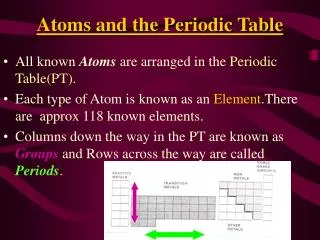
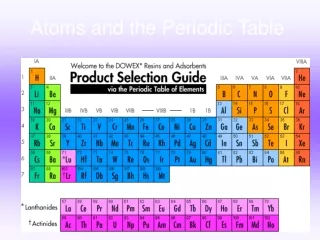
Periodic Table • Groups similar elements together. • Atomic number=the number of protons. • Mass number=the number of protons+neutrons