Understanding Acids and Bases: Theories, Strengths, and Naming Conventions
200 likes | 293 Vues
Explore the properties of acids and bases through Arrhenius, Bronsted-Lowry, and Lewis theories, including strong versus weak acids and bases. Learn how to name acids and bases, understand hydrogen ion behavior in water, dissociation, concentrations, pH measurements, and titration calculations.


Understanding Acids and Bases: Theories, Strengths, and Naming Conventions
E N D
Presentation Transcript
What are acids and bases? • Arrhenius Acids • Hydrogen-containing compounds that ionize to yield hydrogen ions (H+) in aqueous solutions • Arrhenius Bases • Compounds that ionize to yield hydroxide ions (OH-) in aqueous solutions
What are acids and bases? • Bronsted-Lowry Acid • A hydrogen-ion donor • Bronsted-Lowry Base • A hydrogen-ion acceptor
What are acids and bases? • All acids and bases in the Arrhenius theory are also acids and bases based on Bronsted-Lowry theory. • Bronsted-Lowry includes some bases not included in the Arrhenius theory. • Ex: Ammonia (NH3)
What are acids and bases? • Lewis Acid • Substance that can accept a pair of electrons to form a covalent bond • Lewis Base • Substance that can donate a pair of electrons to form a covalent bond
Strong vs. Weak Acids and Bases • Strong acids – completely ionised in aqueous solution • Ex: HCl; HNO3; H2SO4 • Weak acids – ionise only slightly in aqueous solution • Ex: Acetic acid – 1% of acetic acid molecules ionised at any instant
Strong vs. Weak Acids and Bases • Strong bases – dissociate completely into metal ions and hydroxide ions in aqueous solution • Ex: Ca(OH)2; NaOH; KOH • Weak bases – react with water to form hydroxide ion and the conjugate acid of the base (No OH in formula) • Ex: CH3NH2, NH3
Naming Acids • Single Element: • Hydro_____ic acid • Ex: HCl = Hydrochloric acid • Polyatomic Ion: • ATEic ITEous • Ex: H2SO4 = sulfuric acid • Ex: H2SO3 = sulfurous acid
Naming Bases • Bases are named the same way as any other ionic compound • Ex: KOH = potassium hydroxide
Hydrogen Ions from Water • Water that LOSES a hydrogen ion becomes a negatively charged hydroxide ion (OH-) • Water that GAINS a hydrogen ion becomes a positively charged hydronium ion (H3O+)
Dissociation of Water • Self-ionisation of water: reaction in which TWO water molecules produce ions • Ex: H2O + H2O H3O+ + OH- • Can also be written as a DISSOCIATION: • Ex: H2O (l) H+ (aq) + OH- (aq)
Dissociation of Water • In water or aqueous solution, hydrogen ions (H+) are joined to water molecules to form hydronium ions (H3O+) • H+ and H3O+ are both used to represent hydrogen ions in aqueous solution
Concentrations • Acidity or basicity of a solution is discussed in terms of the concentration of hydrogen ions, [H+], or the concentration of hydroxide ions, [OH-] • Acidic: [H+] > [OH-] • Basic (Alkaline): [H+] < [OH-] • Neutral: [H+] = [OH-]
pH • Acidity is measured in pH • pH = -log[H+] • Acidic: pH < 7; [H+] > 1 x 10⁻⁷ M • Basic: pH > 7; [H+] < 1 x 10⁻⁷ M • Neutral: pH = 7; [H+] = 1 x 10⁻⁷ M
pOH • Basicity could be measured in a similar manner called pOH • pOH = -log[OH-] • pH + pOH = 14
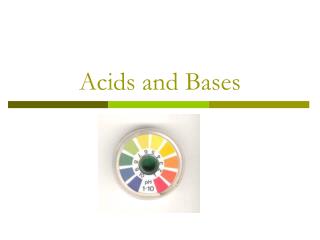
Measuring pH • Acid-Base Indicators • An indicator’s acid and base form have different colors in solution • Limitations: usually work at 25°C • pH Meters • Ex: PASCO Probes • Make rapid, accurate pH measurements • Must be calibrated – put into solution of known pH
Titrations • Neutralisation reaction: hydronium ions combine with hydroxide ions to form water • An indicator can be used to show when the neutralisation is complete
Titrations • If the mole ratio is known, you can calculate the concentration of a given acid or base • nAA + nBB products • This means that nA moles of A reacts with nB moles of B
To work out concentration CA (moldm-3) of unknown solution A of volume VA (dm-3) at the end of the titration: CA x VA = nA CB x VB = nB E.g. CA = nA X CB x VB nB x VA